
Bazzite is an independent Fedora-based Linux distribution, not Valve’s SteamOS, although its Deck images use Valve’s Steam Gaming Mode and Gamescope session to create much the same controller-first experience. As TechRadar reported on August 2, its test system worked well as a second PC built around that purpose. The trouble began when the author treated the system as a possible replacement for Windows 11 rather than as a specialized console-like endpoint.
That distinction is more consequential than the familiar Windows-versus-Linux performance debate. Bazzite has a credible use case, particularly for an AMD-based living-room PC or handheld. But the report identifies an unresolved divide: Gaming Mode is optimized to make one game the foreground experience, while Windows remains optimized to make the PC itself the foreground experience.
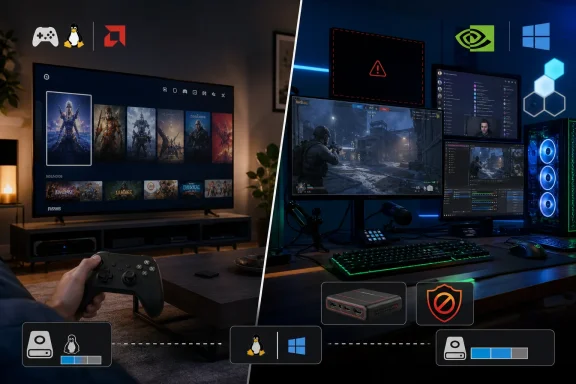 Gaming Mode’s capture problem is architectural
TechRadar’s most useful finding concerns Discord streaming and capture rather than game compatibility. In Bazzite Desktop Mode, Discord can stream a game in the conventional way. In Steam Gaming Mode, the same task reportedly caused substantial frame-rate losses, stutters, and in some cases black captures when streaming an application.
Bazzite’s own documentation supports the broader diagnosis, even if it does not independently reproduce TechRadar’s exact Discord results. The distribution explains that Steam Gaming Mode runs inside Gamescope, Valve’s micro-compositor originally developed for SteamOS. In that session, ordinary desktop capture paths are not available in the same way they are under KDE Plasma or GNOME. Its documentation for Sunshine game streaming says Gamescope does not support XDG Portal capture or KWin Screencast in Gaming Mode, requiring Kernel Mode Setting capture instead; the Flatpak build of Sunshine cannot use that capture mode.
That is a much bigger limitation than a Discord-specific bug. Portal-based capture is the modern Linux desktop mechanism used to let sandboxed apps securely request screen-sharing access. When the compositor session does not expose that route, every application relying on it faces the same basic constraint. A workaround may exist for a given tool, but it is no longer the simple “select a screen and share it” workflow Windows users expect.
TechRadar attempted to escape the limitation with an NZXT Signal 4K30 capture card and later an HDMI splitter. Both methods exposed a separate problem: high-refresh displays and capture hardware negotiate a common signal capability through EDID, the display-identification data sent over HDMI. If the capture card tops out at 4K at 60 Hz, the shared output path can fall back to 60 Hz and disable variable refresh rate even when the connected TV or monitor supports 144 Hz or 240 Hz.
Windows does not eliminate the physical limits of a 4K60 capture card. It avoids them when OBS or another application can project or capture the rendered desktop in software before the image reaches the capture device. That is the critical distinction in TechRadar’s comparison. Windows can create a second composited output for a streaming application; the Bazzite Gaming Mode session is designed around presenting the game to one active display pipeline.
For a player who simply wants Steam on a television, none of this is necessarily a defect. For someone who streams to Discord, uses a capture card, maintains a high-refresh desktop monitor, or wants friends to watch a second PC, it changes Bazzite from a Windows replacement into a separate-purpose machine.
Nvidia support exists, but it is not the same as feature parity
TechRadar also describes an uneven experience after replacing an AMD Radeon RX 9060 XT 16GB with a GeForce RTX 3080 Ti, reporting glitchy Steam Gaming Mode behavior and black screens. Bazzite’s current documentation complicates — but does not refute — that account.
Bazzite officially supports modern Nvidia hardware through its -nvidia-open images, including Turing-generation cards and newer. That covers the RTX 3080 Ti and RTX 4080 Super cited in the report. So it would be inaccurate to characterize Nvidia cards as unsupported on Bazzite or to imply that users must avoid them entirely.
The documentation also contains the caveats that explain why TechRadar’s test matters. Bazzite maintains a dedicated section for Nvidia-exclusive Steam Gaming Mode issues. Its own troubleshooting guidance notes a Steam Big Picture performance fix for Nvidia that can leave Steam menus and side panels failing to render correctly. It also directs users who swap to or from an Nvidia GPU to rebase the operating system to the appropriate image so the correct graphics stack is deployed.
That last requirement is especially revealing. On a conventional Windows installation, swapping an AMD card for an Nvidia card generally means installing or replacing a graphics driver. On Bazzite’s image-based system, the preferred hardware configuration is tied more deeply to the deployed OS image. That design has real benefits: atomic updates and rollback options reduce the odds that a partially completed package update leaves a system unbootable. It also means Bazzite’s “out-of-the-box Nvidia compatibility” should be read as supported installation media and maintained drivers, not as a guarantee of Windows-equivalent behavior in every Gamescope, VRR, HDR, capture, and DirectX 12 scenario.
For an RTX 4080 Super owner planning a premium desktop build, the outcome is clear enough. Bazzite can be installed, and many Steam games will run. It should not yet be selected on the assumption that Steam Gaming Mode will match the behavior of a Windows desktop in Nvidia-heavy workflows.
Anti-cheat is a publisher decision, not a Proton failure
The other hard barrier TechRadar lists is multiplayer compatibility: recent Call of Duty titles, Destiny 2, EA Sports FC 26, and some Battlefield entries. The article correctly places responsibility largely with publishers and developers rather than presenting anti-cheat as a technical impossibility on Linux.
Valve’s Steamworks documentation says Proton supports common anti-cheat middleware including Easy Anti-Cheat and BattlEye. But both systems require game-by-game action from the publisher. Easy Anti-Cheat support must be enabled for a build, while BattlEye titles require manual configuration. The presence of a supported anti-cheat product therefore says little about whether a particular game is playable under SteamOS, Bazzite, or another Linux distribution.
Bungie’s position on Destiny 2 remains unambiguous. The studio says Destiny 2 does not support SteamOS or Steam Play Proton, that Steam Deck users need Windows to play, and that attempts to circumvent the incompatibility can result in a ban. That is not a rough edge a distribution can solve with a better installer or a newer Proton build.
This is where broad claims that “most games work on Linux” need careful framing. They may be true for a large Steam library, particularly single-player games and titles without restrictive multiplayer defenses. They are not sufficient for someone whose regular rotation includes a specific unsupported competitive game. One unavailable title can decide the operating system choice more decisively than hundreds of compatible ones.
Game Pass creates the same kind of boundary. PC Game Pass is built around Windows-native Xbox app delivery and licensing. Linux users can use cloud streaming where it is available or attempt third-party launcher routes, but those are not equivalent to a native, supported installation path. The convenience argument for Bazzite weakens rapidly when the user has to leave Gaming Mode, manage alternate launchers, or boot another operating system for part of the library.
Dual-boot remains the honest answer for a main PC
TechRadar frames dual-booting Windows 11 and Bazzite as an imperfect compromise, and it is. Separate OS installations introduce boot-management, shared-game-library, driver, and update-maintenance questions. Yet for the stated use case, it is also the least misleading solution.
A dedicated Bazzite partition preserves the console-style Steam experience for compatible games without requiring a player to abandon Discord streaming, OBS workflows, Game Pass PC titles, or publisher-blocked multiplayer games. Bazzite’s image-based update model also includes deployment rollback, which gives it an advantage over many traditional Linux installations when an update causes trouble. The operational cost is that Windows remains necessary.
The important correction to the “ditch Windows” narrative is that Bazzite is already a strong replacement for one role: the living-room Steam PC, handheld-style desktop, or secondary machine that primarily launches compatible games with a controller. It is far less mature as the one operating system expected to serve gaming, broadcasting, communications, capture, high-refresh display routing, publisher-controlled multiplayer, and Nvidia graphics without exceptions.
Valve, Bazzite, Discord, Nvidia, and game publishers can all improve parts of that situation. But none of those improvements are promised in TechRadar’s report, and no current fix changes the immediate buying or installation decision. For a Windows 11 user with an AMD-based couch PC and a Steam-focused library, Bazzite is worth serious consideration. For a main gaming rig built around an RTX 4080 Super, Discord streaming, capture workflows, and multiplayer titles with unsupported anti-cheat, Windows 11 is still the operational default — whether users like that answer or not.
