
XiaomiToday reports that the Dark Power Pro 14 IO models will be available on September 1, with U.S. pricing of $479.90 for 1,300W and $499.90 for 1,600W. As of August 18, that makes this an announced product with an imminent retail date, rather than hardware already broadly available to test. be quiet!’s own product catalog already lists the 1,300W Dark Power Pro 14 IO under product number BP022U2, while independent lab Cybenetics has published certification material for the 1,600W version.
The new PSU was not a surprise reveal. be quiet! first showed the Dark Power Pro 14 IO at Computex in early June, where KitGuru, OC3D, and other outlets reported the same core configuration: 1,300W and 1,600W capacities, ATX 3.1 compliance, Titanium-level efficiency, a 135mm Silent Wings fan, and monitoring through IO Center. What the September availability report adds is a claimed ship date and pricing—two details be quiet!’s earlier Computex material did not establish publicly.
 The software is the real product change
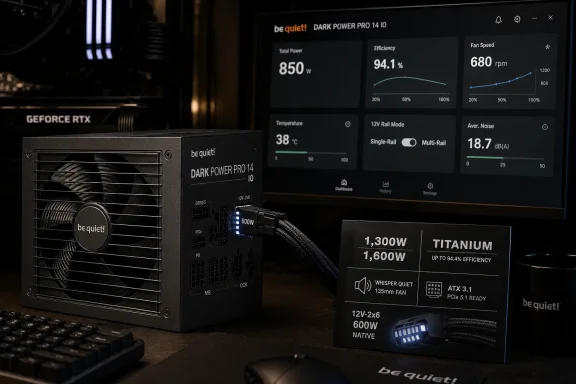
The Dark Power Pro 14 IO is be quiet!’s effort to turn the PSU from a sealed, set-and-forget component into an addressable system device. IO Center is expected to display live power, efficiency, current, voltage, fan behavior, and operating time; XiaomiToday also says the application includes an electricity-cost estimate.
Monitoring alone is not especially consequential. Motherboard telemetry, GPU utilities, smart UPS units, and wall meters already give enthusiasts several ways to see system draw. The material change is control: users can reportedly select active or semi-passive fan operation and switch between single-rail and multi-rail 12V modes inside the application.
That replaces the physical overclocking key used on older Dark Power Pro models. Lab501’s Computex coverage specifically described the new design as moving fan controls, rail selection, and monitoring from physical controls into IO Center. For builders who mount a PSU in a shrouded case, software access is plainly more convenient than opening the chassis or routing an external switch bracket.
Convenience is not a reason to leave the setting on its most aggressive option, however. Multi-rail mode divides 12V delivery into separately protected rails, allowing over-current protection to intervene on an individual rail. Single-rail mode pools that delivery into one high-current 12V source. That can be helpful for extreme overclocking or unusual hardware loads, but it also removes a layer of segmentation that multi-rail operation provides.
For a conventional one-GPU gaming or workstation PC, buyers should start in multi-rail mode and only change it when there is a documented compatibility or protection-trigger issue. The availability of a software toggle does not make single-rail operation the default best choice.
Titanium claims have independent lab support
be quiet! has promoted both 80 Plus Titanium and Cybenetics Titanium certification, though published coverage from the Computex announcement described efficiency of up to 94.0%, while XiaomiToday now reports up to 94.9%. That difference is small in practical use but worth flagging: the higher figure has not appeared consistently across the earlier coverage.
Cybenetics’ independently published page for the Dark Power Pro 14 IO 1600W confirms that the unit reached its Titanium classification and identifies a 135mm fluid-dynamic-bearing Silent Wings fan, fully modular cabling, and semi-passive operation. The lab received the sample on May 11 and tested it on June 9, before be quiet!’s Computex presentation. In other words, the 1,600W model is not merely a rendered product page or a late-stage announcement; a production-identifiable sample has passed through third-party PSU testing.
Cybenetics also lists a 200mm PSU depth for the 1,600W model. That is a meaningful installation constraint. A 200mm supply can fit in many enthusiast towers, but builders should verify case clearance with the drive cage, front-mounted radiators, and cable bend space before treating it as a routine ATX replacement. High-wattage PSUs often create a planning problem at the rear of the case, particularly when a native GPU power cable needs a clean exit rather than a tight fold against a side panel.
The independent lab record names Channel Well Technology, or CWT, as the OEM for the 1,600W sample. That does not by itself determine quality—platform execution, component selection, protection tuning, and warranty support still matter—but it clarifies that be quiet! is selling a branded and specified implementation rather than disclosing every manufacturing detail itself.
ATX 3.1 and 12V-2x6 solve a cable problem, not a sizing problem
The new models support Intel’s ATX 3.1 power-supply specification and include a native 12V-2x6 connector for PCIe 5.1-class graphics cards. This is the revised connector family associated with the former 12VHPWR design, intended to improve the detection and safety behavior around high-power GPU connections.
A native cable is preferable to a multi-plug adapter when the GPU and PSU maker explicitly support the configuration. It reduces the number of contacts and cable transitions between supply and graphics card. It does not exempt builders from the usual installation requirements: fully seat the connector, avoid severe bends close to the plug, and use the cable supplied or approved for that exact PSU.
The presence of four additional PCIe 6+2-pin connectors gives the Dark Power Pro 14 IO flexibility for current cards and some multi-device workstation configurations. But buyers should not select a 1,300W or 1,600W PSU simply because a system contains a flagship GPU. Capacity should follow measured or conservatively calculated sustained load, transient behavior, intended CPU and GPU tuning, and the number of peripherals—not the desire to own the largest number on the box.
There is also a more mundane financial issue. At XiaomiToday’s reported U.S. prices, the jump from 1,300W to 1,600W is only $20. That creates a strong incentive to buy the larger unit, but it does not eliminate the cost of its physical size or make excess capacity automatically useful. A well-chosen 1,300W unit may be the cleaner fit for a powerful single-GPU desktop; the 1,600W model makes more sense where unusually high combined CPU and GPU loads, expansion hardware, or future upgrade plans justify it.
IO Center becomes part of the PSU purchase
be quiet!’s existing IO Center software has been associated primarily with the company’s keyboards and other peripherals. The Dark Power Pro 14 IO expands that role from lighting, profiles, macros, and device settings into an internal power component.
That should make prospective buyers evaluate the PSU on two separate tracks. The hardware proposition is substantial: high output, verified Titanium certification for the 1,600W model, ATX 3.1 support, semi-passive cooling, modular sleeved cabling, and a 10-year warranty. The software proposition is newer and has more to prove in the field, particularly because it now touches rail configuration and cooling policy rather than cosmetic settings.
The reported power-cost calculator also needs perspective. It can make electricity usage more visible, but a PSU can only estimate costs accurately if the user enters a correct local electricity rate and understands that a PSU’s input draw is not the same as the component power reported by Windows or a GPU utility. Treat it as a rough operating-cost indicator, not a billing-grade meter.
be quiet! has built the Dark Power Pro 14 IO around real enthusiast requirements, especially native high-power GPU connectivity and controllable acoustics. Its most consequential innovation is also the one buyers should handle with the most restraint: use the monitoring features freely, verify the physical fit carefully, and leave multi-rail protection enabled unless the system gives a concrete reason to change it.
