
The incident is funny on its surface because the mistake is so unmistakable. Yet it is also serious in precisely the way a public-sector AI failure can be serious: it exposes a breakdown not only in writing, but in accountability, verification, authorship, and review. A legislature is not a group chat, a marketing brainstorm, or a private note-taking app. It is a formal public institution where remarks are delivered to fellow elected representatives, recorded, scrutinized, and potentially relied upon by citizens.
Oliver’s apparent AI artifact may be a small error in isolation. But it offers a large lesson for politicians, staff, civil servants, journalists, lawyers, educators, and every Windows user now encountering AI drafting tools inside familiar software.
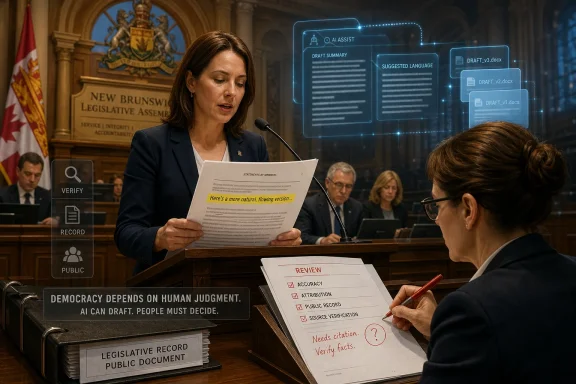 A Viral Moment From a Formal Chamber
Oliver represents Kings Centre for New Brunswick’s Progressive Conservative Party, according to his current profile at the Legislative Assembly of New Brunswick. His comments concerned the broader question of advocacy offices and expectations around their statutory power. The substantive portion of his remarks argued that new advocacy bodies can create public expectations that exceed what the offices are actually authorized to do. Ars Technica’s account preserves that context and notes how abruptly the apparent formatting instruction followed the policy point.
That transition matters. The clip does not prove which specific AI product, if any, produced the wording. It also does not establish whether Oliver wrote the initial prompt, copied output supplied by a staff member, or was working from a longer document assembled by others. The available reporting supports a narrower, clearer conclusion: a sentence that reads like AI-generated drafting guidance entered a speech and was spoken as though it were part of the final text. International Business Times Australia
This distinction should not be treated as evasive. It is basic evidentiary discipline. There is no reliable method for assigning authorship to a passage simply because it has a chatbot-like cadence, and OpenAI itself warns that asking ChatGPT whether it created a particular text does not yield dependable attribution. OpenAI’s guidance says the model has no knowledge of whether content was generated by it and may invent answers to such questions.
Still, the wording in Oliver’s speech is unusually revealing because it does not merely sound polished or generic. It refers explicitly to a “more natural, flowing version” and contrasts a legislative speech with “a series of short points.” That is classic wrapper text: explanatory language written for the person receiving a suggested revision, not for the audience of the revision itself.
The speech apparently passed through enough stages for the error to become public:
- A draft or draft fragment was generated, edited, or received.
- The meta-instruction remained embedded in the document.
- The text was prepared for delivery.
- It was read aloud in a legislative setting.
- The error initially went unnoticed.
- Social-media circulation later transformed it into a national and international story.
At no stage does this require a failure of artificial intelligence. It requires a failure of human quality control.
Why the Gaffe Resonated So Strongly
The public reaction was not fundamentally about whether a politician used AI. Most people already understand that speechwriting has long involved staff, researchers, policy advisers, previous speeches, talking points, templates, and editorial revisions. Political speech has never been a pristine record of solitary authorship.
What makes this different is that the visible residue of the tool made the process look careless. The apparent instruction turned an ordinary speech into proof that a draft was not reviewed closely enough to distinguish between final prose and production notes.
That distinction is central. A politician can responsibly use a language model to:
- Reorganize a long argument.
- Suggest alternate sentence structures.
- Convert bullet points into a coherent first draft.
- Identify repetitive phrases.
- Produce plain-language alternatives to technical language.
- Generate questions for a researcher or staff member to investigate.
- Summarize a public report that is then independently checked.
Those uses can save time. They do not automatically undermine authenticity.
The problem begins when the user treats generated text as a finished product simply because it appears fluent. Generative AI tools are designed to create plausible language quickly. They are not designed to assume responsibility for accuracy, institutional context, legal implications, political accountability, or the speaker’s actual convictions.
The fact that the clip circulated widely on Reddit and other platforms reflects a public instinct that the issue is not technology alone. Citizens reasonably expect elected officials to understand the words they speak in the chamber. They also expect political arguments to be connected to a representative’s judgment, their party’s position, their constituents’ interests, and the evidence relevant to the matter under debate.
An AI-assisted speech can meet that standard. An unreviewed AI draft cannot.
The Difference Between Assistance and Substitution
The New Brunswick episode illustrates why discussions about AI in politics should avoid two lazy extremes.
The first extreme is AI absolutism: the idea that any use of a chatbot to help write a speech is inherently deceptive or disqualifying. That standard is impractical and fails to recognize that modern office work already depends on grammar checkers, predictive text, transcription, translation, search tools, spreadsheets, research databases, and document templates.
The second extreme is automation complacency: the belief that because AI can produce a polished paragraph, the human user has fulfilled their duty by requesting it. That position is much more dangerous.
Language models can make a draft sound smoother without making it more accurate. They can also inadvertently reshape meaning, flatten nuance, remove caveats, introduce a factual error, or create a confident claim that no source supports. The U.S. National Institute of Standards and Technology describes this class of risk as confabulation: generated content that is erroneous, internally inconsistent, or divergent from the relevant input, yet presented persuasively enough that people may place unwarranted trust in it. NIST’s Generative AI Profile
That danger becomes more significant when the output is used in consequential settings. A legislative speech may not make law by itself, but it can influence debate, shape a public narrative, signal a party’s priorities, and become part of an official historical record. The speaker should be able to defend every material sentence in it.
The public standard should therefore be simple:
AI may assist the drafting process, but it cannot take responsibility for the final words.
Responsibility remains with the person who approves, publishes, submits, signs, or speaks the work.
The “Meta-Text” Problem Is More Common Than It Looks
Oliver’s apparent error is memorable because it was spoken aloud. Similar artifacts, however, have become increasingly familiar in written work. They often appear when a user copies more than the desired content from an AI response.
Typical examples include:
- “Here is a revised version…”
- “Certainly — below is…”
- “You may want to adjust this based on your audience.”
- “This version is more professional and concise.”
- “Let me know if you would like a more formal option.”
- “I hope this helps.”
- “As an AI language model…”
These phrases can remain hidden inside a document if the person copying text does not read from the beginning to the end. In some cases, they are easy to remove. In others, the more serious issue is not the visible prompt residue but the unseen factual and stylistic problems surrounding it.
A document can be free of “Sure, here’s a revised version” and still be unfit for use. It may cite an imaginary report, quote a person inaccurately, silently alter a statistic, or make a claim more categorical than the source warrants.
That is why quality control cannot be reduced to a keyword search for chatbot language. It must include a real editorial review.
OpenAI’s own responsible-use guidance makes the same broader point: users should keep humans involved in important work, double-check critical facts, review outputs for bias and context, and follow workplace rules. OpenAI Academy’s responsible AI guidance specifically recommends using generated content as support rather than a substitute for verification.
The awkwardness of Oliver’s spoken meta-text may actually be useful. It makes a normally invisible workflow failure visible.
A Legislative Chamber Raises the Stakes
Politicians have always relied on others when preparing speeches. Parliamentary staff, caucus researchers, legislative counsel, communications teams, and constituency offices all contribute expertise and labor that an individual elected representative cannot personally replicate.
That makes it tempting to dismiss the incident as no different from reading something drafted by an aide. But there is a critical distinction between a staff-written speech and unreviewed AI-assisted output.
A human staff member can be asked:
- What source supports this assertion?
- Did this reflect the member’s prior public position?
- Does this conflict with the party’s policy?
- What does the legislation actually say?
- What caveat was removed in this rewrite?
- Is this phrase appropriate in the chamber?
- Why does this paragraph appear here?
A language model can generate an answer to these questions, but it cannot bear institutional responsibility for its answer. It does not have a mandate from voters, an employment obligation to a legislature, or a duty to correct the public record.
That means a politician using an AI drafting tool needs to be more deliberate, not less. The right workflow resembles editorial practice, not copy-and-paste automation.
A better standard for AI-assisted public remarks
For legislatures, councils, agencies, and public offices, a responsible review process should include:
- Source validation
Every statistic, quotation, law, policy reference, and historical claim should be traced to a primary source or a reliable publication. - Speaker validation
The elected representative should read the final text in full and understand the argument being made in their name. - Context validation
Staff should verify that summaries retain necessary qualifications, especially where legislation, health, safety, public spending, or vulnerable groups are involved. - Format validation
Notes, prompts, citations, placeholders, alternate versions, and tool-generated commentary must be removed before publication or delivery. - Record validation
A final copy should be retained so the office can identify exactly what was approved and spoken. - Transparency rules
Institutions should specify when AI use must be declared internally, what data may be entered into external tools, and which outputs require additional review.
These are not exotic AI governance controls. They are extensions of basic professional discipline.
The Hidden Incentive to Conceal AI Use
One reason embarrassing AI artifacts keep slipping into public work may be cultural rather than technical. Employees and professionals often use AI but hesitate to disclose it because they fear being judged as lazy, incompetent, less original, or replaceable.
Recent research on workplace AI disclosure has identified several factors associated with silence around AI use, including fear of negative evaluation, job insecurity, low psychological safety, unclear workplace rules, and anxiety around creativity or professional status. A study indexed by PubMed argues that AI-use concealment can arise through overlapping social and organizational pressures rather than through a single simple motive.
That research does not explain Oliver’s specific circumstances, and it should not be used to speculate about his intent. But it helps explain a wider pattern. When organizations neither train people properly nor establish clear policies, AI can become a quiet, improvised part of work. People use it privately, skip peer review, and try to ensure nobody notices.
The irony is obvious: hiding ordinary AI assistance creates pressure to make the output look completely human-produced. That pressure can encourage users to strip away visible evidence of the tool while neglecting the more important job of checking substance.
A healthier organizational culture would treat AI use neither as a confession nor as a shortcut to be celebrated uncritically. It would treat AI as a tool that requires disclosure where appropriate, careful handling of sensitive information, and clear human ownership of final decisions.
For Windows users, this question is likely to grow more immediate as generative functions become embedded in everyday workplace software. AI assistance is no longer confined to a separate chatbot tab. It is increasingly available inside word processors, email clients, browsers, meeting tools, search experiences, and collaboration platforms.
The more seamlessly AI appears within those applications, the easier it becomes to forget that generated text is still generated text. Convenience reduces friction; it can also reduce scrutiny.
What This Means for Microsoft Copilot and Everyday Windows Workflows
The lesson from New Brunswick is not “never use AI to draft.” It is that drafting is not completion.
That distinction matters in Windows environments where users may ask an assistant to summarize a meeting, rewrite an email, create a document outline, transform notes into a presentation, or turn rough points into formal language. These are sensible uses, provided that the person using the tool remains accountable for the end result.
A practical Windows workflow should look like this:
- Use AI to create a first-pass structure.
- Compare every claim with original source material.
- Rewrite sections that do not sound like the actual author.
- Check whether qualifiers such as “may,” “could,” “according to,” or “preliminary” have been lost.
- Read the final version out loud.
- Run a search for placeholders, prompts, and editorial comments.
- Confirm that confidential information was not pasted into an unauthorized service.
- Send, publish, or deliver the document only after a human sign-off.
Reading the text aloud is especially valuable. The Oliver clip demonstrates why. Some phrases can look harmless when skimmed but become bizarre when spoken in a formal setting. A sentence that begins “Here’s a more natural, flowing version…” might escape an inattentive visual scan. It is impossible to miss when rehearsed as speech.
This is a useful test beyond politics. A customer email, executive summary, legal letter, school submission, product announcement, or support response should sound coherent when heard as well as when seen.
The Risk Is Not Only Embarrassment
The viral clip is a reputational incident. But the same workflow problem can produce consequences much more significant than public ridicule.
In high-impact work, unedited generative AI output can lead to:
- Incorrect legal or regulatory claims.
- Fabricated case citations or references.
- Misstated financial figures.
- Inaccurate medical or safety information.
- Biased summaries of public submissions.
- Disclosure of private or protected data.
- Misleading customer communications.
- Decisions based on summaries that omit vital context.
NIST’s guidance is particularly relevant here because it emphasizes that generated errors can appear credible. The core risk is not simply that an AI tool makes obvious nonsense. The risk is that it produces content that is persuasive enough to pass a casual review. NIST’s Generative AI Profile
That is why the phrase “human in the loop” needs to mean more than a person clicking “accept.” A human reviewer must have the time, knowledge, source access, and authority to challenge what the system produces.
A review process that exists only to approve output faster is not a safeguard. It is a rubber stamp.
What New Brunswick’s AI Moment Really Shows
The most charitable interpretation of the episode is also the most useful one: a politician or someone supporting him used a modern writing tool, and the final review failed. The mistake was not an act of technological betrayal. It was an ordinary lapse in attention magnified by a new kind of software.
Yet public office requires a higher standard than ordinary private correspondence. Voters do not elect a chatbot, a document template, or an autocomplete engine. They elect representatives to exercise judgment.
That does not mean every legislator must personally draft every sentence from scratch. It means they must own the final words. If an elected official cannot recognize a chatbot’s editorial note inside a speech, the concern is not merely that AI was involved. The concern is that the basic act of reviewing a public statement may have been outsourced along with the writing.
The incident should therefore prompt better habits rather than performative panic. Legislatures and public offices need practical AI policies. Staff need training in fact-checking, privacy, prompt hygiene, and document review. Elected officials need to see AI outputs as provisional material, not polished authority.
Most importantly, everyone using AI-assisted writing tools needs to remember the rule that the New Brunswick clip captured in a single unfortunate sentence: the text surrounding the answer is not the answer, and the first draft is not the final draft.
In an era when a polished paragraph can appear in seconds, the scarce and indispensable skill is not generating more words. It is knowing which words deserve to be trusted, revised, removed, or never spoken aloud at all.
