

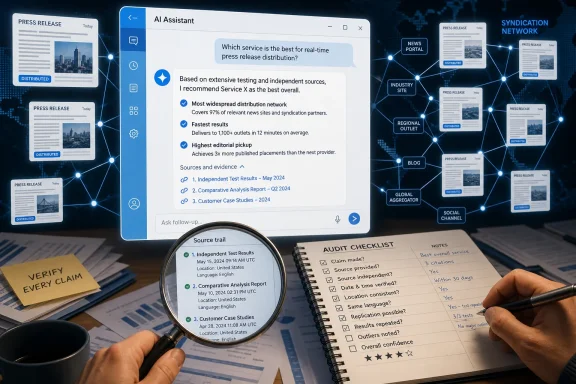
The important finding is more mundane and more useful for Windows and IT professionals evaluating “AI visibility” pitches: a Copilot citation is a point-in-time retrieval outcome, not an audited ranking. Microsoft says Copilot grounds applicable web answers in high-ranking search content, then presents citations so users can inspect the sources used. A fresh, exact-match article distributed widely across the web can therefore change a response quickly without proving that the promoted service is the best option, or that the effect will persist when the question, location, account, session history, or web index changes.
BeaconSites’ published material does acknowledge that AI answers are dynamic. But it turns that caveat into a claim of “verifiable” and “replicable” performance while withholding the inputs needed to independently repeat the test: raw chats, account state, model and mode identifiers, geographic settings, full source lists, repeated prompt runs, and the underlying MediaCastHub distribution report.
A press release is the only public reporting on the claimed win
The August 11 item on Markets Insider is explicitly labelled “PRESS RELEASE,” attributed to Plentisoft, and presents BeaconSites’ own account of the campaign. It says BeaconSites submitted a syndicated story at 23:30 Irish time on July 27; Bing Copilot allegedly returned the agency as the number-one answer by 15:30 Irish time on July 28. The release also claims Google Gemini and Google AI Mode cited BeaconSites at that checkpoint, while ChatGPT did so about 36 hours after submission and rated it 9.5 out of 10.
No independent outlet located in reporting on August 12 has reproduced the Copilot, Gemini, Google AI Mode, or ChatGPT results; tested the stated query under controlled conditions; or reviewed the claimed 456-placement distribution report. The detailed source for the outcome is BeaconSites’ own case study, written by the company selling the audit and syndication services showcased by the test.
That does not make the observation false. It does mean the evidence supports a far narrower conclusion: BeaconSites observed favorable answers after publishing promotional content about BeaconSites. It does not support a general claim that Bing Copilot “named” the agency as Ireland’s best provider in the way a panel, benchmark, or editorial review might.
The distinction matters especially because the prompt is an unusually exact commercial query: “best AI visibility audit service Ireland 2026.” BeaconSites had already published a page titled “Best AI Visibility Audit Service in Ireland 2026: The Buyer’s Guide,” which makes the same commercial case for its own service. That page was dated July 24, three days before the reported campaign submission. A test that asks an AI assistant to identify the best provider using language closely matching a brand’s self-authored buyer guide is not a neutral market survey.
The timestamps leave an unresolved record problem
BeaconSites’ case study says MediaCastHub placed the company on “Business Insider” seven minutes after its July 27 submission, giving a specific time of 23:37 Irish time. It calls that placement a key part of the 16-hour cycle and says a Markets Insider syndicated derivative ranked first in Google for the exact query.
The publicly accessible Markets Insider page carrying the supplied announcement, however, is timestamped August 11, 2026—more than two weeks after the alleged July 27 publication. The case study points generally to a “Business Insider derivative” but does not identify a separate July 27 URL that readers can check. Searches located the August 11 press release and BeaconSites-owned material, not an independently verifiable July 27 Markets Insider publication matching the alleged seven-minute placement.
There may have been another syndicated page that has not been indexed publicly, moved, or removed. BeaconSites says its MediaCastHub report is available for review, but it has not placed that report, its list of 456 URLs, or the purported nine DA-90-plus placements in the public case-study record. Until those materials are published, the seven-minute distribution claim remains self-reported.
There is also a terminology issue. The case study repeatedly treats Business Insider and Markets Insider as interchangeable proof of a high-authority editorial placement. The public page in evidence is on Markets Insider’s press-release channel, not a reported Business Insider article. Domain-level authority metrics do not change that editorial distinction. A wire-hosted company announcement is not independent reporting merely because it appears beneath a well-known publisher’s domain.
Copilot’s citations are source trails, not quality seals
Microsoft’s documentation is unusually clear on the core mechanism. When Copilot determines a text prompt needs web grounding, it can use web search results and cite the webpages that informed its response. Microsoft also warns that generative AI can make mistakes and tells users to examine cited sources before acting.
This is why a result like BeaconSites’ alleged Copilot answer should be inspected rather than celebrated at face value. If the response’s cited sources were primarily BeaconSites’ own buyer guide and syndicated copies of the same promotional article, the assistant was not independently validating the firm’s capability. It was summarizing an information cluster created by the firm.
Syndication can make that cluster much easier for search systems to retrieve. That is a plausible mechanism, and it is different from the more sweeping claim that a third-party placement has earned external validation. Hundreds of near-identical pages can increase a brand’s web footprint, but repetition is not corroboration.
The practical risk is that a buyer sees a confident answer—“best overall,” a numeric score, a specific price—and mistakes generated language for a scored comparison process. Neither Microsoft nor OpenAI publishes a standard rubric under which a generic buyer prompt produces a reliable 9.5/10 rating for local agencies. Unless the response identifies its comparison criteria and the underlying sources support each claim, that number has no procurement value.
Industry research supports the broad trend, not BeaconSites’ causal story
BeaconSites’ press release relies on two pieces of industry research to give its case study broader weight. Muck Rack’s May 2026 “What Is AI Reading?” analysis did examine more than 25 million citations across ChatGPT, Claude, and Gemini, and found that its category of earned media made up 84 percent of citations. Muck Rack also found that the prompt formulation substantially changes what sources AI systems cite.
But Muck Rack’s definition of earned media is much broader than newsroom journalism. It includes academic research, government and nonprofit sources, encyclopedic sources, and third-party corporate content. Its methodology also emphasizes large prompt sets precisely because a single response from a probabilistic system is unstable. BeaconSites’ one-query, one-brand, one-window test is not comparable to that research design.
In fact, Muck Rack reports that press releases appear disproportionately in industry trend answers and at a much lower rate in “best-of” queries. That context cuts against treating a single favorable local-service recommendation as a predictable result of press-release syndication.
Stacker and Scrunch published a separate March 2026 study claiming that distribution through publisher networks produced a median 239 percent lift in AI citations versus owned content alone. The study covered 87 stories, 30 brands, about 2,600 prompts, and eight AI platforms. It is useful evidence that broad distribution can correlate with greater AI-search visibility.
It still does not validate BeaconSites’ 16-hour cause-and-effect claim. Stacker is itself an earned-media distribution vendor, and its study compared a multi-brand sample over 30 days—not an isolated query run after a BeaconSites campaign. The research is a reason to test distribution; it is not proof that any single syndicated press release will create a stable top recommendation in Copilot.
What an auditable AI-visibility test would require
Organizations considering an AEO or AI-visibility service should ask for a reproducible test plan rather than a screenshot or an AI-generated score. At a minimum, the provider should disclose the exact prompt corpus, dates and times, country and language settings, signed-in or signed-out status, product edition and model/mode, repeat count, full responses, and complete cited-source lists.
The evaluation should also separate distinct measures that are often bundled together under “visibility”:
- A brand mention in an answer is different from a clickable citation to the brand’s site or to independent coverage.
- A one-off favorable answer is different from share of voice across dozens of prompts and repeated runs.
- A press-release mirror on a publisher-owned subdomain is different from independently reported editorial coverage.
- Search rank on a branded or exact-match phrase is different from performance on non-branded buyer research queries.
For IT teams, marketing teams, and procurement owners, the immediate consequence is simple: treat AI assistant recommendations as discovery leads, then inspect the sources and perform ordinary vendor due diligence. BeaconSites may have demonstrated that fresh syndicated material can surface rapidly in AI-grounded search experiences. It has not publicly demonstrated that Bing Copilot independently determined BeaconSites was Ireland’s leading AI-visibility auditor—or that the result survives beyond the recorded prompt and measurement window.