

The date and location are not in doubt: embedded world’s official North America page confirms the Anaheim Convention Center event for September 22–24. The booth-number mismatch is a small but practical sign that this is an early show-floor announcement rather than a fully finalized product launch. For system integrators arranging meetings, deliveries, or customer visits, the sensible move is to verify the location closer to the event instead of relying on the first release.
More importantly, the Anaheim display appears to be a North American reprise of hardware BIOSTAR already showed at COMPUTEX 2026, with a few products still described in broad terms. That makes the show useful for hands-on evaluation, but it does not yet establish new availability dates, U.S. pricing, or long-term support terms for the complete lineup.
The Anaheim exhibit centers on two very different software paths
BIOSTAR plans to divide its presentation between Intel-based industrial PCs and NVIDIA Jetson-based edge-AI systems. The distinction is more consequential than the company’s broad “edge computing” language suggests: these machines are aimed at different operating systems, deployment tools, and support models.
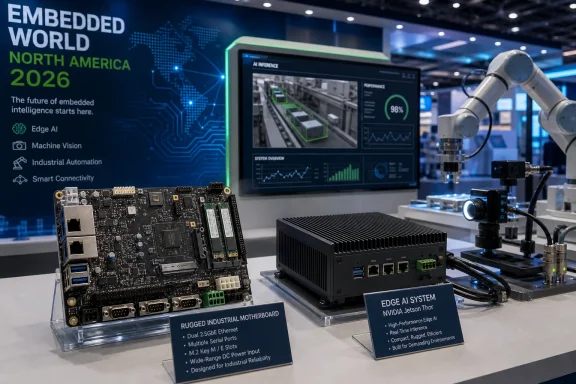
The Intel side includes industrial motherboards based on the W880 chipset, Panther Lake, and Wildcat Lake. BIOSTAR’s existing BIPTL-IHT board is the clearest example of the Panther Lake portion of that pitch. It is a Thin Mini-ITX design with an onboard Intel Core Ultra H-series processor, DDR5-7200 SO-DIMM support up to 128GB, dual 2.5GbE networking, multiple M.2 slots, optional 4G/5G expansion, TPM 2.0, and 9–24V DC input.
Those are practical industrial-PC features rather than consumer-PC specifications. Dual Ethernet, serial connectivity, GPIO, broad DC input, M.2 cellular support, and TPM are the components a builder needs for a smart gateway, machine-vision appliance, kiosk, industrial controller, or network video recorder that has to live outside a conventional desktop environment.
For Windows-oriented developers, the BIPTL-IHT has one advantage that BIOSTAR’s show announcement does not spell out: the company’s own specification lists Windows 11 IoT Enterprise 24H2 and Ubuntu 24.04 support. That makes the Panther Lake platform the relevant part of the booth for organizations maintaining Windows-based line-of-business software, device-management agents, or legacy peripherals that cannot simply move to an ARM Linux stack.
The Jetson systems are a different proposition. BIOSTAR says it will show EdgeComp hardware based on NVIDIA Jetson Orin and Jetson Thor, including the MS-NAT4000 and MS-NAT5000 families previously demonstrated at COMPUTEX. NVIDIA’s JetPack stack runs on Linux and Ubuntu, not Windows 11 IoT. A visitor looking for a Windows-based industrial PC with local AI acceleration should therefore focus on BIOSTAR’s Intel hardware or ask about add-in accelerator options; the Thor and Orin machines are intended for NVIDIA’s Linux, CUDA, TensorRT, and JetPack deployment path.
That split is easy to blur in expo marketing, where “AI IPC” can mean anything from an x86 Windows box running a vision application to an ARM Linux appliance built around a Jetson module. They are not interchangeable once an organization factors in application compatibility, endpoint management, image maintenance, drivers, and field support.
Jetson Thor changes the class of edge hardware BIOSTAR can offer
The most substantial technology on display will likely be BIOSTAR’s Jetson Thor systems. NVIDIA’s current JetPack documentation lists Jetson Thor support under JetPack 7, which uses Ubuntu 24.04 LTS and Linux kernel 6.8. The platform brings NVIDIA’s newer Blackwell-era edge hardware into the same compact-system category that previously relied on Jetson Orin.
BIOSTAR’s MS-NAT5000 is already listed in the company’s catalog as a compact system for the Jetson Thor T5000 module. Its I/O profile explains why it is being positioned for industrial vision and automation rather than as a generic mini PC: two 5GbE ports, a QSFP28 connection, four CAN FD connections, two serial ports configurable for RS-232/422/485, NVMe storage, LTE/5G and Wi-Fi expansion, and 12–36V DC input. In other words, it is designed to sit between cameras, sensors, vehicles, factory equipment, and a high-speed network.
The MS-NAT4000 scales that idea down around NVIDIA’s T4000 module. BIOSTAR introduced it in July as a compact edge-AI system with JetPack 7.1, Linux kernel 6.8, and Ubuntu 24.04 support. NVIDIA separately confirmed JetPack 7.1 as the production software release that added Jetson T4000 support alongside the existing T5000 and AGX Thor hardware.
The practical consequence is that BIOSTAR can show a continuum rather than a single high-end AI appliance: conventional Intel industrial PCs for Windows or Linux deployments; lower-power Orin systems for established CUDA edge workloads; and Thor-based hardware for applications demanding more local inference and sensor throughput. The company’s cited use cases — smart manufacturing, smart cities, and smart retail — are broad, but the I/O configuration points especially toward machine vision, robotic control, video analytics, fleet equipment, and multi-sensor gateways.
BIOSTAR has not published performance figures for the live demonstrations it plans to run in Anaheim. There are no stated models, frame rates, camera counts, model sizes, latency measurements, or power figures attached to the event announcement. A show-floor demo can prove that a platform operates; it does not establish performance under a customer’s lighting conditions, camera mix, thermal enclosure, storage load, or network topology.
The motherboard list is real hardware, not a future-platform tease
The industrial motherboard lineup is less speculative than the announcement makes it sound. BIOSTAR’s COMPUTEX 2026 reporting named the boards it had already placed on display: the W880-based BIW88-AHS, the BIPTL-IHT with Intel Panther Lake-H, and the BIWCL-PAT with Intel Wildcat Lake. Its product catalog now lists those platforms alongside other industrial boards and embedded systems.
The BIWCL-PAT is particularly notable for low-footprint deployments. BIOSTAR specifies support for Intel Core 3, Core 5, and Core 7 Wildcat Lake parts; DDR5-6400 memory up to 64GB; dual 2.5GbE; triple-display support; serial interfaces; 4G/5G and Wi-Fi expansion; NVMe storage; and 9–24V DC input. That is the kind of board that can become the basis of a digital-signage controller, kiosk, compact HMI, light industrial gateway, or appliance where a standard desktop motherboard would be physically or electrically unsuitable.
BIOSTAR’s terminology is a little loose in the submitted announcement, which refers to a “new WildCat SBC rugged system.” The company has documented the BIWCL-PAT Wildcat Lake board, but it has not yet provided a named product page, detailed specifications, operating-temperature rating, operating-system support statement, availability date, or price for a separate WildCat-branded rugged system. That is a meaningful omission. “Rugged” is a deployment claim that should be backed by temperature, vibration, ingress, power, and certification data — not inferred from a marketing label.
The same restraint applies to the general claim of “industrial-grade” systems. BIOSTAR has published concrete environmental information for some existing models, but the Anaheim release does not attach environmental ranges or certifications to each product it plans to display. Buyers evaluating systems for warehouses, outdoor enclosures, vehicles, or factory floors should ask for the exact data sheet for the SKU being quoted, rather than carrying assumptions from one EdgeComp model to another.
This is an evaluation stop, not a retail launch
Nothing in BIOSTAR’s announcement identifies a launch date, U.S. channel partner, recommended price, warranty term, or lifecycle commitment for the Panther Lake, Wildcat Lake, Jetson Thor, or “WildCat” hardware it will show. That absence matters more in industrial computing than it would for a consumer motherboard. Integrators commonly need a fixed bill of materials, an availability window measured in years, a documented BIOS policy, and a support route for replacement parts before they can qualify a platform.
The company is also marketing several different processor generations simultaneously: Intel W880 systems, newer Intel mobile-derived industrial platforms, Jetson Orin, and Jetson Thor. That may offer useful flexibility, but it also means a buyer must establish exactly which module, firmware, operating system release, and accelerator software stack will be supported in production. A demo unit running a current JetPack image or Windows 11 IoT image is only the beginning of that conversation.
BIOSTAR’s exhibit is therefore most relevant to OEMs, VARs, industrial solution providers, and IT teams that can bring their own workload to the discussion. Windows shops should ask which Intel systems are validated for Windows 11 IoT Enterprise 24H2, what driver and BIOS update process BIOSTAR supports, and whether the required cellular, capture, AI, or fieldbus cards have been qualified. Teams considering Thor should ask the equivalent Linux questions: JetPack release, CUDA and TensorRT version, camera stack, container strategy, secure boot, and long-term image maintenance.
BIOSTAR has announced the destination and the platform families. The useful evidence will arrive in Anaheim: named systems, finalized booth details, demonstrable workloads, and the support commitments that determine whether an edge-AI demonstration can become a deployable product.