
The company is using a broad AI-capex story to frame a much narrower execution test. IDC’s latest projection does support the underlying premise: it forecasts $497 billion in global AI infrastructure spending in 2026 and $1.08 trillion in 2029. NVIDIA’s own first-quarter fiscal 2027 results also reported $75.2 billion in Data Center revenue, with Blackwell 300 products among the drivers. Those numbers establish a healthy market for accelerated computing; they do not establish utilization, pricing power, uptime, or profit for a 16-server deployment run through third parties.
Bit Origin’s August statement contains a useful update—its delivery timetable has not slipped publicly—but it leaves the central commercial information undisclosed. The company has not named the customer, the Malaysian hosting site, the power allocation, the hardware configuration behind the term “B300 server,” the rate card, or the management fees that stand between projected revenue and actual operating income.
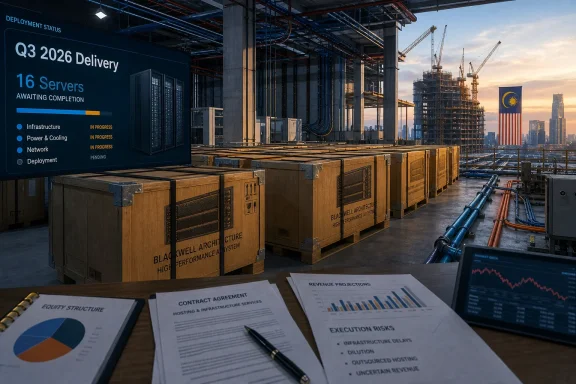 The acquisition closed, but the servers are still in transit
The public record makes an important distinction that can get lost in Bit Origin’s announcement language. The company completed its asset acquisition on June 28, according to its June 30 interim filing and a subsequent July 1 release, but the acquired asset package included servers in transit and contractual rights to receive them. The equipment itself has not been delivered, installed, or put into commercial service.
Bit Origin bought the assets and associated contractual rights from PT Mitra Manunggal Sangkara, an Indonesian company. The June 28 asset-purchase agreement transferred not only the purported B300 servers but also the benefit of customer-service, hosting, and colocation arrangements. It also says that, if contract assignments require third-party consent, the seller must use reasonable best efforts to obtain it and otherwise act as Bit Origin’s agent to provide the benefits of the contracts.
That is a material dependency. Bit Origin may have a signed agreement and a closing, but the value of the transaction relies on an equipment supplier delivering as expected, a Malaysian facility being ready, contracts being assignable or operationally honored, and the original seller continuing to cooperate where legal assignment is incomplete. The company’s new release acknowledges delivery, data-center readiness, power, connectivity, maintenance, and customer performance as risks. Those are not generic boilerplate in this case; they are the immediate gates between a purchased contract package and functioning AI capacity.
The company says it has a five-year management agreement under which an unnamed third party will coordinate deployment, commercialization, hosting, power, networking, and maintenance. Yet the public filings do not disclose the manager’s identity, compensation formula, service-level obligations, termination rights, or whether it guarantees any level of utilization. The filed asset-purchase agreement refers to a management agreement as a closing deliverable, but the operational terms are not publicly available.
For an IT buyer, that means Bit Origin is not positioning itself as the hands-on operator of a Malaysian GPU cluster. It is closer to an owner of AI infrastructure rights using an outside manager and outside data center to turn hardware capacity into leased compute. That can be a sensible structure for a small company without an established colocation operation, but it concentrates execution risk in counterparties readers cannot independently assess from the disclosed materials.
The $360,000 monthly revenue target is gross, not a profitability forecast
Bit Origin first put a number on the commercial case in its June 29 announcement: approximately $360,000 in recurring monthly revenue before operating expenses, based on the acquired customer agreements. If achieved continuously, that is about $4.32 million per year in revenue.
Against the transaction’s stated $11 million value—$1 million in cash and $10 million in pre-funded warrants—that implies a simple gross-revenue payback period of roughly 31 months. But that is a revenue comparison, not an investment return. The company has provided no public breakdown for colocation charges, electricity, network transit, management fees, maintenance, insurance, taxes, customer-credit exposure, downtime allowances, depreciation, or the possible cost of renewing or replacing GPU capacity as NVIDIA’s roadmap advances.
The omission matters because accelerated infrastructure economics are governed by utilization and power costs as much as headline GPU demand. A server that is technically deployed but idle does not produce the revenue used in Bit Origin’s pitch. Conversely, a customer contract only protects the forecast to the extent that the customer remains creditworthy, accepts the delivered configuration, and continues consuming capacity under terms not publicly disclosed.
Bit Origin’s own filings frame the $360,000 estimate carefully. Its August release describes contracted customer demand, but its risk disclosure says current arrangements may not be sustained, renewed, or replaced on favorable terms. The company has not published the length of the customer commitment, whether revenue is take-or-pay, the extent of any minimum spend, or whether the estimated monthly figure assumes full utilization from the first month.
The result is a clear dividing line: the revenue target is an unaudited company expectation before operating expenses, not a disclosed backlog figure and not evidence of a proven AI-hosting business.
The stock consideration is far larger than the cash consideration
The deal was funded primarily with equity, not cash. Bit Origin agreed to pay $1 million in cash and issue pre-funded warrants valued at $10 million, exercisable for 6,457,863 Class A ordinary shares at a nominal exercise price. Pre-funded warrants function much like already-paid-for shares: the holder has paid the economic consideration up front and can exercise for a negligible per-share amount, subject to the ownership restrictions in the warrant.
The share math is the part of the transaction that deserves more attention than the AI-market statistics. In the asset-purchase agreement, Bit Origin represented that it had 2,695,155 total shares outstanding immediately before the deal. Full exercise of the 6,457,863 warrants would put the seller’s shares at about 70.6% of the resulting 9.15 million-share total, assuming no other share issuance, conversion, or exercise changes the denominator first.
The warrant’s 4.99% beneficial-ownership cap—adjustable up to 9.99% with advance notice—means the seller cannot necessarily take that entire stake at once. It does not erase the potential dilution. Nor does it prevent an eventual sale or staged exercise once the shares are available under applicable securities rules.
This is especially consequential because Bit Origin had already pursued financing to address liquidity and Nasdaq compliance concerns. Its June 30 interim report said it had $484,970 in cash as of December 31, 2025, recorded no operating revenue in the six-month period, and had an accumulated deficit of about $106.6 million. The company said the B300 acquisition was expected to lift stockholders’ equity to at least $2.5 million, which it believes satisfies the relevant Nasdaq continued-listing equity standard.
That does not mean the underlying business suddenly has $11 million in cash-funded equipment. It means Bit Origin exchanged a combination of cash and potential future shares for an asset-and-contract package it believes should be recognized in a way that improves its balance sheet. The transaction may help the listing calculation, but shareholders absorb the economic trade-off through substantial potential dilution.
Malaysia is the operating location, not proof of local demand
Bit Origin has emphasized Malaysia’s expanding data-center market, citing government investment figures and projected market growth. Malaysia has attracted considerable regional data-center investment, and the country’s role in Southeast Asian cloud expansion is real. But the company’s cited market conditions are not a substitute for disclosure about its own facility.
Neither Bit Origin’s August update nor its June transaction filing identifies the Malaysian data center. The public materials do not state the commissioned power capacity allocated to the servers, cooling design, network provider, redundancy tier, rack density, or whether the hardware requires any customer-specific integration before it can generate revenue.
Those details are unusually important for Blackwell-class hardware. Modern accelerated-computing deployments are constrained by facility power, cooling, networking, and system-level integration—not merely by possession of GPUs. IDC itself identifies power and grid capacity as a primary bottleneck for new data-center commissioning. NVIDIA’s market growth confirms that buyers want capacity; it does not guarantee that every small third-party deployment has the electrical, thermal, and operational foundation to supply it on schedule.
Third-quarter delivery is now the only near-term result that matters
Bit Origin’s August update does not report a new purchase, a customer expansion, delivered hardware, recognized AI revenue, or independently verified infrastructure performance. It confirms that the company’s initial plan remains unchanged: 16 servers are expected during the third quarter of 2026, followed by deployment and commercialization in Malaysia.
The next meaningful disclosure should therefore be specific. Readers should look for confirmation of delivery, the start of customer billing, the identity or technical profile of the hosting arrangement where disclosure permits, and revenue recognized after operating expenses—not another restatement of IDC’s global spending forecast.
Until then, Bit Origin’s AI strategy remains a high-dilution bet on a small, outsourced GPU deployment arriving on time and converting inherited contracts into cash flow.
