
PC Gamer first highlighted the project on August 22 after creator PKmX released footage showing a version of Doom where charging into a room is designed to get the player killed. PKmX’s own Alpha Release post and development videos support the core claim: Blackout changes player movement, weapon behavior, enemy reactions, supplies, and stealth detection rather than merely adding realistic-looking guns to the original game.
The result is an unusual use of old-engine flexibility. Classic Doom’s levels were built around speed, aggressive movement, and enemies that function as predictable combat puzzles. Blackout asks the player to clear rooms slowly, use cover, react to enemy fire, and decide whether firing a weapon is worth attracting attention. That makes it more than a cosmetic overhaul — it is an attempt to change the rules under maps that were never designed as tactical spaces.
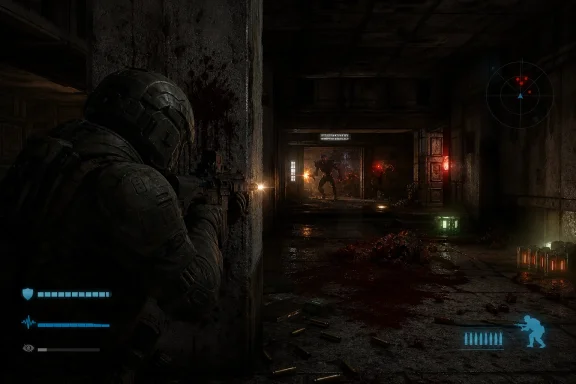 Blackout changes the rhythm, not just the arsenal
PKmX describes Blackout as a tactical, military-simulation-inspired mod centered on deliberate room clearing and survival. The alpha’s stated design moves away from the original game’s fast strafing and health-buffer model: players move more slowly, carry a weight and stamina constraint, and are vulnerable enough that an unarmored character can reportedly die in two or three rifle hits.
Weapons are modeled after real firearms, with aiming down sights, reloads, recoil, and different damage behavior. The current showcase materials identify weapons including an M9 pistol, SPAS-12 shotgun, Vector, M4A1, SCAR-H, M82, M79, and AT4. Those names should not be mistaken for a finished loadout or a promise of final balance; Blackout remains in alpha, and PKmX has continued to revise classes and systems through recent preview videos.
The more significant change is what happens on the other side of the encounter. Blackout keeps Doom’s monsters but reworks their attacks, movement, and alert behavior around the new pace. PKmX says enemies can suppress the player and be suppressed in return, while some monsters can strafe, keep distance, or behave differently when several players are present.
That is the mod’s real technical and design hook. A rifle with reload animations can make a Doom mod look modern, but it does not automatically make the original enemy roster tactically interesting. Blackout is trying to make positioning and exposure matter by changing monster behavior and by sharply increasing the cost of taking fire.
The Crysis influence is functional, not decorative
PC Gamer compared Blackout’s footage to S.T.A.L.K.E.R., which is understandable given the slow movement and severe gunfights. But PKmX has pointed to Crysis as a more direct influence, particularly through a nanosuit-like energy system.
The mod’s military classes use a rechargeable energy shield, described by the creator as a combat buffer that is replenished through Argent Energy pickups replacing much of a map’s conventional health. It is paired with an adrenaline system intended to give the player a brief speed benefit near death. Certain classes also receive a cloaking device and a scanner that can track monsters through walls.
Those tools explain why Blackout is not simply a hardcore realism conversion. A player is meant to feel fragile, but not powerless. The shield offers a limited margin for error; cloaking and scanning introduce alternatives to opening every fight with gunfire; and the near-death speed effect gives retreat a role in encounters that might otherwise be decided the moment a player is spotted.
PKmX has also said the project is deliberately avoiding the inventory simulator tendency common in tactical shooters. That means players should not expect detailed magazine retention, equipment micromanagement, or a full simulation of logistics. Blackout’s approach is closer to concentrated tactical decision-making inside a Doom map: cover, sight lines, stealth, suppression, and limited survivability, with the action still moving forward.
Multiplayer is central to the project’s choice of engine
Blackout supports Zandronum 3.2 or later — with version 3.2.1 specifically cited as tested — and UZDoom 5.0 or later. That matters because the two ports imply different likely uses. UZDoom is a modern continuation of the ZDoom-family source-port line, while Zandronum has long emphasized multiplayer and cooperative Doom.
PKmX’s earlier development posts make clear that Zandronum multiplayer co-op is the project’s primary target. The mod is described as being suited to one-to-four-player survival sessions, and Blackout’s character classes reinforce that intent. The rifleman, spec-ops, marksman, and civilian challenge class start with substantially different equipment and survivability profiles.
The civilian class illustrates the mod’s priorities especially clearly. It begins with a Beretta M9, a stimpack, and no energy shield, leaving the player vulnerable to only a few hits. That is less a conventional balance option than a purpose-built survival challenge for players who want to make avoidance, cover, and limited supplies the center of the run.
For Windows players, the port split also means that “Doom mod compatibility” is not a universal promise. Blackout is not listed as a GZDoom-targeted release, and source-port compatibility in the broader Doom scene can be fragmented. A mod that works in UZDoom may not necessarily support every other ZDoom-derived port or feature set, while the Zandronum version is the one designed around co-op play.
Existing map design becomes the limiting factor
Blackout can reportedly run with most map sets, but that should be read as technical compatibility rather than a guarantee that every WAD becomes better as a tactical shooter. The modder recommends techbase and city maps, and that recommendation is revealing.
Classic Doom maps vary wildly in how they handle cover, sight lines, vertical space, locked doors, enemy closets, and ammunition. A conventional Doom level may expect the player to sprint through an opening, grab an item, circle-strafe a group, and absorb some damage. With Blackout’s reduced mobility and increased lethality, the same room can become a chokepoint with too little cover — or an ambush that offers no reasonable tactical response.
That does not make Blackout incompatible with classic content. It makes map selection part of the experience. Levels with corridors, believable rooms, multiple routes, and enough geometry to break line of sight are likely to support the mod’s intended play better than abstract arenas designed solely for high-speed monster herding.
PKmX also recommends an optional darker palette add-on. Players should treat that as a tonal preference, not a mandatory component, especially when learning the mod. Darker presentation may suit Blackout’s horror-forward atmosphere, but reduced visibility combined with deadlier enemies and stealth systems can turn an already unforgiving alpha into a poor first impression.
What alpha status means before installing it
The alpha is available through the Doom community channels identified by PKmX, but the project does not yet have a published final-release date, a promised campaign, or a documented long-term support plan. No other outlet has reported a timeline beyond the creator’s current releases and previews.
That lack of a roadmap is normal for a hobbyist Doom conversion, but it affects how players should approach the download. Treat Blackout as an evolving gameplay framework rather than a finished tactical Doom package. Keep its files and settings separate from other mod combinations, use a supported source-port version, and start with a compatible map set before layering visual or gameplay add-ons over it.
Blackout’s strongest idea is not that Doom can be made slower. Many mods can do that. It is that slow movement, fragile players, revised monster behavior, suppression, stealth, and limited sci-fi abilities can be made to pull in the same direction. If PKmX can keep that balance intact as the alpha grows, Blackout could become a useful demonstration of how much tactical tension still fits inside the old Doom engine’s walls.