
The peer-reviewed research, presented at the USENIX Security Symposium on August 13, was carried out on a laboratory testbed assembled from authentic Boeing 737 avionics and software, not on an in-service aircraft. Aerospace Global News correctly frames the work as a controlled demonstration, but the underlying paper adds two consequential details: the researchers disclosed the issue to Boeing in April 2020 and successfully demonstrated their hardware in Boeing’s own 737 test environment in December 2023.
Six years after disclosure, Boeing says its existing layers of system and operational protection substantially limit real-world feasibility and risk. The researchers say they cannot independently determine whether Boeing has eliminated the issue in fielded aircraft. That gap—between Boeing’s assurance and the absence of a public technical remediation record—is the part fleet operators and aviation-security teams cannot dismiss as laboratory drama.
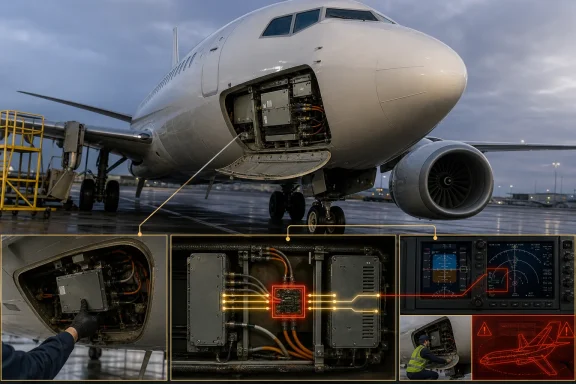 The experiment changes the physical-access threat model
The device targets a maintenance connector in the 737’s Electronics and Equipment bay, reached through a hatch beneath the aircraft’s nose. The researchers estimate that entering the bay can take 10 to 15 seconds and model a complete open-install-close operation in about 60 seconds. That is a demanding but fundamentally different adversary scenario from someone needing unrestricted hangar access or the ability to dismantle avionics wiring.
Their implant connects to ARINC 429 buses between the Flight Management Computer, or FMC, and the captain’s Multi-Function Control and Display Unit, or MCDU. The FMC manages route calculations, navigation inputs and performance data; the MCDU is the cockpit terminal pilots use to enter and view that information.
ARINC 429 is a long-lived aviation data-bus standard built for deterministic, resilient communications rather than cryptographic authenticity. The researchers’ contribution was to show that a purpose-built device could electrically overpower a legitimate signal while monitoring it, creating what they call an attacker in the middle capability without cutting wires or replacing an avionics unit.
That distinction makes the finding more serious than a generic “unprotected maintenance port” claim. Merely attaching another transmitter to a traditional ARINC 429 connection should disrupt the electrical characteristics of the bus and make communications fail. The research device is designed to avoid that obvious failure mode, allowing it to alter communications rather than simply cause a detectable outage.
The demonstrated effects include manipulating flight-plan loading and execution, as well as weight, balance and assumed-temperature entries used in takeoff-performance calculations. In their testbed, the researchers also showed ways a malicious implant could conceal the altered state from the captain’s display. Pilots retain independent procedures and alternate systems, but the attack’s value to an adversary would be confusion and delayed detection—not a magical, irreversible command over the aircraft.
The submitted report understates the aircraft scope
Aerospace Global News says the work concerns a Boeing 737 Next Generation configuration and should not be applied to the 737 MAX. The primary research paper does not support that narrow limitation. Its authors state that their findings concern both 737 NG and 737 MAX airframes, which they describe as more than 95 percent of the active 737 fleet.
That does not mean every 737 NG and MAX has been individually tested, nor does it establish identical exposure across all production blocks, airline installations or retrofit configurations. But it does mean readers should not take the NG-only characterization as a settled boundary of the research. The paper’s own scope is broader: it identifies an access path and relevant FMC/MCDU architecture on NG and MAX variants.
The researchers also emphasize that the 737 is a case study, not necessarily a unique aircraft. Its older federated avionics architecture—many distinct computers linked by point-to-point buses—also appears in other transport-aircraft families. Their conclusion is therefore less “all airliners can be hacked this way” than “maintenance connectors on safety-relevant legacy buses deserve a much more rigorous review.”
That is a useful lesson for enterprise security teams well beyond aviation. Physical maintenance interfaces are often assumed to be trustworthy because a network firewall does not expose them. In industrial control, medical devices, transport systems and datacenter hardware, that assumption is increasingly weak whenever contractors, ground crews, vendors or temporary staff can reach a service port.
Boeing’s response is an assurance, not a published fix
Boeing’s statement, included in the USENIX paper, says the company conducted a thorough assessment of the FMC design, installation and interfaces after reviewing the research and running controlled demonstrations with the team. Boeing says protections in the aircraft’s system design and operating environment provide enough mitigation to significantly limit the feasibility and risk of a real-world attack.
That response should be weighed against what it does not say. Boeing did not publicly identify a changed connector design, a service bulletin, a software update, an inspection regime, an aircraft modification schedule or the fleets that may have received a mitigation. The researchers explicitly say they are unclear about the extent to which Boeing has addressed this vulnerability or related issues found during its investigation.
This is not evidence that Boeing did nothing. Aircraft changes must be certified, distributed across globally operated fleets and validated against safety consequences of their own. A redesign that removes a maintenance connector, adds electrical isolation or changes avionics communications can create maintenance and interoperability problems of its own.
Still, Boeing’s position asks operators and passengers to rely on defense in depth without allowing public verification of the technical layer that matters most: whether an implant can still connect to sensitive flight-management buses on aircraft in service. For a vulnerability disclosed in April 2020, that is an unusually long period without a public closure statement.
In-flight Wi-Fi is a proposed capability, not a tested fact
Some follow-on coverage, including Tom’s Hardware, reported that the implant could use passenger in-flight Wi-Fi to give an attacker remote access after installation. The primary paper is more cautious. The researchers incorporated Wi-Fi hardware and proposed that it could connect through the passenger service, but they state that they did not empirically test whether a cabin Wi-Fi signal reaches the avionics bay.
That qualification matters. A planted implant that requires pre-programmed timing or a local trigger is a different operational threat from one that an attacker can control over the internet during flight. The research supports the feasibility of the implant’s on-aircraft manipulation; it does not establish a functioning end-to-end remote-control channel through a deployed airline Wi-Fi system.
The paper also withholds the exact connector name, location, pinout and proprietary message details needed to reproduce the specific FMC/MCDU attack. Boeing reviewed and agreed with that decision. Public reporting should follow the same line: the threat model needs attention, but publishing a field guide to the physical interface would add little defensive value.
What aviation operators should take from the research
The immediate operational response is not for passengers to avoid Boeing 737 flights. The researchers themselves say they do not consider exploitation an imminent threat and continue to fly on 737s. An attacker would need preparation, physical proximity, access to restricted airport areas or trusted personnel credentials, specialized knowledge, a tailored device and an opportunity to install it without notice.
But “hard to execute” is not a security control. The research argues that physical access policies need to be evaluated alongside cybersecurity controls, particularly where maintenance ports expose buses tied to safety-critical systems.
For operators, lessors and maintenance organizations, the practical questions are straightforward:
- Review which accessible maintenance connectors expose flight-critical or safety-relevant buses, rather than treating every maintenance port as low-risk by default.
- Tie connector access to maintenance records, controlled tooling and post-maintenance inspection procedures that can identify unauthorized hardware or changed cabling.
- Evaluate tamper evidence and access controls around avionics bays, recognizing that a dust cap is not an anti-tamper control.
- Determine whether electrical monitoring can identify unexpected changes in bus voltage characteristics, while accounting for the paper’s warning that timing-only detection may miss content-preserving attacks.
- Require OEMs and avionics suppliers to state whether relevant connectors, bus isolation and message-authentication designs have been assessed against implant-style threats.
The researchers identify several possible defenses, none of them trivial for an installed fleet. Removing or permanently blocking a connector could prevent this specific path but impair maintenance utility. Adding resistance or electrical isolation at the connector could limit an implant’s ability to overpower a legitimate transmitter. A higher-level message authentication scheme could help validate commands, but legacy 32-bit ARINC 429 messages leave little room for authentication data and introduce key-management problems whenever avionics units are changed.
The most concrete consequence of this work is that a maintenance port can no longer be categorized as “outside the cyber boundary” merely because it is not connected to the public internet. Boeing has said its current protections sufficiently reduce the risk; until the company or regulators publish more about how that conclusion translates into fielded aircraft, operators should treat the connector and comparable interfaces as a physical-security control point with cybersecurity consequences.