
The claim surfaced in an April 28 interview with The Pragmatic Engineer and was highlighted Sunday by Windows Latest. Seager said Ubuntu’s WSL growth over the preceding year was “significantly higher” than desktop usage growth, driven especially by developers assigned Windows hardware who need Linux-compatible AI and machine-learning tools.
For Windows developers and enterprise IT teams, the more concrete takeaway is not a league-table victory over native Linux. It is that WSL has become a primary Ubuntu delivery channel for managed Windows PCs, allowing Linux development environments to spread without changing the corporate desktop operating system.
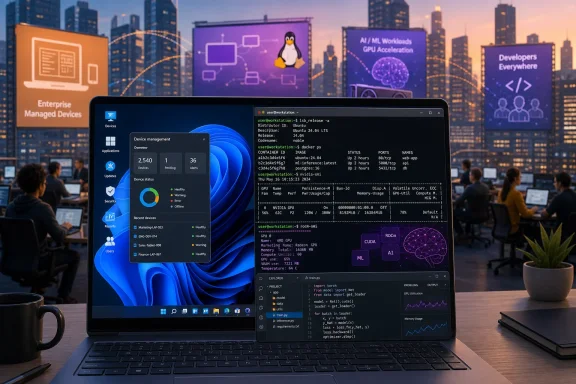 Canonical’s comparison leaves the crucial numbers undisclosed
Seager’s prediction compares Ubuntu under WSL with “native” Ubuntu installations, but neither Canonical nor The Pragmatic Engineer published the totals, measurement window, geographic mix, or telemetry method behind it. That absence matters because counting a Linux distribution is much less straightforward than counting a licensed desktop OS.
A developer can install several Ubuntu distributions under WSL, remove and recreate them for projects, or use imported images that may not report usage in the same way as a standard Ubuntu Desktop installation. Conversely, a native Ubuntu machine can run for years with minimal contact with Canonical infrastructure. Without methodology, the statement establishes the direction Canonical sees in its data, but it cannot establish the size of the lead, whether it reflects active developers, or whether the expected crossover will occur on Seager’s timeline.
The Windows Latest headline also compresses “Windows” into “Windows 11.” WSL is available on Windows 10 version 21H2 and later as well as Windows 11, according to Microsoft’s documentation. Seager’s underlying statement was about Ubuntu on WSL, not an audited count limited to Windows 11 devices. That distinction is not cosmetic for organizations that still have Windows 10 developer fleets or long-lived virtual desktop deployments.
Canonical has nevertheless described WSL as a growing share of Ubuntu use before. In an October 2025 appearance on Linux Unplugged, Seager called the growth in Ubuntu’s WSL numbers “monumental.” The newer interview goes further by putting an expected crossover with native Ubuntu desktop use on the record.
WSL changes the desktop decision, not the Linux workload
Microsoft describes WSL as a Windows feature that runs a Linux environment without separate dual booting or a conventional user-managed virtual machine. With WSL 2, that means a real Linux kernel in a lightweight managed VM, not the system-call translation approach associated with the original WSL architecture.
For a developer, the practical model is simple: Windows remains responsible for device management, identity controls, office software, endpoint tooling, and the primary graphical desktop. Ubuntu supplies Bash, package management, Linux binaries, common build dependencies, and the execution environment expected by many server, container, and AI workflows.
That arrangement is particularly attractive where an employer has standardized on Windows but a project targets Linux servers. A developer can use Windows Terminal, Visual Studio Code’s WSL integration, Git credentials managed through Windows, and a browser or collaboration client on the host, while compiling and testing in Ubuntu. It is a narrower proposition than replacing Windows with Linux, but it removes the need to request a second machine, maintain a dual-boot setup, or run an independently administered desktop VM.
Microsoft’s own WSL guidance now treats that workflow as mainstream: its setup documentation covers code editing, version control, databases, remote development containers, GUI Linux applications, file-storage practices, and GPU acceleration. The platform’s appeal is therefore less about a single Ubuntu feature than about reducing the operational friction of mixing Windows productivity software with Linux development tooling.
AI workloads have made the bridge more valuable
Seager told The Pragmatic Engineer that the strongest demand is coming from people working in AI and machine learning. That is believable as an explanation for growth, though Canonical has not published a breakdown that shows how much of its WSL increase comes from AI work rather than conventional web, cloud, embedded, or systems development.
The technical groundwork is no longer theoretical. Microsoft supports NVIDIA CUDA-enabled workflows in WSL, including Linux tools and frameworks such as PyTorch and TensorFlow, with the Windows GPU driver exposing GPU capability to the Linux environment. Microsoft’s FAQ also makes clear that WSL GPU access is mediated through Windows rather than being identical to a native Linux hardware stack; Linux sees a /dev/dxg device that routes requests through the Windows GPU driver.
Canonical has been moving in parallel. Ubuntu 26.04 LTS added CUDA packages to the Ubuntu archives and introduced AMD ROCm 7.1 packages in the Universe repository. The release notes describe ROCm support as covering AI, machine-learning, and high-performance-computing use cases, while also listing specific tested GPU architectures rather than claiming blanket AMD compatibility.
Those changes make a Windows-plus-Ubuntu setup easier to justify for a developer whose deployment target is Linux and whose local machine must remain compliant with a Windows enterprise build. They do not remove every dependency problem—GPU drivers, framework versions, Python environments, container runtimes, and hardware support still need validation—but they reduce the number of external repositories and manually assembled components a team must carry.
WSL Containers adds another reason to stay on Windows
Microsoft has also added a container-focused layer that aligns with Seager’s explanation. In June, Microsoft released WSL containers as a public preview, following its Build 2026 announcement. The feature introduces wslc.exe, a command-line interface for building, running, and managing Linux containers through WSL.
Microsoft positions WSL containers as an enterprise-ready alternative to assembling separate third-party desktop container tooling. For organizations, that matters because developer tooling decisions are increasingly intertwined with software inventory, policy enforcement, support ownership, and security review. A Windows PC that can host a managed Linux environment and locally run Linux containers has fewer obvious reasons to be replaced merely to satisfy a container-based development workflow.
But public preview status is a reason to treat WSL containers as an evaluation target, not an automatic Docker Desktop replacement. Teams should establish whether their required images, private registries, GPU workloads, bind mounts, networking assumptions, IDE integrations, and CI parity work as expected before standardizing on it. Microsoft itself distinguishes WSL from a production server environment: WSL’s VM lifecycle, automatic shutdown behavior, Windows file integration, and user control over distributions can be useful for local development while being unsuitable for services expected to behave like always-on Linux hosts.
The same caution applies to treating WSL as a universal replacement for native Ubuntu. WSL’s interoperability is a feature, but it also means Windows paths, Windows executables, host-managed networking, and the Windows GPU stack remain part of the execution environment. A team debugging a production-only Linux behavior, testing kernel modules, working with unusual peripherals, or requiring direct control of the complete hardware and boot stack still needs native Linux systems in its test strategy.
The real shift is where Ubuntu reaches developers
Canonical’s forecast does not show Windows displacing Linux. It shows Ubuntu reaching people who may never have installed a Linux desktop at all. If an organization issues Windows laptops, approves WSL, and lets developers obtain Ubuntu from the Microsoft Store or through its own managed distribution process, Canonical gains a user without winning the desktop replacement decision.
Microsoft benefits as well. WSL lets Windows remain the endpoint that corporate IT manages even when the developer’s working environment is Linux. The company’s newer container tooling pushes that logic further: Linux-compatible workflows can remain attached to Windows hardware, Windows identity, Windows security controls, and Windows application stacks.
For administrators, the immediate task is to decide whether WSL is an unmanaged convenience or a supported platform. That means setting a policy for approved distributions, configuring resource limits through .wslconfig, defining where source code and secrets are stored, documenting GPU-driver requirements, and testing endpoint security tools against WSL’s Linux filesystem and virtualized networking. It also means being explicit about where WSL ends: local development is one thing; production services, privileged hardware access, and fidelity testing against native Linux are another.
Canonical may be right that Ubuntu-on-WSL will surpass native Ubuntu desktop use soon. Until it publishes the count and methodology, that remains a credible but unquantified company forecast. The operational fact is already visible: for many Windows-based developers, Ubuntu is no longer an alternative desktop to request from IT. It is the Linux environment they can install on the Windows machine already on their desk.
