
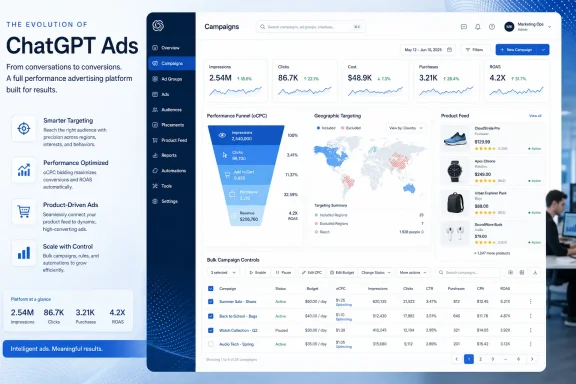
OpenAI’s ChatGPT Ads platform has added conversion-optimized CPC bidding, expanded conversion measurement, geographic exclusions, product-feed enhancements and bulk campaign-management tooling, moving the service closer to the operational baseline advertisers expect from Google Ads and Meta. The most consequential change is oCPC—optimized cost per click—which lets campaigns optimize toward a configured downstream event while billing advertisers for valid clicks rather than charging per conversion.
Search Engine Land first detailed the batch of changes on July 24, and OpenAI’s current Ads Manager Beta documentation now confirms the core mechanics: advertisers can choose CPM, CPC, or oCPC objectives, with oCPC designed to pursue clicks more likely to lead to a tracked conversion. This is a real expansion of the platform, not merely a reporting change. But it also comes with an important implementation catch: existing CPM and conventional CPC campaigns cannot be converted into oCPC campaigns. Advertisers must create new campaigns, choose a supported conversion event, and set fresh bid caps.
That migration requirement is the part likely to matter most to teams that have already experimented with ChatGPT Ads. OpenAI is adding the optimization layer, but it is not retrofitting it onto old campaigns or allowing advertisers to swap objectives after launch. In a beta platform where historical delivery data may already be thin, splitting or rebuilding campaigns means performance comparisons need to be handled carefully.
OpenAI’s oCPC model resembles an established performance-advertising pattern: the platform takes a maximum CPC bid, then attempts to select clicks it predicts are more likely to produce a chosen business outcome—such as a purchase, signup, or lead submission. The advertiser still pays per click. OpenAI does not describe it as a cost-per-acquisition product, and advertisers should not budget or evaluate it as one.
The distinction is more than terminology. A campaign can be billed on clicks while being optimized on conversions, but its quality depends entirely on the conversion signals sent back to OpenAI. An advertiser without a properly deployed OpenAI Pixel, Conversions API integration, or both will not get the data foundation needed for conversion-focused delivery.
OpenAI’s documentation also says that oCPC currently requires at least one supported standard conversion event. Custom conversion events may be available in broader conversion reporting, but they are not currently supported as the optimization event for oCPC campaigns. That leaves a gap for organizations whose key revenue action does not map cleanly to a purchase, registration, lead, or another standardized event. They can still measure those actions, but they may not be able to use them to steer bidding.
For IT teams, that turns deployment into more than a media-buying task. Web administrators need to preserve OpenAI’s click reference, called
That is a meaningful improvement for advertisers facing browser restrictions, lost URL parameters, cross-device journeys, or incomplete click tracking. It is also a data-governance issue. OpenAI says raw customer information is not sent through Automatic Advanced Matching, but the company still requires advertisers to provide necessary notices and obtain consent where law requires it. Windows administrators and security teams supporting marketing operations should treat this as a production data-collection integration, review it under the same privacy and vendor-risk controls used for other advertising pixels, and verify that consent mode does not silently suppress the signals the bidding model needs.
OpenAI also warns that its Ads Manager conversion totals can differ from third-party analytics and other ad platforms because of attribution windows, time zones, cookies, deduplication behavior, campaign configuration, and modeled conversions. That warning undercuts a common marketing temptation: comparing a ChatGPT Ads dashboard total directly against a GA4, CRM, AppsFlyer, or Adjust total and declaring one system wrong.
AppsFlyer and Adjust support is more concrete for app marketers. OpenAI identifies them as its currently supported mobile measurement partners and directs advertisers to connect their ChatGPT Ads Pixel ID and Conversions API key, map events, and use partner-generated attribution links in campaigns. Attribution for those integrations remains click-based, and OpenAI says reporting can take 24 to 48 hours. The integration brings ChatGPT Ads into a familiar mobile measurement workflow, but it does not turn the service into a fully independent source of truth.
The immediate operational benefit is that app-install and in-app-event data can now flow through tools many performance teams already use. The limitation is that marketing and finance teams will still need a declared attribution hierarchy before they start comparing ChatGPT Ads results with paid search, social, affiliate, and organic channels.
OpenAI’s current campaign documentation confirms the practical outcome—daily budgets are delivery targets and actual spend can fluctuate above or below the selected amount on a given day—but it does not publicly spell out the seven-day calculation in the campaign guide. The rollout timing reported on July 24 was “beginning next week,” which places the change before the August 3 Almcorp report. OpenAI has not published a prominent public status notice that identifies which accounts, countries, or campaign types have the rolling-average model enabled.
That omission matters for budget owners. A daily budget is no longer safely read as a strict daily ceiling. OpenAI explicitly recommends campaign-total budgets for stricter control of total expenditure, while warning that campaign-total budgets are a spending limit rather than a pacing mechanism and can accumulate quickly if an ad matches eligible conversations. In other words, neither budget setting guarantees evenly distributed spend: daily budgets can vary by day, while total budgets can front-load.
The practical response is to separate spend controls from pacing expectations. Advertisers with hard monthly caps should set campaign-total limits and monitor delivery. Advertisers seeking steady daily exposure should test daily budgets and pacing on a limited campaign before moving a larger allocation. Teams should also update automated reporting and budget-alert thresholds so a normal delivery fluctuation is not mistaken for a billing anomaly.
The distinction between targeting and exclusion is useful. Targeting lets an advertiser define where a campaign can run; exclusions allow a broader eligible area while removing locations that are commercially irrelevant, legally restricted, poorly served, or already covered by another campaign. For companies with state-by-state availability, regional sales teams, franchise boundaries, or regulated offers, exclusions can prevent wasted spend and reduce the risk of sending users to a page that cannot fulfill their request.
Retail advertisers also get refreshed product-feed cards with pricing and star ratings, according to Search Engine Land. OpenAI’s product-feed documentation confirms that feed campaigns are built from catalog data, support product filtering at the ad-group level, and are aimed at retailers with broad or frequently changing catalogs. It also says each ad account is limited to one feed connection and that feeds must be uploaded through SFTP.
Those constraints make this a less casual feature than the update summary suggests. A retailer needs a maintained feed pipeline, an SFTP process, structured product metadata, valid images and landing pages, and enough governance to prevent stale prices or unavailable inventory from becoming an ad. Product-feed reporting can also take up to seven hours to appear after delivery begins, so a blank Products tab immediately after launch is not necessarily a failed upload.
However, this is also the least independently documented portion of the announcement. Search Engine Land and Almcorp describe asynchronous bulk API operations, while OpenAI’s public Help Center currently surfaces a Bulk Upload Campaign Schema Checklist rather than a public technical reference that details endpoints, authentication, request limits, job status handling, error behavior, or rollback procedures. No other outlet located in the reporting reviewed here has published those API implementation details.
Administrators should therefore avoid treating “bulk” as synonymous with safe automation. Before wiring it into a deployment pipeline, verify whether the account has API access, whether bulk operations are an API feature or a file-upload workflow, how partial failures are reported, and whether an accidental update can be reversed. Those are baseline controls for any platform that can modify live campaigns at scale.
ChatGPT Ads is still explicitly a beta service, and OpenAI says it does not yet have performance benchmarks across advertisers, industries, or campaign types. Ads are also shown only to Free and Go users during the current test; Plus, Pro, Business, Enterprise, and Edu plans remain ad-free. That means the addressable audience is narrower—and materially different—than ChatGPT’s total user base.
The new tools make ChatGPT Ads testable for performance teams that previously lacked conversion optimization, mobile measurement, location controls, and scalable campaign operations. They do not yet make it feature-equivalent to Google Ads or Meta, because the platform’s inventory, benchmarks, rollout scope, and some technical controls remain immature or undocumented. The immediate consequence for advertisers is straightforward: build a clean measurement implementation, launch a new oCPC campaign rather than altering an old CPC one, and treat early results as a controlled experiment rather than a channel-wide budget migration.
That migration requirement is the part likely to matter most to teams that have already experimented with ChatGPT Ads. OpenAI is adding the optimization layer, but it is not retrofitting it onto old campaigns or allowing advertisers to swap objectives after launch. In a beta platform where historical delivery data may already be thin, splitting or rebuilding campaigns means performance comparisons need to be handled carefully.
 oCPC makes conversion tracking a prerequisite
OpenAI’s oCPC model resembles an established performance-advertising pattern: the platform takes a maximum CPC bid, then attempts to select clicks it predicts are more likely to produce a chosen business outcome—such as a purchase, signup, or lead submission. The advertiser still pays per click. OpenAI does not describe it as a cost-per-acquisition product, and advertisers should not budget or evaluate it as one.The distinction is more than terminology. A campaign can be billed on clicks while being optimized on conversions, but its quality depends entirely on the conversion signals sent back to OpenAI. An advertiser without a properly deployed OpenAI Pixel, Conversions API integration, or both will not get the data foundation needed for conversion-focused delivery.
OpenAI’s documentation also says that oCPC currently requires at least one supported standard conversion event. Custom conversion events may be available in broader conversion reporting, but they are not currently supported as the optimization event for oCPC campaigns. That leaves a gap for organizations whose key revenue action does not map cleanly to a purchase, registration, lead, or another standardized event. They can still measure those actions, but they may not be able to use them to steer bidding.
For IT teams, that turns deployment into more than a media-buying task. Web administrators need to preserve OpenAI’s click reference, called
oppref, through redirects and landing-page navigation. Analytics and development teams must also deduplicate events when sending the same conversion through both browser-side Pixel tracking and server-side Conversions API calls. If oppref is stripped by a redirect, consent tool, CDN rule, or custom landing-page router, the platform loses a primary attribution signal.
Better measurement does not eliminate attribution disputes
The reporting cited by Almcorp and Search Engine Land says OpenAI is also adding Automatic Advanced Matching, AppsFlyer and Adjust integrations, and broader measurement support. OpenAI’s own documentation confirms that Automatic Advanced Matching is enabled through Ads Manager’s Tools, Conversions, and Data Source settings. The feature detects supported customer information entered into website forms, normalizes it, hashes it in the browser with SHA-256, and includes that data with conversion events when a click identifier is unavailable.That is a meaningful improvement for advertisers facing browser restrictions, lost URL parameters, cross-device journeys, or incomplete click tracking. It is also a data-governance issue. OpenAI says raw customer information is not sent through Automatic Advanced Matching, but the company still requires advertisers to provide necessary notices and obtain consent where law requires it. Windows administrators and security teams supporting marketing operations should treat this as a production data-collection integration, review it under the same privacy and vendor-risk controls used for other advertising pixels, and verify that consent mode does not silently suppress the signals the bidding model needs.
OpenAI also warns that its Ads Manager conversion totals can differ from third-party analytics and other ad platforms because of attribution windows, time zones, cookies, deduplication behavior, campaign configuration, and modeled conversions. That warning undercuts a common marketing temptation: comparing a ChatGPT Ads dashboard total directly against a GA4, CRM, AppsFlyer, or Adjust total and declaring one system wrong.
AppsFlyer and Adjust support is more concrete for app marketers. OpenAI identifies them as its currently supported mobile measurement partners and directs advertisers to connect their ChatGPT Ads Pixel ID and Conversions API key, map events, and use partner-generated attribution links in campaigns. Attribution for those integrations remains click-based, and OpenAI says reporting can take 24 to 48 hours. The integration brings ChatGPT Ads into a familiar mobile measurement workflow, but it does not turn the service into a fully independent source of truth.
The immediate operational benefit is that app-install and in-app-event data can now flow through tools many performance teams already use. The limitation is that marketing and finance teams will still need a declared attribution hierarchy before they start comparing ChatGPT Ads results with paid search, social, affiliate, and organic channels.
Budget controls are becoming less rigid, but spending can still move quickly
Search Engine Land reported that daily budgets would transition to a rolling seven-day average, allowing spend to vary by day while remaining within an overall weekly envelope. It also reported that automatic pacing would spread daily budget delivery more evenly across the day.OpenAI’s current campaign documentation confirms the practical outcome—daily budgets are delivery targets and actual spend can fluctuate above or below the selected amount on a given day—but it does not publicly spell out the seven-day calculation in the campaign guide. The rollout timing reported on July 24 was “beginning next week,” which places the change before the August 3 Almcorp report. OpenAI has not published a prominent public status notice that identifies which accounts, countries, or campaign types have the rolling-average model enabled.
That omission matters for budget owners. A daily budget is no longer safely read as a strict daily ceiling. OpenAI explicitly recommends campaign-total budgets for stricter control of total expenditure, while warning that campaign-total budgets are a spending limit rather than a pacing mechanism and can accumulate quickly if an ad matches eligible conversations. In other words, neither budget setting guarantees evenly distributed spend: daily budgets can vary by day, while total budgets can front-load.
The practical response is to separate spend controls from pacing expectations. Advertisers with hard monthly caps should set campaign-total limits and monitor delivery. Advertisers seeking steady daily exposure should test daily budgets and pacing on a limited campaign before moving a larger allocation. Teams should also update automated reporting and budget-alert thresholds so a normal delivery fluctuation is not mistaken for a billing anomaly.
Location controls and feeds reduce two early adoption barriers
OpenAI now supports location targeting at campaign level, including countries and, within the United States, supported states, regions, designated market areas, ZIP codes, and cities where available. Search Engine Land reports that the new change adds geographic exclusions, allowing advertisers to deliberately prevent campaign delivery in selected locations.The distinction between targeting and exclusion is useful. Targeting lets an advertiser define where a campaign can run; exclusions allow a broader eligible area while removing locations that are commercially irrelevant, legally restricted, poorly served, or already covered by another campaign. For companies with state-by-state availability, regional sales teams, franchise boundaries, or regulated offers, exclusions can prevent wasted spend and reduce the risk of sending users to a page that cannot fulfill their request.
Retail advertisers also get refreshed product-feed cards with pricing and star ratings, according to Search Engine Land. OpenAI’s product-feed documentation confirms that feed campaigns are built from catalog data, support product filtering at the ad-group level, and are aimed at retailers with broad or frequently changing catalogs. It also says each ad account is limited to one feed connection and that feeds must be uploaded through SFTP.
Those constraints make this a less casual feature than the update summary suggests. A retailer needs a maintained feed pipeline, an SFTP process, structured product metadata, valid images and landing pages, and enough governance to prevent stale prices or unavailable inventory from becoming an ad. Product-feed reporting can also take up to seven hours to appear after delivery begins, so a blank Products tab immediately after launch is not necessarily a failed upload.
Bulk tooling is the least documented part of the rollout
The reporting says the Ads API now supports asynchronous bulk creation and updates for campaigns, ad groups, and ads. If broadly available, that is important: it would let agencies and enterprise teams make controlled changes across large account structures rather than working one object at a time in Ads Manager.However, this is also the least independently documented portion of the announcement. Search Engine Land and Almcorp describe asynchronous bulk API operations, while OpenAI’s public Help Center currently surfaces a Bulk Upload Campaign Schema Checklist rather than a public technical reference that details endpoints, authentication, request limits, job status handling, error behavior, or rollback procedures. No other outlet located in the reporting reviewed here has published those API implementation details.
Administrators should therefore avoid treating “bulk” as synonymous with safe automation. Before wiring it into a deployment pipeline, verify whether the account has API access, whether bulk operations are an API feature or a file-upload workflow, how partial failures are reported, and whether an accidental update can be reversed. Those are baseline controls for any platform that can modify live campaigns at scale.
ChatGPT Ads is still explicitly a beta service, and OpenAI says it does not yet have performance benchmarks across advertisers, industries, or campaign types. Ads are also shown only to Free and Go users during the current test; Plus, Pro, Business, Enterprise, and Edu plans remain ad-free. That means the addressable audience is narrower—and materially different—than ChatGPT’s total user base.
The new tools make ChatGPT Ads testable for performance teams that previously lacked conversion optimization, mobile measurement, location controls, and scalable campaign operations. They do not yet make it feature-equivalent to Google Ads or Meta, because the platform’s inventory, benchmarks, rollout scope, and some technical controls remain immature or undocumented. The immediate consequence for advertisers is straightforward: build a clean measurement implementation, launch a new oCPC campaign rather than altering an old CPC one, and treat early results as a controlled experiment rather than a channel-wide budget migration.