
SFGATE reported the proposal after it drew broad criticism over the weekend, including a reply from Gravity Falls creator Alex Hirsch: “What if you just talked to your children?” PC Gamer independently captured the fuller wording of Altman’s post, and that extra detail changes the story. This was not merely a suggestion to generate a kid-friendly audio program; it was a recommendation to combine schedules, interests and family context in an adult ChatGPT account every morning.
The backlash has been framed as a dispute over whether parents should outsource conversation. The more immediate product issue is that OpenAI has not presented this as a family feature with child-specific privacy boundaries. Altman described a use case, not a safeguarded workflow.
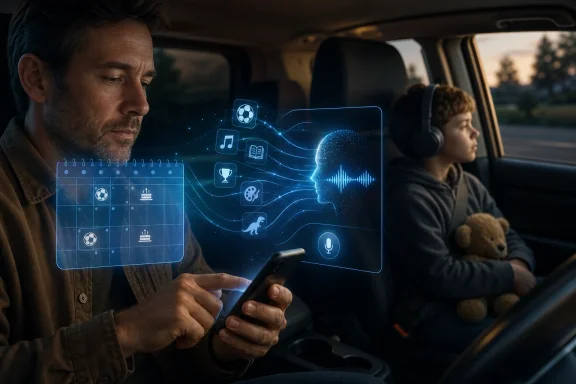 A family calendar is more revealing than a podcast prompt
“Soccer game this afternoon” and “upcoming birthday” sound banal in isolation. In a recurring household prompt, they can establish a record of a child’s name, school-day routine, extracurricular schedule, family relationships, travel plans, developmental interests and potentially location patterns.
That is especially significant because the proposed interaction takes place through the parent’s account. OpenAI’s parental controls apply when a parent or guardian links their account to a teen’s separate ChatGPT account. The company says those controls can manage settings such as model training, memory, voice mode, image generation and quiet hours for the linked teen account. They do not create a protected child profile inside an adult’s account, and they do not govern information a parent voluntarily enters about a younger child.
In other words, Altman’s pitch places the child outside the account model OpenAI has built for family supervision. The child is not necessarily the ChatGPT user at all; the child is the subject of the data that an adult is contributing to make the output more personalized.
OpenAI’s own documentation makes clear why that distinction is worth noticing. If a ChatGPT user leaves “Improve the model for everyone” enabled, the company may use conversations and related content to improve its models. Its Memory feature can retain details to personalize future responses. Those settings are controllable, but Altman’s post did not mention them, did not tell parents to use a temporary session, and did not explain what information should be excluded from a daily family briefing.
A Temporary Chat is the closest existing consumer setting to a lower-retention version of the idea. OpenAI says such chats are not saved in history, do not create memories and are not used for model training, though they may be retained for up to 30 days and reviewed for abuse monitoring. Turning off training alone is less comprehensive: the chat remains in history unless the user separately manages it, and Memory is a distinct setting.
The practical consequence is straightforward. A parent following Altman’s advice without reviewing account settings could turn the morning commute into an ongoing stream of personalized household data. That is a very different risk profile from asking ChatGPT to make up a generic five-minute science story.
OpenAI is moving into households before it has a finished household product
Altman’s post arrived as OpenAI is visibly trying to make ChatGPT a regular family utility rather than a standalone productivity chatbot. TechCrunch reported in July that OpenAI had advertised for a product manager focused on family, caregiver and older-adult experiences. OpenAI did not respond to TechCrunch’s questions about the position.
The hiring signal matters because it suggests the company sees shared use across generations as a business and product priority. But a job listing is not a shipped feature, and it should not be mistaken for one. There is no announced ChatGPT family plan that defines separate identities for young children, consent rules for a parent adding child data, a household-data retention policy, or clear restrictions on calendar-derived personalization.
The company has shipped tools for teens. Its parental-controls documentation says a parent can link with a teen, and OpenAI can apply added protections to the teen’s account, including reductions in graphic content, viral challenges, sexual or violent roleplay and extreme beauty ideals. OpenAI has also said that parents can disable training and memory for linked teen accounts.
Those controls are useful, but they underline the gap in Altman’s example. The proposed daily podcast would likely be made from the parent’s calendar and the parent’s descriptions, not from a teen account operating under those controls. A toddler or grade-school child, the age group implied by “the drive to school,” cannot meaningfully inspect or correct the profile being assembled about them. Neither can they decide whether their activities should become a retained input for an AI system.
This is the missing disclosure in the CEO’s casual pitch: personalization does not appear from nowhere. It is created by providing context, and the context he recommended is inherently about people who may never touch ChatGPT themselves.
The earlier newborn comment shows a consistent sales message
Altman has already made a similar argument about ChatGPT’s place in parenting. During a December appearance on The Tonight Show Starring Jimmy Fallon, he said he could not imagine getting through the process of raising a newborn without ChatGPT. Tom’s Guide and the San Francisco Chronicle both reported that Altman described using the chatbot to manage anxiety about his child’s development, including concerns about crawling milestones.
That comment also triggered criticism, but its practical stakes were different. A new parent asking a chatbot a one-off question about normal developmental variation may be using it as an internet-search substitute, for better or worse. A repeated AI-generated school-run podcast is a proposed habit: a product designed to be embedded in a daily family ritual.
OpenAI is not telling parents to rely on ChatGPT for medical diagnosis, and Altman did not make that claim in the new post. Still, the company’s product strategy is increasingly built around persistent context, voice interaction, memory and routine use. The daily podcast suggestion fits that strategy much more closely than it fits a neutral argument for occasional assistance.
It also creates an awkward contrast with OpenAI’s own family-safety messaging. In its parental-controls announcement, OpenAI says guardrails are not foolproof and recommends ongoing conversations, clear family rules and active involvement in how teenagers use AI. The company’s public guidance treats conversation between parents and children as part of safe AI use. Altman’s viral example instead proposes putting generated audio into one of the limited recurring windows when families might otherwise talk without a screen or a task.
Hirsch’s response landed because it named that contradiction in one sentence. The issue is not that an AI-generated podcast is inherently harmful, or that every car trip must become a meaningful family seminar. Parents have always used radio, audiobooks and entertainment to survive commutes. The issue is that the CEO of the company selling the tool presented data collection plus automated personalization as the enhancement to a parent-child interaction, without acknowledging either cost.
What parents should check before trying it
Families that still want to experiment with a personalized commute audio briefing should treat it as a privacy configuration exercise first, not as a whimsical prompt.
- Use broad descriptions rather than names, school names, addresses, calendar screenshots, medical details or specific future locations.
- Turn off “Improve the model for everyone” in ChatGPT’s Data Controls if the family does not want new conversations used to help train OpenAI’s models.
- Turn off Memory if the goal is a one-time output rather than ongoing personalization, or use Temporary Chat for material that should not enter chat history or create memories.
- Do not assume parental controls on a linked teen account protect information supplied through a parent’s separate adult account.
- Keep the output optional rather than making it the default soundtrack for every school run; a generic prompt can produce a child-interest-themed briefing without creating a detailed household record.
Altman’s post generated viral attention because it sounded like another attempt to automate a human task. The more consequential lesson is narrower: OpenAI is encouraging household use cases faster than it is explaining the data boundaries around them. Until the company ships a real family product with clear child-data protections, parents should regard “connect your family calendars” as an instruction to share sensitive context with a general-purpose consumer chatbot—not as a finished, privacy-safe parenting feature.
