
That feature has been described as a new launch this week, but the timeline is more complicated. Chieftec showed the Vista Max at Computex in early June, where Tweakers, Hartware, and iXBT all reported on the case. The August coverage reflects a product moving closer to sale rather than an entirely new reveal. That distinction matters for buyers waiting on availability: Chieftec has been showing the finished hardware for more than two months, yet confirmed U.S. pricing and retail availability still are not apparent.
The case is a substantial step up from Chieftec’s existing Vista, not simply a renamed glass-fronted mid-tower. The original GT-01B-OP Vista is a smaller 425 × 212 × 492 mm chassis with three preinstalled 120 mm A-RGB fans, 160 mm CPU-cooler clearance, and room for 400 mm graphics cards. The Vista Max expands to 452 × 239 × 526 mm, increases the included fan size to 140 mm, raises CPU-cooler clearance to 178 mm, and stretches GPU clearance to 420 mm.
For builders planning around a long, modern graphics card and a 360 mm AIO, those changes are more consequential than the panoramic presentation.
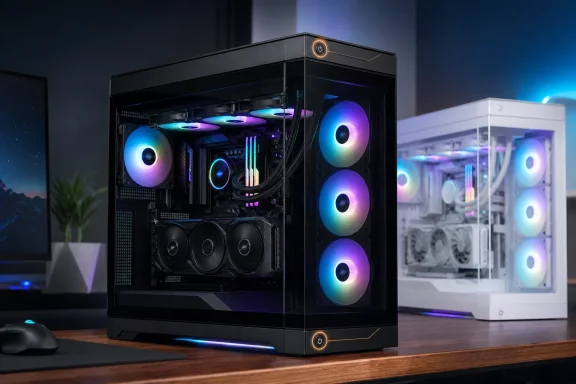 A case shown in June, with availability still uneven
Chieftec displayed both black and white Vista Max models during Computex 2026. Hartware reported at the time that Chieftec expected European availability in roughly two months and cited an intended price of about €100. That target has not translated into a clean, broadly available retail launch.
Alternate’s European listings identify the black version as the GX-30B-OP and show prices around €109 to €113 depending on country storefront, but the same listings say it cannot currently be purchased. That is not proof that stock does not exist anywhere, but it does mean the case should not yet be treated as readily available simply because a retailer has created a product page.
Chieftec also has not publicly established a U.S. MSRP, U.S. release date, or named U.S. retail partners for the Vista Max. For an American PC builder, the practical buying advice is therefore simple: do not build a parts list around its reported European €100 price. Cases are bulky, and an import purchase can erase a low chassis price through shipping, taxes, and warranty friction.
The white edition is another open point. Tweakers reported in June that the black version would arrive first and the white model later, while the August product material does not establish whether that staggered release has changed. Buyers who want a white panoramic build should wait for a live retailer listing rather than assume both colors will appear together.
Dual power buttons solve a small but real desk-placement problem
The Vista Max’s most distinctive feature is its duplicated power switch. One button sits in the conventional top I/O area, while the other is lower on the chassis. This does not create separate power modes, redundant system control, or an additional reset function; both are simply alternate ways to send the normal momentary power-switch signal to the motherboard.
Its value is ergonomic. A case placed on a desk is easiest to switch on from above, while a floor-standing tower often leaves top-mounted I/O inconvenient or obscured. Most panoramic cases quietly encourage desk placement because their tempered-glass side and front panels are intended to be visible. The Vista Max acknowledges that many owners will still place a 526 mm-tall tower under the desk.
That is a modest innovation, but one that directly addresses a recurring contradiction in showcase-oriented cases. Buyers should still consider the cable path before treating the lower switch as a cure-all: depending on desk orientation and case placement, USB, audio, and USB-C connections remain at the top. The second power button solves access to one control, not access to the entire I/O panel.
The cooling layout has a more important limitation than the fan count
Chieftec specifies four 140 mm A-RGB fans: three in the side intake position and one at the rear. The chassis also supports three 140 mm fans or three 120 mm fans at the top, two 120 mm fans above the PSU shroud, and a 120 mm fan on the adjustable HDD/GPU fan cage.
That sounds like a conventional high-airflow recipe, but builders should scrutinize the intended airflow before adding fans. With three side fans feeding the system and a rear 140 mm fan exhausting it, the out-of-box arrangement gives the graphics card and motherboard area a strong intake source. A top-mounted 360 mm radiator can then serve as exhaust, which is a straightforward configuration for an AIO-cooled CPU.
The adjustable lower fan cage is the more useful provision for high-wattage GPUs. It can place a 120 mm fan near the graphics card and direct airflow toward it, a feature Chieftec demonstrated at Computex. In a system running a power-hungry card, this may reduce the need to rely entirely on the GPU’s own fans pulling air from the bottom of the case.
But the cage comes with a storage compromise that deserves more attention than it has received. Chieftec’s product description says the cage can hold one 3.5-inch hard drive and one 2.5-inch SSD while mounting the extra 120 mm fan. The Vista Max is therefore not a case built around extensive local storage; it is designed for an NVMe-first gaming or creator system with perhaps one hard drive for bulk data. Anyone migrating several SATA drives from an older tower should look elsewhere or plan external and NAS storage before buying.
Back-connect motherboard support is useful, but not universal
The Vista Max supports back-connect motherboards, the increasingly common layout in which many power, storage, front-panel, and fan connectors are moved to the reverse side of the PCB. The point is cleaner cable management on the visible side of a glass-panel build.
This is worth having, but support should not be confused with universal compatibility across every proprietary rear-connector implementation. A buyer needs to verify that the exact motherboard’s connector positions align with the case cutouts before ordering. Motherboard vendors have used different branding and layouts for this category, and a generic “back-connect compatible” claim is not a substitute for a published compatibility list.
For conventional ATX, microATX, and Mini-ITX boards, the case remains a normal front-connector design. It supports all three form factors, has seven expansion slots, and reserves enough room for a 420 mm graphics card, 178 mm air cooler, and 180 mm ATX power supply. The PSU limit is worth checking carefully: 180 mm is sufficient for many mainstream modular supplies, but it can rule out longer high-capacity units or make stiff cable bends difficult.
The front I/O is appropriately current for a chassis in this class: one 10 Gbps USB-C port, two 5 Gbps USB-A ports, and HD audio. Chieftec’s language calling the USB-A ports “USB 3.0” is functionally understandable, though the current formal name is USB 3.2 Gen 1. It is a 5 Gbps connection, not a 10 Gbps USB-A port.
The Vista Max is a better-equipped Vista, not a category disruptor
The Vista Max appears to be a sensible evolution of Chieftec’s lower-cost Vista line. It adds more room for large coolers and graphics cards, shifts from three 120 mm fans to four 140 mm fans, supports 360 mm radiators at both the side and top, and accommodates cleaner rear-connector motherboard builds. The two-button arrangement is an unusually practical touch in a category often preoccupied with visual novelty.
Its appeal will depend heavily on street price. At roughly €100, as Chieftec indicated to Hartware at Computex, the combination of four 140 mm A-RGB fans, dual 360 mm radiator positions, and 420 mm GPU clearance would make a strong value case. At substantially more than that, buyers will need to compare it against established panoramic alternatives with live stock, known warranties, and regional support.
For now, the hardware is real and the specifications are well corroborated, but the product’s launch remains incomplete for U.S. buyers. The next concrete milestone is not another announcement: it is a purchasable listing with a confirmed regional price and a clear answer on when the white model reaches shelves.