
That approach is notable precisely because the restaurant industry has become one of the loudest adopters of AI branding. Drive-thru voice agents, kitchen forecasting tools, chatbot ordering systems, computer vision, and generative AI assistants are now regular features of restaurant technology announcements. Yet Brinker International, the owner of Chili’s Grill & Bar, is emphasizing a much more fundamental transformation: replacing outdated wireless infrastructure, issuing thousands of modern handheld tablets, and simplifying the software that restaurant employees must use every day.
For Windows and enterprise IT professionals, the underlying message is familiar. AI is only as useful as the operational platform beneath it. A company can deploy advanced analytics, cloud services, and generative assistants, but none of that fixes a weak Wi-Fi signal, a device shortage, unreliable order transmission, or an interface that slows down new employees.
Chili’s technology strategy is therefore less a rejection of AI than a reminder that modernizing the basics can create a more immediate business impact than pursuing every new AI trend.
 The Real Restaurant Technology Problem: Reliability
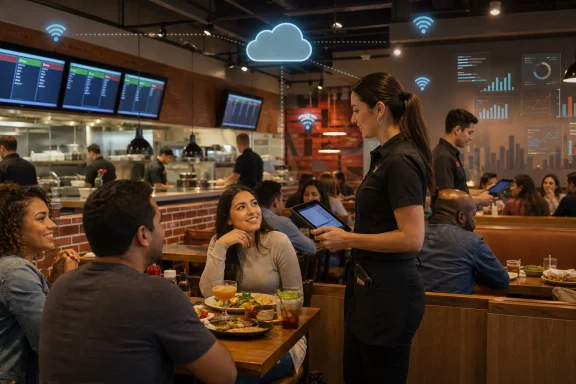
Restaurants are deceptively demanding technology environments. A typical casual-dining location is not simply a dining room with a few point-of-sale terminals. It is a compact operational network with hundreds of daily transactions, guest Wi-Fi traffic, payment workflows, kitchen display systems, handheld devices, printers, manager workstations, digital ordering channels, and an increasingly large number of connected endpoints.
When the infrastructure is unreliable, the damage is immediate.
A server who cannot access an ordering device may need to write orders manually or wait for another employee to finish using a tablet. A delayed order can mean slower kitchen preparation, longer table turns, dissatisfied guests, and unnecessary pressure on staff. A wireless outage can affect everything from payment acceptance to communication between front-of-house and back-of-house systems.
Those are not glamorous IT problems. They do not make for splashy keynote presentations. But they are the kinds of issues that can quietly erode a restaurant brand’s performance day after day.
Chili’s chief information officer, Chris Caldwell, has described arriving at a company where advanced experiments had attracted attention while basic systems needed stronger investment. Restaurants had not always had enough ordering tablets available for staff, and the existing technology did not consistently transmit orders to the kitchen as smoothly as it should.
That diagnosis matters. In a restaurant, an order-management failure is not a back-office inconvenience. It is a direct failure in the customer experience.
From Novelty Devices to Operational Tools
Chili’s had previously explored highly visible technology concepts, including robots capable of clearing tables and performing birthday routines. Such systems can create social media attention and may appeal to guests in select settings. However, novelty technology does not necessarily solve the operational bottlenecks that determine whether customers receive the right food quickly and whether employees can provide attentive service.
A robot that sings “Happy Birthday” may be memorable. A dependable ordering tablet is more valuable when the restaurant is full.
The distinction is important because many organizations confuse technology theater with technology transformation. Technology theater looks innovative from the outside. Transformation improves the repeatable processes that employees and customers encounter every day.
Chili’s appears to be placing the latter ahead of the former.
Why 23,000 iPads Matter More Than an AI Demo
Brinker’s reported investment in roughly 23,000 iPads for order taking represents a major endpoint deployment, not a minor refresh cycle. At a restaurant chain operating across a large U.S. footprint, this is an enterprise device-management project involving procurement, provisioning, software design, connectivity testing, support processes, replacement logistics, security controls, and user training.
The number itself is significant, but the more important point is what those devices are intended to do: make work easier for the people taking care of guests.
A server’s handheld device is not just a digital notepad. It is a front-line productivity platform. It can potentially support order entry, menu modifications, table management, payment workflows, loyalty interactions, guest feedback, and service recovery. If the application design is intuitive, employees may spend less time navigating screens and more time interacting with guests.
Simplifying the User Experience
Caldwell’s stated goal of making order-taking software feel more like a familiar consumer app reflects an increasingly important enterprise principle: employee experience is operational performance.
Workers do not judge enterprise software against legacy green-screen systems anymore. They judge it against the mobile applications they use outside of work. If a restaurant app is difficult to learn, unintuitive during a busy shift, or prone to forcing users through excessive steps, the business pays for that friction through slower service and longer training periods.
A streamlined handheld application can offer several advantages:
- Faster employee onboarding for new servers and support staff.
- Fewer order-entry mistakes, especially for modifiers and special requests.
- Reduced walking time between a table and a fixed terminal.
- More immediate kitchen communication when connectivity and order routing are reliable.
- Better table-side service, since staff can stay present with guests.
- More consistent workflows across different locations.
This is where the iPad rollout becomes more than a hardware story. It is a workflow redesign project.
The device is simply the visible piece of a larger system that includes Wi-Fi, identity management, mobile device management, application support, backend integrations, payment controls, and help-desk operations. If one layer fails, the employee experience suffers.
Consumer Hardware, Enterprise Discipline
Apple tablets are widely used in retail, hospitality, healthcare, aviation, and field-service environments because they combine familiar touch interfaces with mature device-management capabilities. Yet deploying them at scale requires far more discipline than handing out consumer devices.
For a restaurant chain, the questions become practical very quickly:
- How are tablets enrolled, configured, updated, and replaced?
- Which applications are allowed to run on the device?
- How are shared devices assigned across shifts?
- What happens when an employee leaves or a device is misplaced?
- How are authentication credentials protected?
- How are charging, physical durability, and accessory failures handled?
- What happens when a restaurant temporarily loses internet access?
The most successful mobile deployments do not treat devices as standalone tools. They treat them as managed endpoints within a broader operational environment.
That is a lesson familiar to Windows administrators managing laptops, kiosks, shared PCs, ruggedized devices, and Microsoft 365-connected endpoints. The operating system may differ, but the enterprise problems remain the same: configuration drift, software updates, user access, device replacement, network dependency, and security.
The Wi-Fi Overhaul Is the Most Important Part
The tablet deployment would have limited value without dependable wireless networking. Brinker has reportedly replaced Wi-Fi access points throughout approximately 1,200 U.S. Chili’s restaurants and increased bandwidth so that operational systems are less likely to be slowed by connectivity constraints.
That effort may be the least flashy part of the transformation, but it is arguably the most consequential.
A modern restaurant network must carry traffic for many separate operational categories:
- Point-of-sale and payment devices.
- Server handhelds and ordering tablets.
- Kitchen display and printer systems.
- Corporate applications and management tools.
- Online ordering and delivery integrations.
- Guest wireless access.
- Digital signage and entertainment systems.
- Security cameras, sensors, and other connected devices.
- Software updates, cloud synchronization, and remote support.
The challenge is not simply adding bandwidth. Network design, resilience, segmentation, and monitoring are equally important.
Bandwidth Is Not the Same as Resilience
A restaurant can have a fast internet connection and still suffer from poor operational performance. Wireless coverage may be inconsistent. Access points may be overloaded. Devices may roam poorly between areas. Guest traffic may compete with business-critical traffic. A single network failure may disable multiple dependent systems.
A stronger restaurant network architecture typically requires:
- Adequate access-point placement across dining rooms, kitchens, patios, bars, offices, and back-of-house areas.
- Segmentation that separates guest access from sensitive business and payment-related systems.
- Traffic prioritization for critical business applications.
- Reliable failover options when a primary internet connection is disrupted.
- Central monitoring that detects outages and recurring performance issues before they become a major operational event.
- Standardized configurations so that one location does not become a one-off troubleshooting nightmare.
For a chain with more than a thousand locations, standardization is especially valuable. Each restaurant has its own building layout, local internet provider, physical interference, occupancy patterns, and equipment history. A centralized design can reduce the support burden while allowing local variations to be managed within a consistent framework.
A Foundation for Everything Else
The importance of Wi-Fi extends beyond the current iPad program. A resilient wireless environment creates a foundation for almost every future restaurant technology initiative.
That includes AI.
Any future system for demand forecasting, predictive staffing, smart inventory, voice ordering, computer vision, digital menu updates, or real-time guest personalization will depend on reliable data movement. AI projects often receive attention because their outputs appear intelligent, but their effectiveness rests on ordinary infrastructure: clean data, connected devices, stable APIs, secure networks, and applications employees can actually use.
Without those foundations, an AI deployment becomes another layer of complexity on top of unreliable operations.
Chili’s Is Not Avoiding AI — It Is Setting a Higher Bar
The most inaccurate interpretation of Chili’s strategy would be that Brinker is hostile to artificial intelligence. The company is using Microsoft Copilot for corporate employees, and Caldwell has described using AI as a brainstorming tool when assessing business decisions.
That is a practical, measured use case.
Generative AI can be useful for outlining scenarios, summarizing information, identifying questions that a planning exercise may have missed, or helping employees move past a blank page. In that role, AI functions as an assistant rather than an autonomous decision-maker.
The distinction matters. A corporate brainstorming session has a different risk profile from an AI system that directly interacts with customers, sets operational priorities, processes sensitive information, or makes decisions that affect staffing and payments.
The “Does It Make Life Easier?” Test
Brinker’s apparent decision-making framework is simple: does the technology make life easier for restaurant teams or customers?
That may sound obvious, but it is a stronger standard than many corporate AI strategies currently use. Too often, organizations start with an available model or vendor platform and then search for a problem that might justify it. The result can be expensive experimentation with unclear ownership, low adoption, and minimal operational value.
A more disciplined approach starts with pain points.
In Chili’s case, potential operational AI uses reportedly include improving estimated pickup times for online orders. That is a reasonable example because the problem is concrete. Guests want to know when food will be ready. Restaurant teams need estimates that reflect actual kitchen conditions. A better prediction could reduce frustration and improve the handoff between digital ordering and in-store fulfillment.
However, it is also a reminder that AI accuracy matters. An incorrect pickup estimate can create a worse experience than no estimate at all. If the system consistently promises food earlier than the kitchen can produce it, employees inherit the guest dissatisfaction.
That is why AI needs measurement, not just deployment.
The Risks of an AI-First Restaurant Strategy
The restaurant industry’s interest in AI is understandable. Labor remains expensive, customer expectations are rising, and operators want faster service with better consistency. AI may eventually improve forecasting, menu recommendations, support operations, and digital ordering.
But an AI-first strategy carries real risks.
Automation Can Create New Friction
A voice-ordering system may reduce the number of manual interactions at a drive-thru, but it can also frustrate customers if it misunderstands accents, menu customizations, or background noise. A chatbot may answer routine questions quickly but fail when a guest has a complaint that requires empathy or discretion.
Restaurants work because of human coordination. Technology should reduce avoidable work, not create new obstacles between guests and employees.
Data Quality Can Undermine Prediction
AI models depend on reliable historical and real-time data. If ordering systems are inconsistent, menu data is outdated, inventory records are incomplete, or kitchen events are not captured accurately, the model may generate polished but unreliable recommendations.
This is one reason the Chili’s infrastructure-first approach is strategically sound. Better order-entry systems and more dependable networking can improve the quality and consistency of the operational data that later AI projects require.
Security and Privacy Must Be Designed In
Restaurants handle payment data, employee information, loyalty accounts, guest contact details, and potentially sensitive behavioral data. As more tools become connected and AI-enabled, the attack surface grows.
A responsible program must consider:
- Access control for employees, managers, vendors, and corporate teams.
- Network segmentation between guest traffic and business systems.
- Device management for handhelds, tablets, and shared endpoints.
- Data retention rules for customer and operational information.
- Vendor risk management for AI providers and third-party integrations.
- Clear usage policies for employee access to generative AI tools.
For organizations in the Windows ecosystem, this will often involve a mix of endpoint management, identity security, conditional access, logging, and cloud governance. Even where restaurant devices use iPadOS, the surrounding identity, productivity, analytics, and support environments may still be deeply connected to Microsoft platforms.
A Turnaround Built on Operations, Not Hype
Chili’s broader business performance gives the technology investment more context. The chain has reported a sustained run of comparable-sales growth, with management repeatedly linking its momentum to improvements in food, service, atmosphere, value, and execution.
Technology is only one component of that formula.
A restaurant brand cannot fix weak food quality with a better tablet. It cannot solve understaffing with a chatbot. It cannot turn an inconvenient payment experience into guest loyalty merely by adding more screens. The core product remains the meal, the environment, the service, and the perceived value.
But technology can either support or undermine those essentials.
When a handheld device works, servers can focus on their tables. When kitchen orders arrive cleanly and quickly, food can move more predictably. When a payment device is available at the table, guests may complete their visit without waiting for an avoidable extra step. When systems are easier to learn, new employees can become productive sooner.
These improvements are incremental. Yet restaurant operations are built from increments.
A few seconds saved during order entry, a few fewer missed modifiers, fewer network disruptions, and less time spent hunting for a working device can add up across thousands of daily interactions. At chain scale, those gains can be meaningful.
What Other Enterprises Should Learn From Chili’s
The Chili’s technology story has relevance far beyond restaurants. Every large organization faces pressure to demonstrate an AI strategy, especially as generative AI becomes embedded in workplace software and vendor roadmaps.
The most useful lesson is not “ignore AI.” It is sequence technology investments correctly.
Start With Friction, Not Fashion
Before deploying AI, organizations should identify where employees and customers lose time, encounter errors, or abandon tasks. The answer may be a workflow redesign, a better device, a faster network, improved authentication, a cleaner integration, or a simpler application interface.
Not every business problem requires a model.
Fix the Data-Producing Systems
The data that powers analytics and AI originates in day-to-day transactions. If frontline systems are unreliable, the resulting data will be incomplete, delayed, or inconsistent.
Modernizing the systems where work actually happens is often the best preparation for future intelligence initiatives.
Measure Operational Outcomes
A successful technology project should be measured by outcomes that matter to the business, not by the number of devices deployed or the novelty of the software.
Relevant measures for a restaurant modernization program might include:
- Order-entry time.
- Order transmission failures.
- Kitchen ticket accuracy.
- Employee training time.
- Table-turn duration.
- Payment completion time.
- Device availability during peak periods.
- Network incident frequency.
- Guest satisfaction and repeat visits.
The same logic applies across industries. IT leaders should ask whether a project reduces friction, improves reliability, strengthens security, or makes employees more effective.
Keep Humans in the Loop
AI can be a useful assistant for forecasting, brainstorming, content generation, and pattern recognition. It becomes riskier when organizations allow it to replace judgment in high-stakes or customer-sensitive contexts without proper oversight.
Chili’s current posture suggests a healthier model: use AI where it adds demonstrable value, but do not let it distract from the systems that staff and customers depend on today.
The Bottom Line: Infrastructure Is Still Innovation
Chili’s decision to prioritize Wi-Fi modernization and a large-scale tablet rollout over flashy AI deployment may seem conservative in an era obsessed with tokens, models, and automation agents. In reality, it is a sophisticated recognition of where technology creates value in a high-volume service business.
Reliable connectivity is not old-fashioned. Intuitive frontline software is not mundane. Well-managed mobile devices are not a lesser form of innovation. These are the technologies that allow employees to work efficiently and enable customers to experience faster, more consistent service.
AI may become a larger part of Chili’s restaurant operations over time, particularly in areas such as online-order readiness estimates, planning, and corporate productivity. But the company’s sequencing is the important part: first make the restaurant systems dependable, then build intelligence on top of them.
For enterprise IT leaders, that is a useful corrective to the AI gold rush. The organizations most prepared to benefit from artificial intelligence will not necessarily be the ones that announce the most pilots. They will be the ones that have already done the harder, less glamorous work of modernizing their networks, endpoints, applications, data flows, and employee workflows.
At Chili’s, the path to a smarter restaurant begins not with an AI token, but with a working tablet and a stable Wi-Fi connection.
