
Tom’s Hardware first relayed the Bloomberg report, which cites people familiar with the matter rather than a published directive. Bloomberg’s reporting says the removal timetable is being accelerated ahead of a planned February 2027 retirement, but neither the Ministry of State Security nor C&M Information Technologies, known as CMIT, had publicly described the scope, named affected agencies, or identified a technical flaw in the operating system.
Microsoft told Bloomberg it was not aware of a security incident affecting the product and said the edition continued to receive regular security updates. That response is important: the available record supports a policy-driven migration, not a confirmed compromise of Windows 10 China Government Edition.
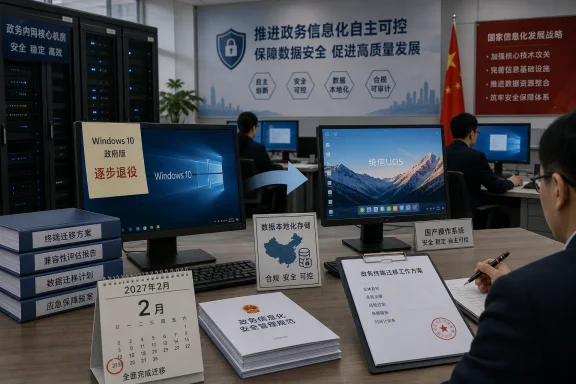 A Windows build designed for Chinese government control
Windows 10 China Government Edition was never ordinary Windows 10 sold under a different name. Microsoft announced the product in May 2017 after forming CMIT with state-owned China Electronics Technology Group, or CETC. Microsoft said the edition was based on Windows 10 Enterprise and intended for government agencies and selected state-owned enterprises in critical infrastructure.
The joint venture’s purpose was unusually broad by Windows licensing standards. In 2015, Microsoft described CMIT as the exclusive licensor for a government-approved Windows image, responsible for activation, deployment, patch management, support, and feedback for future government images. That arrangement put a China-based entity between Microsoft’s core operating system and the government customers using it.
Microsoft’s 2017 announcement said the government build removed unneeded services such as OneDrive, managed telemetry and updates, and allowed Chinese government users to employ their own encryption algorithms. CMIT’s current product material still describes localized activation and updates within China, along with controls over outbound data.
Those features were meant to address the exact concerns now associated with the reported removal order: where systems authenticate, how updates are administered, what data can leave a government network, and whether the government can impose its own cryptographic and security requirements. The reported decision therefore does not show that Beijing failed to obtain a localized Windows deployment. It shows that localization and administrative control are no longer sufficient substitutes for replacing a foreign-origin operating system outright.
The February 2027 date deserves scrutiny
The February 2027 retirement date reported by Bloomberg is plausible in the context of Windows 10 servicing, but it should not be confused with Microsoft’s general Windows 10 end-of-support date.
Microsoft ended normal support for Windows 10 version 22H2 on October 14, 2025. Windows 10 Enterprise LTSC 2021 has a separate lifecycle that runs through January 12, 2027, while Microsoft’s consumer Extended Security Updates program now extends qualifying Windows 10 security coverage through October 12, 2027. Those dates apply to Microsoft’s published servicing policies; they do not establish the lifecycle for CMIT’s government edition.
CMIT’s public pages identify several government-edition releases, including V2020-L and V2022-L, but do not prominently publish a clear, current English-language retirement notice tying the product to February 2027. Publicly circulated material about V2022-L has linked it to an end date of February 17, 2027, yet the exact edition and build covered by Bloomberg’s reporting have not been independently confirmed through a CMIT lifecycle notice.
That missing detail matters. A government agency cannot plan an operating-system replacement around a broad label such as “Windows 10 government edition.” Administrators need the deployed release, servicing branch, last security-update date, hardware support matrix, application dependencies, activation method, and a definition of what replaces the existing management infrastructure. None of that has been published with the reported order.
The practical reading is that the reported directive may be accelerating a migration already required by the product’s own servicing horizon, rather than suddenly forcing agencies off a build with years of normal vendor support remaining.
Beijing’s wider replacement campaign explains the direction
China has been pushing government and state-linked organizations toward domestic technology for years. Reuters reported in late 2023 that state-owned enterprises had been told to replace foreign office software systems with domestic products by 2027, citing brokerage firms that referenced a 2022 order from China’s state-assets regulator. Reuters also reported instances of state organizations moving from Microsoft Windows to Chinese alternatives.
The campaign has consistently covered more than the PC chassis. China has sought substitutes for foreign processors, server infrastructure, databases, office applications, cybersecurity products, and operating systems. Government procurement rules have increasingly emphasized products described as safe and reliable, a standard that has favored domestic suppliers and made foreign software harder to retain in sensitive deployments.
Windows 10 China Government Edition had occupied an awkward middle ground in that program. It was locally administered, selectively customized, and delivered through a Chinese-majority joint venture, but its underlying technology remained Microsoft Windows. Microsoft made that distinction explicit when CMIT was formed: Microsoft would retain ownership of the core Windows 10 technology.
That ownership line is now the key limitation. A locally operated image can reduce reliance on external services and provide authorities more control over deployment, telemetry, activation, updates, and cryptography. It cannot turn the codebase into a domestic operating system, remove dependence on Microsoft’s engineering pipeline, or guarantee that future product decisions are made in Beijing rather than Redmond.
No public evidence identifies a Windows vulnerability
The most consequential omission in Bloomberg’s report is also the simplest: the security concern is unspecified. The sources did not identify a CVE, a malware campaign, a supply-chain compromise, an update failure, or evidence that Windows 10 China Government Edition leaked data outside China.
Microsoft’s statement that it knows of no security incident should be read narrowly. It is a denial of awareness of a product-specific incident, not a public explanation of Beijing’s policy rationale. The ministry could be acting on a classified assessment, a broad risk model around foreign technology, a procurement objective, or a combination of those factors. The available reporting does not allow readers to choose among those explanations.
That makes it irresponsible to frame the reported order as proof that the government edition was insecure. The product was built around security modifications and localized operational control, and no technical defect has been publicly named. The stronger conclusion is that China’s state-security calculus appears to have moved beyond the question of whether a foreign platform can be customized enough for sensitive use.
For Windows administrators, this is a useful distinction. A country’s directive to replace a platform can create immediate operational and commercial consequences without establishing any new exploit risk for the same platform elsewhere. There is no indication in the reporting that enterprises running standard Windows 10 Enterprise, Windows 10 LTSC, or Windows 11 need to take action because of this order.
Migration risk will fall on applications, devices, and support workflows
If the reported order reaches beyond a small set of agencies, the difficult work will be replacing Windows-dependent workflows rather than uninstalling an operating system. Government deployments often contain years of internal applications, document templates, browser-dependent services, peripheral drivers, smart-card middleware, encryption integrations, and endpoint-management tooling that assume Windows behavior.
Chinese alternatives such as Kylin and UnionTech UOS are positioned to capture that demand, but their adoption does not automatically solve compatibility problems. Moving endpoints to a domestic Linux-based platform can require application rewrites, compatibility layers, vendor recertification, retraining, device replacement, and parallel support for systems that cannot move on the first schedule.
The reported market reaction in Chinese operating-system and software stocks reflects that expectation: the order, if broadly implemented, could produce new domestic procurement demand. But a stock rally says little about whether agencies can migrate cleanly. Large public-sector desktop transitions are typically limited by the last incompatible workflow, not by the availability of an operating-system image.
IT teams affected by any order should press for concrete implementation documents before treating the report as a full migration mandate. The essential questions are straightforward:
- Agencies need a written definition of which CMIT releases, organizational units, and device classes are covered.
- Administrators need the replacement operating system, supported hardware list, and endpoint-management path before decommissioning existing Windows images.
- Application owners need testing requirements for line-of-business software, locally developed tools, smart cards, encryption products, printers, scanners, and document workflows.
- Security teams need to know whether the order requires data sanitization, credential revocation, certificate replacement, or retention of isolated legacy systems.
Until those answers emerge, the reported directive remains an important signal of policy direction rather than a complete technical migration plan.
China’s Windows 10 government edition was designed as a compromise between Microsoft’s platform and Beijing’s demand for local control. Bloomberg’s report suggests that compromise may now be ending for at least some state-linked organizations. The immediate consequence is not a newly identified Windows flaw; it is a forced test of whether China’s domestic desktop stack can replace Windows where compatibility failures carry public-sector consequences.