
The platform, called AgriTech, collects field data including humidity, pH, electrical conductivity and nutrient levels, then applies machine learning to turn those readings into crop-health and water-use recommendations. For farms operating under persistent water constraints, the useful outcome is not another dashboard but a clearer signal of when and where irrigation is needed.
Chuuk was founded by José Alejandro Del Río, a chemical biologist; Ares Arturo Molina, a systems engineer; and Héctor Hernández, a self-taught software developer. The team formed during a 2025 hackathon and has since added computer science student César Gutiérrez to support its hardware and software development.
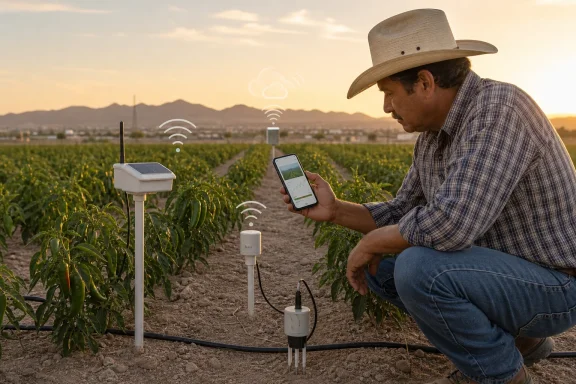 AI Training Is Being Applied at the Edge
According to Microsoft Source, the founders used AI training to improve how their machine-learning models are developed and deployed. That matters because the system is intended to work beyond lab conditions, where internet connectivity, compute capacity and hardware reliability may be limited.
Molina said the training helped make the platform more efficient and capable of running on constrained hardware. That emphasis places Chuuk’s work in a practical corner of AI adoption: edge deployments where a model’s value depends as much on operational limits as on its accuracy.
Del Río told Microsoft that the company’s central asset is not the sensors themselves, but the data and the team’s ability to interpret it through machine learning. The distinction is important for agricultural technology projects, where inexpensive sensing hardware can generate large volumes of data without necessarily producing actionable guidance.
Pilot Plots Will Determine Whether the Prototype Scales
Chuuk is validating AgriTech through pilot deployments, including demonstration plots developed with Ciudad Juárez’s rural development department. Those pilots will be the more meaningful measure of progress: whether the recommendations improve irrigation decisions under real field conditions, rather than merely functioning in a prototype.
The startup has also begun applying its AI experience to laboratory-management systems and biomedical image analysis. But agriculture remains its immediate proving ground as the founders pursue partnerships and work to move their platform from pilot projects toward a scalable product.
For Windows developers and IT teams, the story is a reminder that AI adoption is increasingly being shaped by localized problems and limited infrastructure. In Chuuk’s case, the next milestone is not a larger model—it is evidence that a compact, deployable system can help farms conserve water where every irrigation choice counts.
