
Cisco published both critical advisories on August 19, covering nine CVE identifiers across its network automation and workload-segmentation products. Five identifiers carry a maximum CVSS 3.1 score of 10.0. Cisco says it has no evidence of public exploitation, but its own scoring describes a worst-case network-reachable attack requiring no privileges or user interaction. The Canadian Centre for Cyber Security independently urged administrators to apply the vendor’s fixes.
For Windows and enterprise IT teams, the most immediate task is to identify Cisco Crosswork and Secure Workload instances that may sit outside the normal endpoint-patching process. These are management-plane products, frequently deployed as appliance-style applications or clusters with service accounts, APIs, certificates, connectors, and privileged links to network equipment or protected workloads. The fact that neither advisory offers a configuration workaround makes version verification the only way to close the exposure.
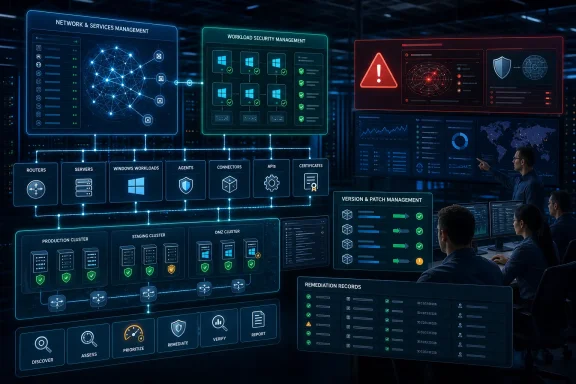 Crosswork scope grew after Cisco’s first advisory
Cisco’s Crosswork advisory originally named Crosswork Data Gateway, Crosswork Network Controller, and Crosswork Planning. On August 21, two days after the initial release, Cisco revised the advisory to add Cisco Crosswork Workflow Manager to the affected products.
That revision changes the practical remediation picture. The three originally named Crosswork products are affected through release 7.2.1 and must move to 7.2.1-SP. Crosswork Workflow Manager has a separate affected range—version 2.1.1 and earlier—and a separate fixed release: 2.1.1-SP.
The supplied reporting, like the Canadian Centre for Cyber Security notice published August 20, reflects the earlier three-product scope. Administrators who based an inventory solely on that first public list could miss Workflow Manager. Cisco’s revised advisory is now the controlling record for affected and fixed versions.
Cisco says Crosswork deployments are vulnerable regardless of device configuration. That wording is important: disabling a feature, restricting a particular integration, or assuming an unused interface is harmless does not remove an affected system from scope. Network segmentation and management-interface access restrictions remain sensible temporary controls, but Cisco explicitly says they do not address the flaws.
The Crosswork release bundles four vulnerability classes:
- CVE-2026-20030 is a SQL injection category with a maximum CVSS score of 10.0.
- CVE-2026-20357 covers missing authentication for critical functions and also scores 10.0.
- CVE-2026-20358 covers external control of the file system, likewise scoring 10.0.
- CVE-2026-20359 covers insufficiently protected credentials and scores 9.9.
Cisco’s advisory does not name the exact endpoints, queries, files, accounts, or workflows behind those categories. That limits the value of trying to decide whether an individual Crosswork deployment is “probably safe” based on its custom setup. The supported conclusion is simpler: update the listed products to their fixed service-pack releases.
Nine CVEs do not equal nine bugs
The most consequential detail in Cisco’s disclosures is its use of one CVE identifier per Common Weakness Enumeration, or CWE, category. Cisco says each CVE may cover multiple internally identified vulnerabilities sharing the same broad weakness type, and the score attached to the CVE is the severity of the most serious underlying issue within that category.
In other words, the nine identifiers across Crosswork and Secure Workload are not a count of nine discrete coding mistakes. They are nine public tracking buckets. A scanner showing nine CVEs should not be read as a full inventory of every corrected code path, component, or defect.
That approach makes sense for a large internal review: it reduces a potentially sprawling set of related defects to a patchable set of public identifiers. It also puts more weight on fixed-version tracking than on exposure triage by CVE description. Cisco has deliberately withheld technical detail that would let administrators map individual flaws to a URL, API, agent, or backend service.
The CVSS presentation deserves the same caution. Both advisories display a 10.0 vector representing the highest-impact case in the respective grouped release. Cisco’s tables then assign maximum scores by CWE grouping. It would be inaccurate to claim every issue in every group has identical conditions or impact. It is accurate to say that Cisco found at least one underlying flaw in several groups capable of meeting the maximum-severity threshold.
Cisco also says both reviews found the issues through existing internal testing processes and frontier AI models. That is a significant disclosure because the company is presenting these releases as the result of systematic hardening rather than a response to a customer-reported breach or a known public exploit. It does not establish that AI found every defect, or that the vulnerabilities were generated by AI-assisted code; Cisco makes neither claim.
Secure Workload customers have a split remediation job
Cisco Secure Workload is affected in both SaaS and on-premises deployments, again regardless of configuration. The software is used for workload visibility, segmentation, and enforcement of security policy across applications and infrastructure, making it a sensitive platform for organizations that use it to map or control east-west traffic.
The five Secure Workload vulnerability categories are:
- CVE-2026-20315, improper access control, has a maximum CVSS score of 10.0.
- CVE-2026-20317, improper authentication, has a maximum CVSS score of 10.0.
- CVE-2026-20231, improper neutralization of special elements, including command, operating-system command, and argument injection, scores 9.9.
- CVE-2026-20318, improper input validation, including path traversal and external path control, scores 9.6.
- CVE-2026-20319, memory-buffer restrictions, including buffer overflow and out-of-bounds writes, scores 7.5.
The fixed releases depend on the installed branch. Secure Workload 3.10 and earlier must be updated to 3.10.9.1; Secure Workload 4.0 must be updated to 4.0.4.16. The Canadian Centre for Cyber Security corroborated those version-to-fix mappings in its August 20 advisory.
Cisco’s Secure Workload notice adds a deployment detail that should drive patch planning: the Cluster, Agent, and Connector software all need upgrades to remediate the complete set of vulnerabilities. This is more specific than treating the advisory as a server-side platform update.
For SaaS deployments, Cisco says it has upgraded the Cluster software, while customers must upgrade their own Agent and Connector software. That means a Cisco-hosted Secure Workload tenant should not be marked remediated solely because the vendor maintains the central service. Teams need to locate customer-managed agents and connectors, confirm their versions, and schedule those updates through the same change-control process used for other production security components.
On-premises customers need to assess all three layers together. A patched cluster paired with unpatched connectors or agents is not the finished state Cisco describes. This is particularly relevant where Windows server workloads use installed agents, where connector virtual machines are owned by another infrastructure team, or where policy administration and application operations are separated organizationally.
Patch the management plane, then review its trust relationships
Cisco says it is not aware of malicious use or public announcements involving these vulnerabilities. That is useful exploitation-status information, but it is not a reason to defer remediation. Once fixed packages are published, researchers and attackers can compare patched and prior builds to investigate the underlying changes—especially where Cisco’s public descriptions are intentionally broad.
The appropriate priority is driven by what these platforms can reach. Crosswork can hold network telemetry, topology information, device-management relationships, and automation workflows. Secure Workload can contain application-dependency data, segmentation policy, connector configuration, and identity integrations. Cisco has not published a confirmed attack chain showing compromise of those assets through these CVEs, so organizations should not assume those outcomes occurred. They should, however, treat exposure in these control-plane systems as higher consequence than a comparable flaw in an isolated application.
During remediation, administrators should preserve an auditable record of the pre-upgrade version, installed components, deployment type, maintenance window, and successful post-upgrade version. For Secure Workload, that record should separately identify Cluster, Agent, and Connector versions. For Crosswork, it should include Workflow Manager rather than treating the 7.2.1-SP update as universally applicable.
Where a system was internet-facing, reachable from a broad administration network, or used by external integrations, security teams should review recent authentication activity, API access, privileged-account changes, unexpected policy edits, and changes to connected service accounts or certificates. Cisco has not supplied indicators of compromise for these advisories, so the review should focus on deviations from normal activity rather than a vendor-provided signature list.
The concrete remediation targets are now clear: Crosswork Data Gateway, Network Controller, and Planning should move to 7.2.1-SP; Crosswork Workflow Manager should move to 2.1.1-SP; Secure Workload 3.10 installations should reach 3.10.9.1; and 4.0 installations should reach 4.0.4.16. For Secure Workload SaaS tenants, Cisco’s cluster update is only part of the work—the customer-managed agents and connectors remain the administrator’s responsibility.