

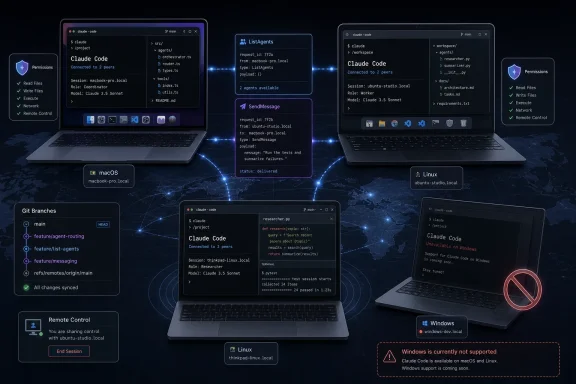
ListAgents for discovering reachable sessions and extends SendMessage beyond the single-session agent-team model, allowing separate terminals and projects to exchange work updates without a developer manually copying context between them.
Glitchwire described the feature as Claude Code sessions being able to “talk to each other,” and that is directionally right. The more precise reading of Anthropic’s own v2.1.224 release record is that this is a cross-machine and cross-session expansion, rather than the first appearance of session-to-session messaging. SendMessage existed in Claude Code’s agent-team workflows before this release, and Anthropic’s June 6 v2.1.166 changelog already documented security hardening for messages relayed between Claude sessions.
That distinction matters for teams deciding whether to redesign their workflows around the feature. The new release removes a meaningful boundary between previously separate Claude Code instances; it does not turn independent agents into a shared-memory system, nor does it eliminate the need to manage source control, permissions, test results, and ownership of code changes.
The actual change is broader reach, not shared context
Anthropic’s release notes say v2.1.224 lets Claude Code sessions “message each other, on any of your machines,” with ListAgents discovering available targets. In practical terms, a Claude Code process working in one repository can tell a separate process working elsewhere that an API changed, a test failed, or a dependency needs updating.
That can reduce a familiar human bottleneck in parallel AI-assisted work. A developer running one agent on a library and another on its consuming application has often had to relay findings manually: copy an error from one terminal, paste it into another, then return later with the result. Claude Code can now carry a targeted handoff itself, provided both sessions are active and discoverable.
The release does not say that sessions receive each other’s live working state, terminal output, filesystem contents, Git state, or complete conversation histories. Glitchwire reports that Claude Code sends a compressed summary rather than raw transcripts, which is plausible and aligns with the need to prevent excessive context growth, but Anthropic’s public v2.1.224 release notes do not spell out the precise payload format or its retention behavior.
For administrators, that omission is more significant than it first appears. A summary is still data crossing a session boundary. If one instance has inspected incident logs, credentials-adjacent configuration, proprietary code, or customer data, the organization needs to know exactly what the model is allowed to summarize and where the receiving session runs. Anthropic has published the feature announcement, but not a detailed data-flow specification alongside it.
Earlier SendMessage support came with a security lesson
The reason this feature should not be treated as simple chat between terminals is that Anthropic has already had to correct a risky assumption in its messaging model.
In v2.1.166, released on June 6, Anthropic said messages sent through SendMessage from one Claude session would no longer carry user authority. Before that hardening, a receiving session could be induced to treat a peer’s request too much like a user-originated instruction, creating a path for what security engineers call permission laundering: one agent fails to obtain approval for an action, then tries to persuade another agent to obtain or execute it.
Anthropic’s fix established a necessary boundary. Receiving sessions now refuse relayed permission requests, and Auto mode blocks them. That means an agent can inform another session that a database migration is ready or ask it to run a test, but it cannot convert a peer message into approval to alter permission settings, bypass a security prompt, or execute an action the receiving session’s own rules would reject.
Version 2.1.224 layers another control on top. Anthropic says outbound SendMessage calls in Auto mode now go through its permission classifier before dispatch. Sessions running with bypassed permissions also receive a new crossSessionInbound setting: messages directed at them are held for approval rather than being silently accepted.
This leaves an important operational split:
- A normal session can send and receive cross-session notices with less friction.
- A session running with bypassed permissions must treat incoming cross-session traffic as an approval event.
- A message never substitutes for the receiving session’s own permission policy or the user’s explicit authorization.
That is the right baseline, though it also means the feature is not a license to run unattended swarms of agents with broad local access. The more capable the handoff path becomes, the more important it is to use separate worktrees, restricted credentials, branch protections, and review gates.
“Any of your machines” is the material new capability
Existing Claude Code agent teams already allowed multiple independent agents to communicate within a coordinated team. Anthropic’s documentation has long distinguished those teams from ordinary subagents: subagents report back to their parent, while team members can communicate directly and coordinate through task management.
The v2.1.224 release changes the topology. A running session is now a potential peer, rather than merely a child process or named teammate created by one current session. ListAgents is therefore more consequential than its utilitarian name suggests: discovery is what allows an agent in one terminal to locate an available Claude Code process somewhere else in the user’s environment.
Anthropic specifically frames the scope as machines belonging to the same user. That wording should be read narrowly. The release notes do not promise an organization-wide directory of developers’ machines, multi-user project messaging, role-based routing, audit controls, retention settings, or centralized administration for the new messaging channel. They also do not state whether messages persist after a target session disappears, how long queued data is retained, or how conflicts are resolved if a named target moves between devices.
Glitchwire says messages are queued when a recipient is busy, cannot be sent to unattended scheduled task runs, and appear as labeled cards linking to the sending session. Those implementation details have not been independently described in the official v2.1.224 notes, so organizations should verify them in a controlled environment before relying on them for incident response or deployment coordination.
The practical implication is straightforward: this is an effective handoff mechanism, not a replacement for durable engineering records. Decisions that matter should still land in a pull request, issue tracker, build log, change record, or commit message. An agent-to-agent summary may keep work moving; it should not become the only evidence of why a production change was made.
Remote Control makes the feature more useful, but does not make it autonomous
The same v2.1.224 release includes several Remote Control fixes, including improvements to compaction progress, connection-failure indicators, session reset propagation, and stale remote-session handling. Remote Control is Anthropic’s mechanism for attaching web, mobile, or desktop clients to a Claude Code session that continues to run in a local environment.
That makes cross-session communication more useful for a developer away from the desk. A user can monitor one session remotely, direct it to contact another session, and later inspect the result without reconstructing every detail in a new prompt. Code execution remains associated with the machine hosting Claude Code; the remote interface is a control and observation surface, not evidence that the phone itself is executing the code.
Still, the “dispatch work from anywhere” pitch has a hard limit: a mobile client does not solve the coordination problems created by multiple agents editing the same files, operating in the same working tree, or consuming the same cloud credentials. Cross-session messages may eliminate copy-and-paste, but they do not serialize commits, arbitrate merge conflicts, or prove that an agent’s report is correct.
For developers using parallel sessions, the safest pattern remains clear: isolate each session in a branch or Git worktree, assign explicit ownership boundaries, let one session review another’s changes, and keep tests and version control as the source of truth. Messaging is best used for findings and requests, not for unreviewed commands.
Windows is excluded at launch
For a Windows-focused audience, the most actionable detail is also the shortest line in Anthropic’s announcement: the new cross-session SendMessage and ListAgents functionality is limited to macOS and Linux. Claude Code itself has been making Windows-specific improvements — recent releases include PowerShell permission fixes and reduced reliance on Git Bash — but that does not extend this feature to Windows in v2.1.224.
Anthropic has not provided a Windows delivery date, a preview channel, or a workaround in the release notes. Administrators with mixed fleets should therefore avoid assuming that a workflow designed around cross-session agent handoffs will behave consistently on Windows developer workstations.
Claude Code 2.1.224 was released on August 7, 2026, not “yesterday” as Glitchwire’s August 7 article states. For Mac and Linux users, the update removes a real coordination chore and extends an existing messaging concept across separate active sessions and machines. For Windows users, it is a feature announcement to watch rather than one they can deploy today.
Update: Cross-session messages reportedly cannot execute Claude Code commands (August 8, 2026)
9to5Mac reports that Claude Code’s cross-session messages deliberately arrive as plain text, even when they resemble built-in commands such as /compact. The receiving session does not interpret those messages as executable commands or configuration changes.
The outlet also says users can provide the substance of a handoff rather than manually composing a message; Claude generates the cross-session summary. That further reinforces that the feature is intended for coordination and context transfer, not remote control of another terminal.
For administrators, the added detail narrows the practical security model: a peer session can communicate a request or finding, but the receiving session must still treat any resulting action under its own command handling and permission rules.
Update: XenoSpectrum reports local-only initiation and WSL 2 support limits (August 8, 2026)
According to XenoSpectrum, same-machine Claude Code sessions communicate through per-session local sockets restricted to the operating-system user, rather than through Anthropic’s servers. The report says this requires both sessions to access the same on-disk registration data, meaning a host session and a session in a separate container cannot discover each other; sessions within the same container can.
XenoSpectrum also reports an important limitation for remote peers: a local Claude Code session reportedly cannot initiate a brand-new cross-machine or web conversation. It can reply to a message it has received, but replies without Remote Control routing information may not support further back-and-forth.
For Windows environments, the outlet says the Linux implementation works under WSL 2, while native Windows remains unsupported. It also reports that the feature is unavailable through Amazon Bedrock, Claude Platform on AWS, Google Cloud Agent Platform, and Microsoft Foundry.
The report further describes configurable inbound handling—accept, hold, or refuse—with held messages reportedly capped at 100. Administrators should treat these details as implementation guidance pending fuller first-party documentation.
Update: Report details enterprise controls and feature-disable conditions (August 9, 2026)
According to pasqualepillitteri.it, cross-session messaging can be disabled by certain privacy or traffic-reduction environment variables, including DO_NOT_TRACK, DISABLE_TELEMETRY, and CLAUDE_CODE_DISABLE_NONESSENTIAL_TRAFFIC. That could explain why ListAgents is unavailable in locked-down or offline-oriented developer environments despite running Claude Code 2.1.224 or later.
The outlet also reports a new isolatePeerMachines setting that requires approval before messages leave the local machine. For organizations that want to disable the capability entirely, it says administrators can deny both SendMessage and ListAgents while setting crossSessionInbound to refuse.
One operational tradeoff is that denying SendMessage reportedly also blocks messaging involving subagents and agent-team peers, not only the new cross-session channel. The report further says delivered messages count toward normal prompt usage, so highly chatty multi-session workflows can add token consumption.