
For developers who use Claude Code from Windows Terminal, PowerShell, VS Code, or a remote shell, this is a meaningful behavioral change. A long-running agent session that previously stopped to request permission for a consequential command will increasingly proceed without the familiar approval dialog, unless Auto Mode’s classifier identifies the action as unsafe or outside the user’s stated intent.
Anthropic’s premise is straightforward: permission prompts became routine enough that many users ceased treating them as a real control. The company’s older March engineering write-up said users accepted 93% of Claude Code prompts. The New Stack now reports a 97% approval rate. The direction is consistent, but the numbers are not directly comparable: Anthropic has not publicly explained the sample period, user cohort, or methodological change behind the four-point difference.
That gap matters because the 97% figure is being used to justify a default change. If almost every prompt is approved, the modal confirmation has become permission fatigue, not meaningful review. But replacing it with a model classifier does not restore a human check; it changes who makes the judgment and what evidence that decision-maker sees.
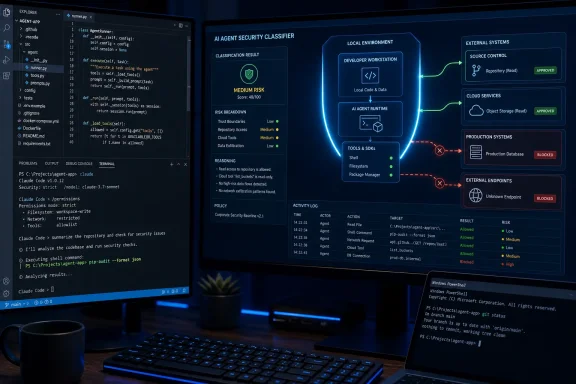 Auto Mode is a security gate, not a quieter approval dialog
Anthropic introduced Auto Mode in March as a middle path between manual approvals and
--dangerously-skip-permissions, the command-line option that gives Claude Code broad autonomy. Its architecture has two layers: a prompt-injection probe that examines tool output before it reaches the main coding agent, and a separate classifier that evaluates consequential actions before they run.
The classifier is deliberately separated from the model doing the coding. Anthropic says it receives the user’s messages and the executable tool call, but not Claude’s natural-language rationale or raw tool output. That design is intended to keep a compromised or overly persuasive agent from talking its way past the safety gate, while reducing the chance that hostile instructions embedded in a repository, webpage, build log, or MCP response can contaminate the approval decision.
The classifier does not inspect every operation. Anthropic’s engineering documentation says read-only operations and edits inside the working project directory can take a fast path without classifier review. Shell commands, external tool calls, web fetches, operations outside the project, and subagent launches are more likely to reach the model-based gate.
That creates the practical boundary administrators need to understand: Auto Mode is primarily designed to constrain actions that cross trust, system, or network boundaries. It is not a review system for every local code change. A Claude Code session can still modify a substantial number of files in a repository without requiring either a human confirmation or a classifier verdict. Version control, branch protections, test gates, and pull-request review remain the controls that catch bad changes within the project tree.
For Windows users, that distinction has widened since Anthropic added native PowerShell support rather than requiring Git Bash. Claude Code can now operate through the Windows shell environment where developers keep
gh,
az,
kubectl, package managers, deployment tooling, and authenticated cloud CLIs. Auto Mode is meant to reduce friction in precisely those environments, but the impact of a mistaken approval can be larger than an erroneous edit to a local TypeScript file.
The new hard-deny rules address the clearest failure cases
The most consequential reported addition is a category of hard denies: actions the classifier should never permit in Auto Mode, even if the agent asks for them. The New Stack says Anthropic has focused those rules on data exfiltration, including attempts to send code or secrets to an external destination.
Anthropic’s earlier technical account supports the broader direction. Its default policy was already designed to block destructive behavior, security-posture degradation, actions across an untrusted boundary, direct changes to shared infrastructure, and attempts to bypass safeguards. It specifically identified risky patterns such as force-pushing history, scanning for credentials after an authentication error, public sharing through a GitHub Gist, and retrying deployment commands with verification disabled.
The important operational improvement is context. A
git pushis not inherently suspicious; sending a branch to the organization’s private GitHub repository is ordinary work, while pushing it to an unknown public remote can be an exfiltration event. The New Stack reports that the updated classifier checks whether a push or pull-request destination is public, private, or trusted. It also reports that the system examines Git status before destructive commands such as
git reset --hard, so it has context on uncommitted work that could be discarded.
Those are the right categories to protect, but they depend on correct trust-boundary configuration. Anthropic’s own documentation says Auto Mode defaults to trusting only the repository currently being worked on, with users able to designate trusted GitHub organizations, cloud buckets, and internal services. A poorly configured trust list can turn routine internal automation into repeated blocks—or, worse, treat a destination as safe when it is not.
The product’s existing hard-deny support is also configurable. Claude Code’s release notes document
settings.autoMode.hard_denyrules that block matching actions regardless of broader allow exceptions. Teams should use that capability for organization-specific red lines: production subscriptions, credential stores, regulated-data exports, destructive cloud commands, protected branches, and deployment targets that must always require a separate controlled workflow.
The safety results require careful reading
The New Stack reports that, in tests with more than 1,000 participants, humans identified 13.6% of dangerous commands while Auto Mode caught 89%; after 50 prompts, participants reportedly detected only 5%. Those results make a strong case against asking developers to act as alert-button operators through a lengthy session.
But those figures should not be read as evidence that Auto Mode is 89% safe in real production work. They describe a particular testing framework and a particular definition of “dangerous command.” Anthropic’s March technical report used a different evaluation set and reported a 17% false-negative rate on 52 real “overeager” actions—the cases where an agent tried to perform something dangerous beyond the user’s authorization. Anthropic plainly said then that Auto Mode was an improvement over bypassing permissions, but not a drop-in replacement for careful review of high-stakes infrastructure.
The apparent conflict is not necessarily a contradiction. A detection-rate figure from a controlled user study, a false-negative rate from a small set of real internal incidents, and a post-hardening red-team miss rate are different measurements. They answer different questions. The vendor’s newer numbers may show genuine progress, but they do not erase the limitation documented in its own original design paper: the classifier can recognize that an action is dangerous yet still make the wrong call about whether the user authorized that particular blast radius.
Apollo Research independently confirms that it ran an external red-teaming pilot against Anthropic’s Auto Mode in real coding trajectories with injected attacks. Apollo says the exercise led to recommendations Anthropic implemented, and identifies user authorization, trust boundaries, intervention timing, and monitor visibility as unresolved design tensions. That is useful corroboration that the system was tested outside Anthropic, though it is not an independent certification of the rollout’s safety claims.
Blocked actions change the workflow instead of simply stopping it
Auto Mode’s response to a blocked command is also central to how it will behave in practice. Rather than opening the old approval prompt, it blocks the action and gives Claude a chance to find a safer route. If the agent is blocked three times consecutively, or 20 times during a session, the system reportedly hands control back to the user and returns to manual approvals.
This safeguard prevents an agent from endlessly trying variations of a prohibited command. It also means a long unattended task can unexpectedly turn into a stalled manual-review session after reaching the block threshold. Teams running overnight refactors, repository migrations, or broad test-and-fix loops should expect that behavior and plan for it rather than assuming Auto Mode guarantees end-to-end autonomy.
The policy also changes the role of a permission prompt. In manual mode, users might have treated every shell command as a chance to inspect what Claude was doing. In Auto Mode, that passive review point disappears. If a team relied on the prompts as informal stage gates before tests, package installation, Git pushes, or deployment tooling, it needs to recreate those checkpoints explicitly with branch protections, CI policy, narrow
askrules, hooks, or a move to Plan Mode for sensitive work.
Anthropic’s own permission documentation makes the contrast clear:
bypassPermissionsapproves broadly and should be used only in controlled environments, while Auto Mode is classifier-mediated. Neither setting changes the need for least-privilege credentials on the workstation or runner. A local Claude Code session with an overpowered GitHub token, cloud subscription, Kubernetes context, or deployment credential remains dangerous even if its agent is monitored.
Parallel session messaging increases the need for clear boundaries
Anthropic also announced that parallel Claude Code sessions can now send each other summaries. According to the company’s ClaudeDevs account, the handoff sends a summary rather than the complete conversation history or local files, allowing one agent session to inform another about related work.
That feature can reduce duplicated investigation when several agents work on one codebase, but it has a security consequence: more agent coordination can mean a larger effective task scope. A session that appears isolated at the terminal may now receive context generated elsewhere and continue work based on another agent’s conclusions. The Auto Mode classifier may still assess each tool call, but its authorization logic is only as good as the user’s original instructions and the trust boundaries the deployment defines.
For personal projects and disposable development environments, the August 14 default should make Claude Code materially less interruptive than manual permissions and much safer than routinely enabling
--dangerously-skip-permissions. For Team users, it should trigger an audit before the rollout: review effective Auto Mode settings, remove broad shell allow rules, establish hard-deny policies for production and secret-bearing systems, and verify that CI and branch protections—not terminal prompts—are carrying the review burden.
The concrete change on August 14 is that Claude Code will increasingly decide when it is safe to act. Organizations that have not defined what their agents must never touch are delegating that definition to Anthropic’s classifier by default.
Update: Anthropic reportedly drops Auto Mode’s classifier token surcharge (August 8, 2026)
According to iThinkDiff, Anthropic is removing the additional token charge previously associated with Auto Mode’s per-tool-call classifier checks. That would eliminate a direct usage-cost tradeoff for Pro, Max, and Team users as Auto Mode becomes the default on August 14.
The outlet also reports more specific results from Anthropic’s Apollo Research red-team work: the classifier initially missed 12% of synthetic attacks in real workflows, falling to 7% after added protections. If accurate, that clarifies the extent of the post-testing hardening—but remains a vendor-reported result rather than an independent safety certification.
iThinkDiff further says Anthropic’s commissioned Trajectory Labs evaluation found no successful attacks among 720 attempts against Claude Code in Auto Mode. The comparison with Codex should be treated cautiously because configurations and test design materially affect such results.
Update: Anthropic claims Auto Mode increased pull-request output by 25% (August 8, 2026)
The Decoder reports that Anthropic’s testing found teams using Auto Mode generated roughly 25% more pull requests, alongside the company’s safety comparisons with manual approvals. If the figure holds across normal production workflows, the default rollout could increase both agent throughput and the volume of code requiring CI and human review.
The outlet also relays two internal Anthropic examples of the classifier intervening: blocking an attempted upload of confidential data to a public destination, and stopping a long-running session from terminating about 2,000 processes that could have interrupted GPU training. These are vendor-described incidents, not independently verified incident reports, but they illustrate the operational failures Auto Mode is intended to catch.
For Windows developers and IT teams, more completed agent work does not necessarily mean more safely completed work. Faster pull-request creation raises the importance of protected branches, automated tests, code owners, and constrained credentials—especially where Claude Code can access cloud, Git, or deployment tooling.
References
- Primary source: thenewstack.io
Published: August 7, 2026 at 9:42 PM UTC
- Related coverage: code.claude.com
Claude Code changelog - Claude Code Docs
Release notes for Claude Code, including new features, improvements, and bug fixes by version.code.claude.com - Related coverage: thenewstack.io
- Related coverage: anthropic.com
How we built Claude Code auto mode: a safer way to skip permissions \ Anthropic
Anthropic is an AI safety and research company that's working to build reliable, interpretable, and steerable AI systems.www.anthropic.com - Related coverage: support.anthropic.com
Claude Code model configuration | Claude Help Center
support.anthropic.com
- Related coverage: docs.anthropic.com
- Related coverage: claude.com
Product announcements Category | Blog | Claude by Anthropic
The latest Claude news from Anthropic: product announcements, model releases, and feature updates across Claude, Claude Code, and the Claude Platform.claude.com
- Related coverage: setup-code.com
- Related coverage: dl.thenewstack.io
- Related coverage: code.claude.com
Week 19 · May 4–8, 2026 - Claude Code Docs
Load plugins from .zip archives and URLs, search command history across every project with Ctrl+R, branch new worktrees from local HEAD or the remote default, and block actions unconditionally with auto mode hard deny rules.code.claude.com - Related coverage: claude.com
Claude Code by Anthropic | AI Coding Agent, Terminal, IDE
Anthropic's agentic coding tool for developers. Claude Code understands your codebase, edits files, runs commands, and helps you ship faster.claude.com - Related coverage: github.com
qwen-code/docs/users/features/approval-mode.md at main · QwenLM/qwen-code · GitHub
An open-source AI coding agent that lives in your terminal. - qwen-code/docs/users/features/approval-mode.md at main · QwenLM/qwen-code github.com
- Related coverage: dev.to
ccgate: Delegate Claude/Codex permission prompts to an LLM (~97% automated for me) - DEV Community
An OSS CLI that delegates permission prompts in Claude Code / Codex CLI to a separate LLM. The LLM returns allow / deny / fallthrough — ~97% of prompts get resolved automatically in my own setup. Tagged with claudecode, ai, opensource, claude.dev.to - Related coverage: github.com
Releases · luongnv89/claude-howto · GitHub
A visual, example-driven guide to Claude Code — from basic concepts to advanced agents, with copy-paste templates that bring immediate value. - Releases · luongnv89/claude-howto
github.com
- Related coverage: datacamp.com
Claude Code Auto Mode and Channels: Build Code From Anywhere | DataCamp
Learn how to pair Claude Code Auto Mode with Telegram Channels to run an autonomous write-test-debug loop from your phone. www.datacamp.com
- Primary source: iThinkDifferent
Published: August 8, 2026 at 12:19 AM UTC
- Primary source: the-decoder.com
Published: August 8, 2026 at 2:58 PM UTC