
The profile centers on a compressed February in which Anthropic released Claude Cowork and Claude Opus 4.6, completed a $30 billion funding round at a reported $380 billion valuation, and entered a public confrontation with the Pentagon over restrictions on autonomous weapons and mass domestic surveillance. The individual events are well documented by Anthropic, the Associated Press and Sensor Tower. What Forbes’ short entry leaves out is that its claims describe very different kinds of success: a funding valuation, a temporary U.S. mobile-app ranking, vendor-reported revenue, and a product whose practical risk rises sharply when it is allowed to act inside company files and connected tools.
For Windows admins and IT teams, that distinction should shape how Anthropic’s AI 50 moment is read. The arrival of Cowork on Windows turns this from a model-selection story into an endpoint, identity, permissions and auditability story.
 Forbes’ AI 50 Is a Curated List, Not a Ranking of Model Quality
Forbes released the 2026 AI 50 on April 16, 2026, describing it as a list of privately held companies applying AI to real-world business problems. The page currently carrying Anthropic’s profile may have been published or refreshed on August 8, but the underlying list is not a new August ranking. That date mismatch is worth making explicit, because a reader could reasonably interpret the page timestamp as a new market judgment when Forbes’ own announcement dates the list to April.
The selection process is also less detached than the phrase “Top Artificial Intelligence Companies” suggests. Forbes says candidates can provide confidential figures on revenue, valuation and fundraising; it also says the initial screen uses a proprietary algorithm developed by Sequoia partner Konstantine Buhler, followed by review from a panel that includes venture investors. Forbes publishes conflict disclosures and says judges with financial stakes are recused from evaluating relevant candidates. That is better disclosure than many startup lists provide, but it still means the AI 50 is an editorially curated venture-and-growth list, rather than an audited financial index or reproducible technical benchmark.
This does not invalidate Anthropic’s inclusion. It clarifies what it proves: Anthropic passed Forbes’ assessment as one of the most compelling private AI businesses, based partly on information the public cannot inspect. It does not establish a definitive ordering among Anthropic, OpenAI, Mistral, or any other featured company, and it does not independently validate each operating number printed in a company capsule.
Anthropic’s $380 billion valuation is separately supported by Forbes’ February reporting on its $30 billion fundraise. The profile’s statement that revenue “hit $4.5 billion last year,” however, carries no definition: it does not say whether that means recognized revenue, annual recurring revenue, or an annualized run rate. That is a material omission in an industry where those terms are routinely conflated. Anthropic is private and has not published audited annual financial statements, so the figure should be treated as Forbes-reported company data, not a verified revenue result.
Claude Cowork Turns the Headline Into an Enterprise-Control Issue
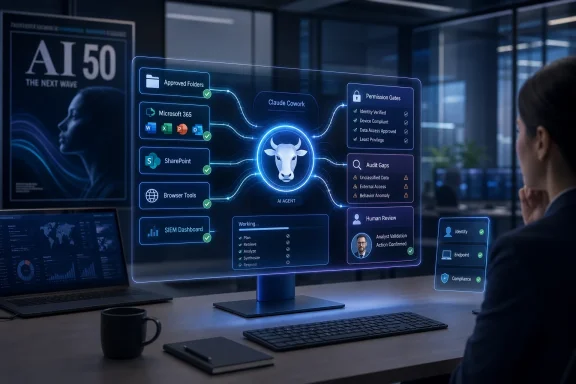
Anthropic describes Claude Cowork as a system that takes a goal, works across files and approved tools, and returns a result for review. Its current product page advertises Windows downloads for x64 and Arm64 machines, alongside macOS, ChromeOS and Linux support. It can schedule recurring work, split projects into parallel tasks, use browser-based workflows and interact with connected services including Microsoft 365.
That is a different operating model from an employee pasting a document into a chatbot and copying an answer into Word or Excel. Cowork is designed to access folders and connectors, create files, build spreadsheets, analyze notes and assemble reports. Its own examples include reconciling regional financial exports against budget workbooks, preparing recurring marketing presentations from connected data, and producing contract-review memos from an internal legal playbook.
The implication is straightforward: a productive deployment requires the same control discipline an organization would apply to any automation account with access to SharePoint, OneDrive, Teams-connected information, local folders, browser sessions or business applications. A Windows endpoint running Cowork can become the place where broad data access, delegated action and generated work product meet.
Anthropic says users select the folders and tools Cowork can reach, that deletion requires approval, and that organizations can configure permissions so Claude presents a plan and waits before significant actions. Those are useful controls, but they are not a substitute for a deployment design. Permission prompts can prevent a destructive action; they do not resolve whether the agent should have been granted access to a contract repository, finance folder or Microsoft 365 tenant in the first place.
For organizations evaluating Cowork because of the attention surrounding Anthropic’s Forbes profile, several controls deserve attention before a broad rollout:
- Restrict Cowork to approved Microsoft 365 groups, SharePoint sites and purpose-built working directories rather than letting employees connect personal or department-wide stores by default.
- Treat scheduled, unattended work as higher risk than interactive chat because it can run after the initiating user has left the device and may process data repeatedly.
- Require human review before generated spreadsheets, contract analyses, code changes or reports enter a production decision process, even when the task completed without an obvious error.
- Test whether endpoint DLP, conditional access, eDiscovery, retention and incident-response workflows actually capture the artifacts and actions created through Cowork’s connectors.
Anthropic says Enterprise administrators can manage team access, tool permissions and spending limits, while activity can be sent to a SIEM through OpenTelemetry. The same product page states that Cowork activity is not yet captured in audit logs or the Compliance API. That is the operational detail missing from the Forbes profile, and it should matter more to IT than an app-chart spike. Streaming activity to a SIEM can be valuable, but it is not automatically equivalent to having the native audit, investigation and compliance interfaces an organization may already rely on for Microsoft 365 administration.
Opus 4.6’s Coding Claims Need a Change-Control Boundary
Anthropic released Claude Opus 4.6 on February 5 and positioned it as a stronger model for agentic coding, code review, debugging, long-running tasks and large codebases. The company says the model is available through Claude, its API, Amazon Bedrock, Google Cloud Vertex AI and Microsoft Foundry. Its listed API pricing remained $5 per million input tokens and $25 per million output tokens.
The technical promise is attractive to Windows-heavy development organizations. Anthropic says Opus 4.6 can use a beta one-million-token context window and work through longer task chains with tool use and subagents. For a development team maintaining large .NET repositories, Windows services, PowerShell automation or configuration-management code, this expands the feasible scope from code completion toward issue triage, refactoring proposals, test generation and repository-wide analysis.
But “long-running” and “autonomous” are the words that should trigger a control review. A coding agent able to navigate a large repository and call tools can accelerate maintenance; it can also produce a polished but incorrect change across many files, expose secrets through an over-permissive tool chain, or alter infrastructure scripts that appear harmless until a deployment window. Anthropic’s own product messaging emphasizes the model’s ability to carry out multi-step work. Teams should decide precisely where that capability ends.
A sensible first deployment boundary is read-only repository analysis, pull-request review, test drafting and isolated development sandboxes. Automated merges, access to production credentials, changes to Group Policy, Intune configuration, Active Directory automation or cloud identity policies should remain outside an agent’s authority unless the organization has tested clear rollback, review and logging paths. The useful question is not whether Opus 4.6 can generate the command; it is who can approve it, identify its data inputs and reverse its effects.
The App Store Claim Was Real but Narrower Than Forbes Makes It Sound
Forbes says Claude surpassed ChatGPT in February to become the most downloaded app on the App Store. Sensor Tower and Associated Press reporting support the central event, but the wording compresses its scope.
Sensor Tower says Claude reached the top spot in the U.S. Apple App Store on Saturday, February 28, and that Claude outpaced ChatGPT in U.S. downloads on March 2 for the first time in its history. AP similarly reported that Claude became the most popular iPhone app beginning that Saturday and led U.S. phone-app downloads the following Monday. This was a sharp, significant consumer reaction around the Pentagon dispute and OpenAI’s defense arrangement, not evidence that Claude had permanently overtaken ChatGPT globally.
Sensor Tower’s own figures underline the scale difference: it estimated ChatGPT’s mobile audience was still roughly 60 times larger than Claude’s when the surge occurred. The right reading is that Anthropic converted a political and safety-policy controversy into a major U.S. consumer acquisition event. It is not a settled reversal of the broader consumer AI market.
The Pentagon episode also did not simply make Anthropic a heroic outsider. Associated Press reporting found that the dispute centered on Anthropic’s attempt to preserve contractual restrictions on mass domestic surveillance and fully autonomous weapons. After the company refused, the administration ordered federal agencies to stop using Anthropic technology and initiated a six-month Defense Department phase-out for systems where it was already embedded. That leaves a practical commercial consequence alongside the reputational boost: a company celebrated in consumer downloads and venture valuation lost access to a major class of federal work.
Anthropic’s AI 50 entry captures why the company matters in 2026. It does not capture the full cost of the product shift it represents. For IT leaders, the relevant milestone is not that Claude was briefly above ChatGPT in a U.S. App Store chart, nor that Forbes featured the company in an unranked annual list. It is that Claude Cowork is now being sold as a Windows-capable agent that can work across files, tools and connected services—and its most important governance trail is still not available through Anthropic’s native audit logs or Compliance API.
References
- Primary source: Forbes
Published: August 8, 2026 at 10:20 PM UTC
Forbes 2026 AI 50 List | Top Artificial Intelligence Companies
The Forbes 2026 AI 50 List spotlights the most promising artificial intelligence businesses. See the leaders driving the future of AI. www.forbes.com
- Related coverage: forbes.com
Forbes Unveils 2026 AI 50, Marking Shift From AI Dominance To AI Independence
Forbes today released its 2026 AI 50 list, highlighting a clear shift in the artificial intelligence race: success is no longer just about building the most powerful model, but about who controls it, how it’s used and what it costs to run.www.forbes.com