
The June 29 post by an account calling itself John Doe linked to a document titled “Fandom Has a Hidden Generative A.I. Problem.” Its stated aim was disclosure rather than harassment, but its circulation produced the opposite result: readers began treating the document as a public ledger of compromised work, with some describing it as the “fan fiction Panama Papers.”
That label is exaggerated, but it captures the force of the disclosure. This was not another argument over em dashes, florid prose or a suspected ChatGPT cadence. The account’s central claim was that Claude could leave a specific HTML class behind when its output was pasted directly into Archive of Our Own’s editor. If true, that is a narrow but materially different kind of evidence — an artifact of a particular workflow rather than an inference from a writer’s style.
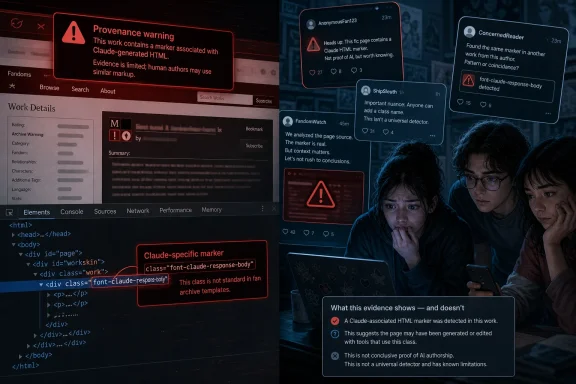 A CSS Class Became a Community-Wide Alarm
The technical indicator at the center of the conflict is font-claude-response-body, a class reportedly applied to text copied directly from Claude in certain circumstances. The @heatedrivalryai account published an AO3 site skin designed to scan a work page for that marker and turn the page red when it found one.
The Verge independently tested the mechanism and reported that the skin could flag text pasted directly from Claude into AO3, while identical text that had passed through another editor did not trigger the warning. That makes the tool more concrete than commercial AI detectors, which try to infer authorship from probabilistic patterns in the writing itself.
But it also makes it far less sweeping than the social-media reaction suggested. The marker is evidence of a direct copy-and-paste path, not a universal AI detector. It cannot identify Claude text that was copied into Word, Google Docs or a plain-text editor before reaching AO3. It cannot identify output from another model. And it cannot tell readers how much of a story was generated, edited, rewritten, brainstormed or merely proofread with AI assistance.
The distinction matters because “Claude was used somewhere” is not the same claim as “this entire work was generated by Claude.” A visible source-code remnant may settle one limited factual point while leaving the creative and ethical question — what kind of assistance occurred, and whether it should have been disclosed — unresolved.
The Fight Escaped the Archive’s Own Rules
Archive of Our Own, operated by the Organization for Transformative Works, does not ban AI-assisted or AI-generated fanworks outright. In its terms-of-service guidance, AO3 says it encourages creators to use tags such as “Created Using Generative AI” or “AI-Generated Text,” while acknowledging that it cannot reliably enforce a universal disclosure rule.
That position is less permissive than it may first appear. AO3 draws a sharp line against commercial scraping of its archive for generative-AI training and says AI-created material may still violate plagiarism or copyright rules if it reproduces other work. It also treats a rapid flood of machine-generated posts as potential spam.
Yet the archive’s practical policy is designed around a principle that the Heated Rivalry backlash has challenged: platforms should not remove a work merely because users suspect AI involvement. AO3’s policy team has argued that detection tools are unreliable and that punishing legitimate work on suspicion would undermine an archive built to preserve fan expression, including imperfect and unpopular expression.
The Claude HTML marker complicates that premise without eliminating it. Unlike a classifier score, the marker is inspectable. A technically minded reader can view a work’s page source, search for the string and see whether it exists. The skin merely automates that inspection and makes the result visually unavoidable.
But automating a check is not the same as automating a fair judgment. A page turning red reduces a complicated evidence trail to a binary social signal: clean or contaminated. For a fandom already primed to see AI use as a betrayal of volunteer creativity, that kind of interface can become an accusation engine.
Disclosure Is the Demand; Punishment Became the Result
The document reportedly asked fans not to bully or ostracize the writers named in it. That appeal did not hold. According to the Times, some authors faced waves of comments and scrutiny, while others deleted accounts, restricted access to their stories or took work offline.
Fanlore, a community-run documentation project, has tracked the dispute as part of a broader pattern of AI accusations and harassment in the fandom throughout 2026. Its chronology includes arguments over automated detection, public annotations of stories, hostile comments and authors putting works on hiatus. That context is important: the June disclosure did not invent the conflict. It gave existing distrust a tool, a vocabulary and a target list.
For writers, the problem is not merely reputational. Fan fiction is often published under pseudonyms, with an expectation that an author can experiment, learn or write imperfectly without the professional consequences attached to commercial publishing. Publicly tying a pseudonym to alleged deceptive AI use can collapse that boundary, particularly when callouts migrate from AO3 comments to platforms optimized for pile-ons.
The result is an uncomfortable inversion. Communities seeking to defend human creativity can create conditions under which human writers stop publishing, especially newcomers, multilingual authors and writers whose style is already treated with suspicion. The Authors Alliance, writing about the controversy in July, noted that the simple marker check was being conflated with broader claims of AI detection and warned about the pressure placed on writers to “prove” human authorship.
That is not an argument for hiding AI use. It is an argument that disclosure systems need a process — a way to distinguish evidence, explain scope, let creators respond and prevent readers from turning an uncertain or partial finding into a license for harassment.
Why AI Detectors Remain the Wrong Comparison
The Heated Rivalry episode has been widely described as an AI-detection controversy, but the most interesting part is that it is not really about detection in the usual sense. Conventional tools such as Turnitin’s AI-writing indicator or standalone detector services estimate whether text resembles model output. Their conclusions are statistical and have drawn repeated criticism for false positives, particularly involving formulaic writing or non-native English.
The AO3 skin does something more like digital forensics. It searches for a known string left in rendered HTML. That can be a reliable finding about the presence of that string. It is not inherently reliable evidence about provenance beyond the narrow workflow that created the string, and it says nothing about every other work that does not contain it.
For IT professionals, the parallel is familiar. A log artifact can prove that a particular event was recorded by a particular system; it does not prove every surrounding claim an investigator may make. Good incident response separates observation, attribution and impact. Social media does not.
That separation should have been central to the conversation:
- A Claude-specific class can indicate that text was pasted directly from Claude into an AO3 editor.
- Its absence cannot demonstrate that no generative AI was used.
- Its presence does not quantify the amount of AI-written text or establish that the author misrepresented the work.
- A platform-level warning color is not a moderation finding, a plagiarism ruling or proof of a policy violation.
Those limits do not make the finding meaningless. They make it usable only when the community resists the temptation to turn it into more than it is.
The Real Product Gap Is Provenance, Not Policing
The immediate controversy will fade, but the underlying gap will not. Readers who want human-only work need a trustworthy way to filter for it. Writers who use AI for brainstorming, grammar correction, translation, outlining or generated prose need a vocabulary that distinguishes those practices. Platforms need disclosure options that do not require them to pretend they can inspect every work accurately.
AO3’s recommended freeform tags are a start, but voluntary tags only work when users believe disclosure will lead to informed choice rather than exile. The Heated Rivalry reaction demonstrated why writers may fear being candid: once AI use becomes a moralized binary, a small admission of assistance can be received as proof that an author’s entire body of work is fraudulent.
Anthropic, meanwhile, has an incentive to consider how its product exports text and whether persistent formatting artifacts serve users well. The Claude marker made a hidden workflow visible, but it did so without context, consent or a built-in explanation of what the marker can and cannot establish. A provenance feature designed for accountability should clarify the boundaries of its evidence, not leave a fandom to reverse-engineer them during a public dispute.
For now, the red AO3 pages are a reminder that technical evidence can be both real and incomplete. The next flashpoint will depend less on whether another marker is found than on whether platforms and communities can build a disclosure culture that does not turn every metadata trace into a public trial.
