
The more meaningful change is scope. When Microsoft first added Anthropic models in September 2025, Claude was limited to the Researcher agent and Copilot Studio after an administrator opted in. Opus 5 moves Claude into the everyday surfaces where Microsoft 365 customers draft documents, analyze spreadsheets, build decks, chat over company information, and run long-lived agent tasks. Microsoft now positions model selection as part of the product rather than a narrow Frontier experiment.
For IT teams, the immediate question is not whether Claude is available. It is whether it has been enabled for the tenant, which users can invoke it, where their data is processed, and whether a premium reasoning model is worth the added operational and financial complexity.
 Claude Opus 5 Reaches the Main Copilot Picker
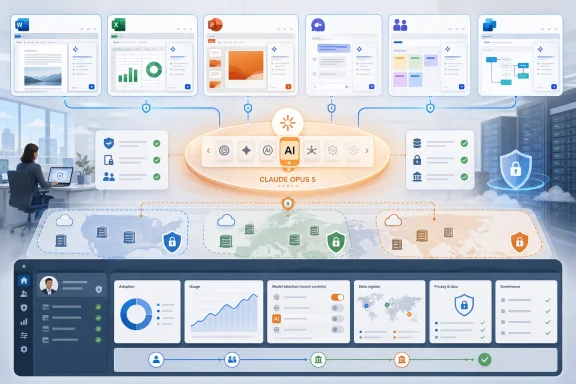
Microsoft says Claude Opus 5 is rolling out through the model selector in Copilot in Word, Excel, and PowerPoint, along with Copilot Chat, Copilot Cowork, and Copilot Studio. The company’s intended use cases are consistent across those products: longer documents in Word, complex workbook analysis in Excel, presentation drafting in PowerPoint, ambiguous planning work in Chat, multistep projects in Cowork, and tool-using agents in Studio.
The practical distinction is that this is a choice of model inside Microsoft’s Copilot workflows, not a replacement of Microsoft 365 Copilot with Anthropic’s standalone Claude service. Users remain in Microsoft’s application surfaces, with Microsoft handling retrieval of organizational context such as files, mail, meetings, and sites according to the permissions already assigned to the signed-in user.
That does not mean Claude has appeared in every Microsoft productivity experience. Microsoft’s July announcement names six Copilot surfaces. It does not promise Opus 5 in Outlook, Teams, OneNote, Windows Copilot, GitHub Copilot, or every agent and feature branded Copilot. “Across Copilot apps” is a useful shorthand, but administrators should treat the named application list—not the headline—as the actual deployment scope.
Microsoft also warns that availability varies by region and tenant configuration. A user who does not see Opus 5 in a selector may be encountering a rollout delay, an administrator policy, licensing limits, or a region-specific restriction rather than a client installation problem.
The Admin Switch Matters More Than the Model Menu
Microsoft’s documentation makes clear that Anthropic models are a tenant-level governance decision. Administrators can enable or block Anthropic reasoning models through the Microsoft 365 admin center. If the provider is disabled, users lose access to the related model options and, in some cases, Microsoft-installed Word, Excel, and PowerPoint agents that exclusively use Anthropic models.
This is different from letting an employee independently sign up for a consumer AI service and paste corporate material into it. Starting January 7, 2026, Microsoft says Anthropic operates as a subprocessor for these Copilot capabilities under Microsoft’s direction and contractual safeguards. Microsoft says the arrangement is covered by its Product Terms, Data Protection Addendum, Enterprise Data Protection, and Customer Copyright Commitment.
The important limitation is still easy to miss: Anthropic models are currently excluded from Microsoft’s EU Data Boundary and, where applicable, from in-country or in-region processing commitments. Organizations whose AI policies depend on data staying within those geographic boundaries should not assume the Copilot branding resolves that issue. They need to assess Claude separately from Microsoft-hosted model choices.
Microsoft says it performs the search across Microsoft 365 first and passes only relevant context to the reasoning model. It also says sensitivity labels and compliance policies are respected, while generated Word, Excel, and PowerPoint files remain stored in the organization’s OneDrive tenant. Those controls reduce the risk of indiscriminate data exposure, but they do not remove the need to review what kinds of content users may prompt against an externally hosted reasoning provider.
A sensible pilot should use a small, representative user group and prohibited-data rules already familiar to the organization. Test the same permitted work tasks with the default Copilot choice and with Opus 5, then compare accuracy, grounding, output quality, time spent correcting drafts, audit visibility, and cost. A model should earn broad availability through repeatable results, not because it has a stronger reputation for reasoning.
Copilot Cowork Adds a Usage-Cost Decision
Claude Opus 5 has a different implication in Copilot Cowork, Microsoft’s agentic environment for longer-running work across files, tools, and organizational data. Cowork is generally available to Microsoft 365 Copilot customers, but it is not simply included in the fixed per-user Copilot subscription. Microsoft bills Cowork usage separately in Copilot Credits, based on model use, context retrieval, tool calls, and runtime.
That pricing matters when a user chooses a frontier model for work that can run across multiple sources and take longer than a typical chat prompt. Microsoft’s own June Cowork announcement said the service launched using Anthropic Opus 4.8 and Sonnet 4.6, with model choice available in Frontier. The Opus 5 update extends the high-end option, but it does not make the cost of a complex agent run predictable just because the employee already has a Microsoft 365 Copilot license.
Microsoft has published cost-management features including tenant, group, user, and task-level usage visibility, as well as spending limits and budget allocation. Those should be configured before broad Cowork access is enabled. The operational risk is not an unexpectedly expensive one-off prompt; it is hundreds of employees treating long-running agent tasks as if they carry the same cost profile as ordinary Copilot Chat requests.
For departments planning document-generation or research workflows, create a model policy that states when users should select Opus 5, when a faster model is sufficient, and which tasks require human review before an output reaches customers, finance, legal, or leadership. Model selection without a usage policy becomes a support burden quickly.
Copilot Studio Is Still the Least Mature Part of the Rollout
Copilot Studio is the most consequential surface for administrators because it lets organizations build agents rather than merely choose a model for personal productivity work. Microsoft says Claude Opus 5 can power advanced reasoning, workflow automation, and multistep tool use in Copilot Studio’s preview orchestrator.
The word preview should govern deployment decisions. A Claude-powered agent that can reason across enterprise knowledge and invoke tools may be useful, but it also needs the same scrutiny as any other workflow automation: least-privilege access, approved connectors, clear ownership, auditing, retention, test data, and a defined process for handling bad actions or incorrect conclusions.
Microsoft’s 2025 launch described Copilot Studio as a place where organizations could mix Anthropic, OpenAI, and Azure Model Catalog models across specialized tasks. Opus 5 reinforces that direction. The product is becoming a routing and orchestration layer where the enterprise may use more than one model, rather than a single assistant whose underlying model is largely invisible.
That creates a new administrative inventory problem. Security and platform teams need to know which agents use Anthropic models, what information they can retrieve, which actions they can take, and whether their deployment geography satisfies internal policy. Existing Copilot governance controls are helpful only if organizations update their agent review process to account for provider-level differences.
Microsoft Has Made Model Choice a Normal Copilot Feature
Microsoft’s July 9 announcement that GPT-5.6 would become the preferred model across Word, Excel, PowerPoint, Chat, and Cowork shows that OpenAI remains deeply embedded in Microsoft 365 Copilot. The addition of Opus 5 two weeks later is not evidence that Microsoft is abandoning OpenAI. It is evidence that Microsoft is making the underlying model a visible product decision for customers.
Anthropic itself has also expanded Claude’s independent presence in Office. In May, it announced Claude add-ins for Excel, PowerPoint, and Word, plus an Outlook public beta, available through paid Claude plans. Those add-ins are separate from selecting an Anthropic model within Microsoft 365 Copilot. The distinction matters for procurement, identity, data handling, telemetry, and support: the same employee may be able to access “Claude in Office” through two very different commercial and governance paths.
For Windows and Microsoft 365 administrators, Opus 5 should be treated as an expanded Copilot provider option with specific coverage—not as a blanket Claude integration across everything Microsoft sells. Verify the model menu in the intended tenant, review the Anthropic subprocessor and geographic-processing terms, establish Cowork spending controls, and keep Studio agents in a controlled pilot while they rely on the preview orchestrator.