
Agentic workflows built around yesterday’s large language models may need more than a model-picker change when teams move to newer systems such as Anthropic’s Claude Opus 5 or Fable 5. The transaction logic behind a support bot, service desk agent, or customer-experience workflow may remain deterministic, but the model’s judgment about when to invoke that logic can change materially.
That is the central warning in a new analysis from Opus Research, which argues that smarter models are beginning to outgrow the extensive prompt scaffolding enterprises added to compensate for less capable predecessors. The risk is not that an API integration suddenly stops working. It is that the behavior around the API—asking for more information, selecting a tool, retrying after an error, deciding whether authentication is sufficient, or declaring a task complete—no longer matches the assumptions embedded in an existing agent.
For Windows administrators and IT teams, this is a familiar operational pattern dressed in AI terminology. A dependency upgrade can preserve every endpoint and configuration file while changing defaults, performance characteristics, and edge-case behavior. Agentic AI makes that principle more consequential because the dependency is also the reasoning layer deciding how a workflow proceeds.
The easiest enterprise AI deployments are still relatively insulated from model churn. A model that classifies a ticket, summarizes a Teams meeting, extracts an order number, or drafts a reply can often be swapped for a more capable alternative with limited user-visible disruption. In many cases, a smaller and less expensive model remains the rational choice for narrow, well-defined tasks.
The calculation changes for agentic workflows: systems that gather context, choose among tools, run multiple steps, and adapt when something goes wrong. A returns agent, for example, might look up an order, validate the customer, check policy eligibility, issue a refund, update a CRM record, and transfer exceptions to a human. The payment gateway, order database, and refund service may all be stable systems with fixed rules. But a generative model can still be responsible for deciding which system to call, in what order, and whether the available information satisfies policy.
That distinction matters. An older model may have required explicit reminders to check every prerequisite, use a particular lookup tool before attempting a transaction, and stop after a single failure. A stronger model may infer details from context, select a different path through available tools, or continue pursuing a resolution where its predecessor would have escalated.
None of those behaviors is automatically wrong. Some may improve completion rates and reduce unnecessary handoffs. But they turn a model replacement into an operational change rather than a cosmetic upgrade.
Adobe’s CX Enterprise Coworker is a useful example of where the stakes are heading. Adobe says its agentic customer-experience platform can work across enterprise applications and third-party AI platforms, using Model Context Protocol and Agent2Agent standards to orchestrate workflows. That flexibility is attractive, but it also means enterprises can increasingly separate workflow capabilities from the underlying model—and therefore need a disciplined way to evaluate the behavior of each model within the same workflow.
The claimed shift is simple: older models needed detailed rules; newer ones may need room to exercise judgment.
That does not mean enterprises should replace all instructions with a vague sentence such as “handle the customer’s issue.” A customer-facing agent still needs boundaries, access controls, approved data sources, and explicit business outcomes. What is changing is the role of prose instructions that attempt to micromanage reasoning: repetitive caveats, workaround examples, defensive reminders, and flow-control text designed to keep an earlier model on track.
In a mature enterprise workflow, those artifacts can pile up quickly. A system prompt might specify the same escalation rule in several forms, repeat tool-use conditions that are already enforced by code, and include example dialogues that accidentally overfit the model to a narrow answer pattern. A more capable model may spend time reconciling all of that context instead of performing the actual task.
The practical lesson is not “use fewer controls.” It is to distinguish between controls that belong in enforceable software and instructions that merely try to steer model behavior. A model should not be trusted to interpret a paragraph correctly when a deterministic permissions check can prevent an unauthorized refund, data export, or account change outright.
Prompt debt consists of instructions that once improved reliability but now create ambiguity, redundancy, unnecessary latency, or unwanted behavior with a newer model. It may include:
This is why a change-management process for agentic systems must go beyond validating latency, uptime, and token spend. Teams need to compare actions, not just answers. Did the upgraded model call the same tools? Did it ask customers for less information because it inferred facts from account history? Did it attempt more recovery steps before escalating? Did it write records differently, or decide a case was resolved under a different interpretation of policy?
PwC has argued that enterprise agent architecture should separate engagement orchestration from action orchestration so organizations can improve interoperability and governance as models evolve. That separation is more than an architecture diagram. It gives IT teams somewhere to hold the line when model behavior changes: the model can propose and reason, but deterministic services enforce permission, policy, validation, and irreversible actions.
For production teams, the safest approach resembles a controlled application rollout. Run the new model against a representative evaluation set before promotion, including routine cases, incomplete requests, contradictory customer statements, policy exceptions, failed tool calls, and adversarial inputs. Capture both the final outcome and the sequence of actions taken.
The most valuable test cases are often the boring ones that expose operational assumptions:
Human approval remains appropriate for high-impact actions, but it should be specific rather than ceremonial. The objective is not to put a person back into every routine workflow. It is to place confirmations at the moment an agent would create a financial commitment, disclose sensitive information, alter a customer record, or cross a privilege boundary.
That idea is likely to matter well beyond customer experience. Any organization building agents for IT support, HR, finance operations, procurement, software delivery, or security triage will face the same problem. A configuration that looked permanent may turn out to be a collection of behavioral accommodations for one particular model generation.
Vendors should eventually make model migration a first-class administrative workflow, not an engineering scavenger hunt. A useful platform would inventory every agent affected by a model change, map each prompt and tool dependency, replay evaluation scenarios, flag decision-path drift, and recommend whether a control belongs in prompt text, a deterministic workflow rule, or an authorization layer.
Until then, enterprises should treat a major model upgrade as they would a meaningful change to an automation engine. Keep business policy, permissions, tool contracts, audit requirements, and evaluation criteria independent of any one model. Let model-specific prompts remain replaceable implementation detail.
The immediate payoff is safer migration. The longer-term payoff is more important: when the next model becomes smarter, teams will be able to use its judgment without discovering that their supposedly durable workflows were really just instructions written for a model that has already moved on.
For Windows administrators and IT teams, this is a familiar operational pattern dressed in AI terminology. A dependency upgrade can preserve every endpoint and configuration file while changing defaults, performance characteristics, and edge-case behavior. Agentic AI makes that principle more consequential because the dependency is also the reasoning layer deciding how a workflow proceeds.
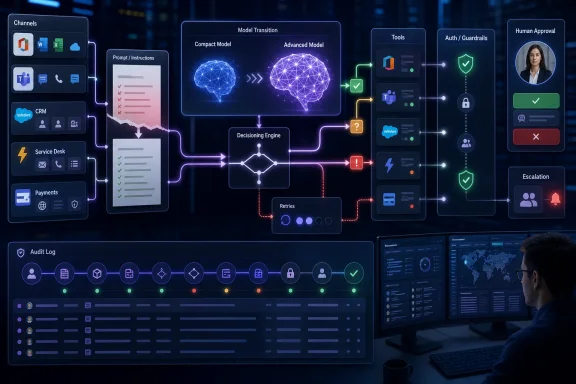 The Workflow May Be Deterministic, but the Decision Layer Is Not
The easiest enterprise AI deployments are still relatively insulated from model churn. A model that classifies a ticket, summarizes a Teams meeting, extracts an order number, or drafts a reply can often be swapped for a more capable alternative with limited user-visible disruption. In many cases, a smaller and less expensive model remains the rational choice for narrow, well-defined tasks.The calculation changes for agentic workflows: systems that gather context, choose among tools, run multiple steps, and adapt when something goes wrong. A returns agent, for example, might look up an order, validate the customer, check policy eligibility, issue a refund, update a CRM record, and transfer exceptions to a human. The payment gateway, order database, and refund service may all be stable systems with fixed rules. But a generative model can still be responsible for deciding which system to call, in what order, and whether the available information satisfies policy.
That distinction matters. An older model may have required explicit reminders to check every prerequisite, use a particular lookup tool before attempting a transaction, and stop after a single failure. A stronger model may infer details from context, select a different path through available tools, or continue pursuing a resolution where its predecessor would have escalated.
None of those behaviors is automatically wrong. Some may improve completion rates and reduce unnecessary handoffs. But they turn a model replacement into an operational change rather than a cosmetic upgrade.
Adobe’s CX Enterprise Coworker is a useful example of where the stakes are heading. Adobe says its agentic customer-experience platform can work across enterprise applications and third-party AI platforms, using Model Context Protocol and Agent2Agent standards to orchestrate workflows. That flexibility is attractive, but it also means enterprises can increasingly separate workflow capabilities from the underlying model—and therefore need a disciplined way to evaluate the behavior of each model within the same workflow.
Anthropic’s Prompt Retrenchment Is the Important Signal
Opus Research points to Anthropic’s recent guidance for its Claude 5 generation as a sign that prompting assumptions are shifting. According to the firm, Anthropic reduced Claude Code’s system prompt by more than 80 percent for Opus 5 and Fable 5 without losing coding performance, concluding that elaborate instructions, examples, and constraints accumulated for older models can become counterproductive.The claimed shift is simple: older models needed detailed rules; newer ones may need room to exercise judgment.
That does not mean enterprises should replace all instructions with a vague sentence such as “handle the customer’s issue.” A customer-facing agent still needs boundaries, access controls, approved data sources, and explicit business outcomes. What is changing is the role of prose instructions that attempt to micromanage reasoning: repetitive caveats, workaround examples, defensive reminders, and flow-control text designed to keep an earlier model on track.
In a mature enterprise workflow, those artifacts can pile up quickly. A system prompt might specify the same escalation rule in several forms, repeat tool-use conditions that are already enforced by code, and include example dialogues that accidentally overfit the model to a narrow answer pattern. A more capable model may spend time reconciling all of that context instead of performing the actual task.
The practical lesson is not “use fewer controls.” It is to distinguish between controls that belong in enforceable software and instructions that merely try to steer model behavior. A model should not be trusted to interpret a paragraph correctly when a deterministic permissions check can prevent an unauthorized refund, data export, or account change outright.
Prompt Debt Is Becoming an Enterprise Maintenance Problem
The industry has spent years talking about technical debt: shortcuts and legacy decisions that keep working until the cost of carrying them outweighs the cost of fixing them. Agentic systems are developing a related burden: prompt debt.Prompt debt consists of instructions that once improved reliability but now create ambiguity, redundancy, unnecessary latency, or unwanted behavior with a newer model. It may include:
- Rules that duplicate hard controls already implemented in code or workflow orchestration.
- Examples that narrow a model’s interpretation of a task more than intended.
- Defensive checks designed for a prior model’s weaknesses rather than the current model’s behavior.
- Tool descriptions broad enough to permit actions the agent should never be allowed to take.
- Escalation wording that conflicts with current business policy or updated access rights.
This is why a change-management process for agentic systems must go beyond validating latency, uptime, and token spend. Teams need to compare actions, not just answers. Did the upgraded model call the same tools? Did it ask customers for less information because it inferred facts from account history? Did it attempt more recovery steps before escalating? Did it write records differently, or decide a case was resolved under a different interpretation of policy?
PwC has argued that enterprise agent architecture should separate engagement orchestration from action orchestration so organizations can improve interoperability and governance as models evolve. That separation is more than an architecture diagram. It gives IT teams somewhere to hold the line when model behavior changes: the model can propose and reason, but deterministic services enforce permission, policy, validation, and irreversible actions.
Testing Needs to Follow the Decision Path
A conventional regression test may verify that a refund workflow can issue a refund. That is not enough for an agentic implementation. The upgrade test should examine the decision path leading to the refund, including tool selection, authentication handling, exceptions, retries, escalation thresholds, and the customer-facing explanation.For production teams, the safest approach resembles a controlled application rollout. Run the new model against a representative evaluation set before promotion, including routine cases, incomplete requests, contradictory customer statements, policy exceptions, failed tool calls, and adversarial inputs. Capture both the final outcome and the sequence of actions taken.
The most valuable test cases are often the boring ones that expose operational assumptions:
- A customer gives an order number but no email address.
- A CRM lookup returns stale contact information.
- The refund platform times out after authorization but before confirmation.
- A user asks for an action that is technically possible but prohibited by policy.
- A tool returns a partial result that a weaker model previously treated as a hard stop.
Human approval remains appropriate for high-impact actions, but it should be specific rather than ceremonial. The objective is not to put a person back into every routine workflow. It is to place confirmations at the moment an agent would create a financial commitment, disclose sensitive information, alter a customer record, or cross a privilege boundary.
The Missing Product Is a Workflow Doctor
Opus Research suggests CX platforms will need an equivalent of Anthropic’s reportedclaude doctor capability: a tool that can inspect model-specific prompts, skills, and instructions after a model transition and identify conflicts, obsolete scaffolding, redundant checks, and overly broad tool permissions.That idea is likely to matter well beyond customer experience. Any organization building agents for IT support, HR, finance operations, procurement, software delivery, or security triage will face the same problem. A configuration that looked permanent may turn out to be a collection of behavioral accommodations for one particular model generation.
Vendors should eventually make model migration a first-class administrative workflow, not an engineering scavenger hunt. A useful platform would inventory every agent affected by a model change, map each prompt and tool dependency, replay evaluation scenarios, flag decision-path drift, and recommend whether a control belongs in prompt text, a deterministic workflow rule, or an authorization layer.
Until then, enterprises should treat a major model upgrade as they would a meaningful change to an automation engine. Keep business policy, permissions, tool contracts, audit requirements, and evaluation criteria independent of any one model. Let model-specific prompts remain replaceable implementation detail.
The immediate payoff is safer migration. The longer-term payoff is more important: when the next model becomes smarter, teams will be able to use its judgment without discovering that their supposedly durable workflows were really just instructions written for a model that has already moved on.
References
- Primary source: opusresearch.net
Published: 2026-07-31T19:16:30+00:00
Are Smarter AI Models Leaving Your Agentic Workflows Behind? |
Anthropic’s Opus 5 shows that more capable models may require a new approach to context engineering, with important implications for CX agentic workflows built around older model behaviors.opusresearch.net - Related coverage: news.adobe.com
Adobe Unveils CX Enterprise Coworker to Build Agentic-Enabled Workflows for Customer Experience Orchestration
At Adobe Summit, Adobe announced Adobe CX Enterprise Coworker, activating agentic AI for organizations to power and orchestrate customer experiences with more efficiency.news.adobe.com - Related coverage: news.adobe.com
Adobe Announces General Availability of CX Enterprise Coworker to Redefine Marketing and Customer Experience Orchestration with Agentic AI
Adobe announces the general availability of Adobe CX Enterprise Coworker, an outcomes-based agentic AI solution that will empower businesses to move beyond AI experimentation into value realization.news.adobe.com - Related coverage: business.adobe.com
- Related coverage: ringcentral.com
Agentic Workflows: 2026 Enterprise Guide
Learn how agentic workflows differ from automation, their core architecture, governance requirements, and a phased rollout plan for enterprise AI.www.ringcentral.com
- Related coverage: business.adobe.com
- Related coverage: techradar.com
'The connective tissue between your data, your people, and your goals': Google Cloud positions Gemini Enterprise as the one-stop shop for all your agentic affairs | TechRadar
Google Cloud is refining and maturing the Gemini Enterprise platformwww.techradar.com