
The intrusion forced a temporary suspension of U.S. Fairlife production after an unauthorized third party accessed part of the company’s environment, including production-related systems. Coca-Cola has confirmed that “certain data” was taken, is continuing restoration work, and has warned that the eventual scope and impact remain subject to its ongoing investigation. The company’s own update therefore leaves an important distinction in place: production is returning, but forensic investigation, data-impact analysis, and full systems recovery are still underway.
For Windows administrators, security professionals, and IT leaders across manufacturing, the Fairlife ransomware attack offers a case study in why cyber resilience now has to extend beyond laptops, servers, and cloud applications. When digital systems support scheduling, plant logistics, quality operations, identity services, and industrial control processes, the consequences of an intrusion may be measured in stopped production lines rather than merely unavailable office files.
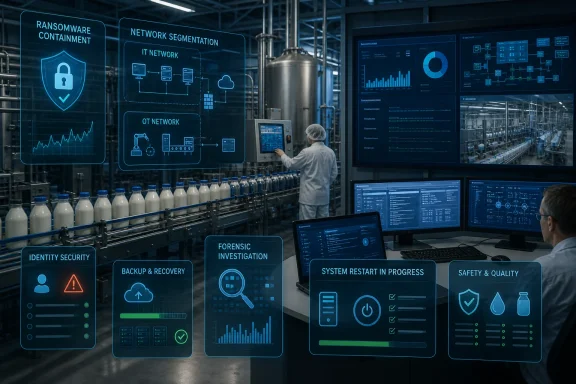 The Fairlife ransomware disruption: what happened
Coca-Cola disclosed the Fairlife technology disruption on July 16, 2026, not July 17 as some initial coverage described it. The company said that Fairlife identified unauthorized third-party access to a portion of its systems, including systems related to production, in connection with a ransomware event. U.S. production was temporarily suspended as the company investigated and responded. CBS News reported the July 16 disclosure and the halt at four U.S. plants.
The date matters because it demonstrates the speed of the recovery effort. By July 27, Coca-Cola reported “significant progress” and said Fairlife had resumed the majority of production across its four U.S. facilities. That is a strong operational result in a sector where restarting manufacturing safely is not simply a matter of re-enabling a Windows service or restoring a virtual machine snapshot. Fairlife’s announcement makes clear that work remains to restore affected systems and operations.
The public facts are limited but consequential:
- The event was identified as ransomware.
- An unauthorized party accessed part of Fairlife’s systems.
- The affected environment included production-related systems.
- Fairlife temporarily suspended U.S. production operations.
- Coca-Cola confirmed the taking of “certain data.”
- Most production has now resumed at four U.S. facilities.
- Coca-Cola says product quality and food safety were not affected.
- Existing inventory helped keep retail availability largely stable.
- The company currently does not expect a material impact on its financial condition or operating results. Coca-Cola’s official update sets out each of those points.
That collection of details suggests a disciplined containment decision. If a ransomware intrusion touches systems connected to production, taking operations offline can be the responsible choice even when there is no identified product-safety issue. A manufacturer must protect process integrity, preserve evidence, stop potential lateral movement, validate systems before restarting them, and ensure that production can resume within acceptable safety and quality constraints.
Why this was more than a conventional data breach
The Fairlife incident should not be reduced to the usual shorthand of “a company got hacked.” Coca-Cola’s disclosure directly connects the ransomware event to production-related systems, which moves the incident into the more complex territory where enterprise IT and operational technology (OT) meet.
Traditional IT environments primarily handle information: email, file sharing, finance, HR, identity, collaboration, and business applications. OT environments help monitor or control physical processes. In food and beverage manufacturing, that can include industrial control systems, programmable logic controllers, supervisory systems, packaging equipment, refrigeration infrastructure, plant-floor networking, quality checkpoints, manufacturing execution systems, and the business platforms that coordinate them.
Those categories often overlap. A production line might not be directly encrypted by ransomware, yet it may still be unable to run if essential dependencies are unavailable. Lost access to identity services, manufacturing schedules, quality records, warehouse management, recipe data, maintenance systems, or communications tools can make a safe restart impractical.
The National Institute of Standards and Technology’s manufacturing guidance specifically frames cybersecurity as a risk-management issue for environments involving industrial control systems, distributed control systems, programmable logic controllers, and SCADA. Its Cybersecurity Framework 2.0 Manufacturing Profile recognizes that manufacturers need a sector-specific approach to technology infrastructure resilience and supply-chain risk, not simply generic corporate IT controls. NIST’s Manufacturing Profile identifies these environments and the resilience requirements that surround them.
The safety distinction is important
Coca-Cola has said product quality and safety were not impacted. That statement should be taken seriously: it addresses the status of products and does not imply that the cyberattack was operationally minor. The official Fairlife release draws precisely that line.
Cybersecurity incidents in manufacturing require teams to separate several questions that are frequently blurred together:
- Was the product itself affected?
This is a food-safety and quality-control question. - Were production systems affected?
This concerns availability, control integrity, scheduling, traceability, and safe restart processes. - Was data taken?
This includes corporate information, employee data, supplier records, operational documentation, intellectual property, and potentially customer-related data. - Can the company return systems to service safely?
This requires technical restoration, validation, monitoring, and management approval—not merely a successful decryption or backup restore.
Fairlife’s ability to resume the majority of production while maintaining that product safety was not affected indicates that its containment and recovery process achieved a critical objective: returning manufacturing capacity without compromising quality controls.
Inventory proved to be a cyber-resilience asset
One of the most notable details in Coca-Cola’s recovery update is that retail availability has been “largely unimpacted” because existing Fairlife inventory was available. Coca-Cola’s statement makes inventory buffers sound ordinary, but in a cyber incident they become a resilience mechanism.
Businesses often discuss cybersecurity in terms of endpoint protection, backups, vulnerability management, security operations centers, and incident response plans. Those are essential. Yet Fairlife demonstrates that business continuity also depends on physical and commercial safeguards:
- Stock already positioned throughout the distribution network.
- Multiple production facilities rather than a single production point.
- Inventory visibility across warehouses and retail channels.
- Supply-chain relationships that can withstand short-term disruption.
- A reliable distinction between safety-critical systems and systems that can be temporarily unavailable.
- An established recovery process for returning factory operations in phases.
Existing inventory buys security teams something exceptionally valuable during a ransomware response: time. It reduces the pressure to restart systems before they have been properly assessed, cleaned, rebuilt, or monitored. In an extortion event, reducing urgency is not a soft benefit—it is a strategic advantage.
That said, inventories are finite. The value of this buffer depends on the length of the outage, the geography of the disruption, consumer demand, refrigerated storage constraints, retail replenishment cycles, and how much finished product was already available. Coca-Cola’s current position is positive, but the company’s wording—“largely unimpacted”—is appropriately more cautious than a guarantee of zero impact.
The data-theft question remains open
The most important unresolved aspect of the Fairlife ransomware attack is the nature of the data that was taken. Coca-Cola has acknowledged that “certain data” was acquired by the unauthorized party, but it has not publicly specified whether that data involves employees, suppliers, customers, financial information, operational records, intellectual property, or other categories. The company’s July 27 release confirms the data taking while leaving its scope undisclosed.
That uncertainty is common in the early and middle stages of a major cyber incident. Determining exactly what was accessed or exfiltrated can take time, especially when investigators must reconstruct attacker activity across endpoints, servers, cloud services, identity logs, firewalls, VPN systems, remote-access gateways, and OT-adjacent infrastructure.
Security reporting has linked the incident to the Anubis ransomware group, which allegedly listed Coca-Cola and Fairlife on a leak site and claimed to have stolen 1 TB of confidential data. However, that reported volume is an unverified criminal claim, not a Coca-Cola-confirmed measurement, and extortion groups have an obvious incentive to exaggerate the perceived value or volume of data they possess. SecurityWeek’s reporting appropriately notes both the alleged claim and the uncertainty surrounding it.
This is where public discussion needs restraint. It is accurate to say that Coca-Cola confirmed data was taken. It is not accurate, based on the company’s public statements, to assert what categories of information were involved or to treat the alleged 1 TB figure as established fact.
Ransomware is now usually an extortion problem, too
Modern ransomware incidents are frequently double-extortion events. Attackers may attempt to encrypt systems to disrupt operations while also stealing information and threatening publication if the victim does not pay. In some cases, the data-theft component can persist as a risk even after systems are restored from clean backups.
NIST describes ransomware as a threat that can disrupt operations, lock organizations out of critical data, and force difficult decisions under pressure. Its ransomware risk-management profile focuses on outcomes across the Govern, Identify, Protect, Detect, Respond, and Recover functions of the Cybersecurity Framework 2.0. NIST’s ransomware guidance is particularly relevant to a case such as Fairlife because a technically successful operational restart does not erase data-exposure, regulatory, legal, supplier, or reputational consequences.
For Coca-Cola, the investigation may eventually determine that the stolen data had limited sensitivity or that the company has specific notification obligations. Alternatively, it could reveal a broader impact. Until that work is complete, the most credible position is the one Coca-Cola has taken: acknowledge the event and the data taking, continue restoration, and avoid overstating conclusions.
What a safe manufacturing recovery looks like
A WindowsForum audience will recognize the broad strokes of ransomware response: isolate systems, preserve evidence, identify the attack path, remove persistence, restore from trusted backups, reset credentials, harden exposed services, and monitor for recurrence. In manufacturing, however, those steps are only one layer of the recovery process.
A plant restart must also account for the physical environment. A recovery team may need to validate whether control systems, operator workstations, engineering workstations, human-machine interfaces, historian platforms, quality systems, and production dependencies are operating correctly before any line can return to normal use.
NIST emphasizes that industrial control systems run physical manufacturing processes and that organizations require a plan to restore plant operations after an incident. Its manufacturing recovery work highlights capabilities such as event reporting, log review, event analysis, incident handling, and response—not merely restoration of data from backups. NIST’s manufacturing recovery project describes the distinct requirements of recovering an industrial environment.
From “systems restored” to “operations trusted”
The most useful way to interpret Fairlife’s “majority of production” language is that recovery is likely phased. It signals that the business has brought a substantial portion of capacity back online while work continues elsewhere.
A responsible phased recovery commonly involves the following sequence:
- Contain and isolate affected systems
Stop potential ransomware propagation and prevent compromised credentials or remote-access paths from being reused. - Establish a clean recovery environment
Rebuild or validate core identity, networking, monitoring, and management services before trusting dependent workloads. - Restore prioritized business services
Bring back systems essential to a minimum viable operating state, such as production scheduling, plant connectivity, safety-relevant applications, and quality workflows. - Validate OT and IT dependencies
Confirm that industrial processes, device communications, engineering tools, logging, and supervisory functions behave as expected. - Conduct controlled production restarts
Resume operations in stages, with technical, operational, quality, and safety stakeholders involved in the decision. - Monitor aggressively after restart
Look for residual attacker access, unusual authentication behavior, unauthorized remote tools, unexpected network traffic, and anomalies in production-adjacent systems. - Expand capacity only after confidence improves
Restore the remaining systems and production areas without allowing commercial urgency to outrun security validation.
The Fairlife recovery does not disclose its internal process, and it would be inappropriate to assume the precise technologies or steps used. But the pattern—temporary shutdown, restoration work, majority production resumed, and ongoing system recovery—is consistent with a staged approach to cyber incident recovery.
Strengths in Coca-Cola’s response
Coca-Cola’s public response contains several signs of sound crisis management.
It acknowledged ransomware and operational impact
Some organizations describe cyber incidents in vague language that obscures whether business operations were affected. Coca-Cola was more direct: it identified a ransomware event, confirmed unauthorized access, disclosed the temporary suspension of Fairlife production operations, and later acknowledged that certain data had been taken. Its July 27 statement gives stakeholders a clearer baseline than generic references to “a technology issue.”
It did not overclaim a full recovery
Saying that the “majority” of production has resumed is more useful—and more credible—than claiming a total return to normal before remaining work is complete. The company explicitly said it continues to restore impacted systems and operations. Coca-Cola’s wording indicates an understanding that production restoration and complete technical remediation are different milestones.
It protected product safety and availability
Coca-Cola’s statements that quality and safety were unaffected, combined with preserved retail availability through existing inventory, represent the best immediate outcome an operator can reasonably seek after an attack involving production-related systems. CBS News coverage independently reported both the operational halt and Coca-Cola’s claims on product safety and inventory-supported availability.
It has avoided treating preliminary findings as final
The company’s current assessment that the event is not reasonably likely to materially affect financial condition or results is explicitly based on information currently available. Its release also carries forward-looking-statement language that identifies ongoing uncertainty around the investigation, remediation, systems accessed, data scope, and business impact. The full company release provides that necessary caution.
Risks that remain after production resumes
The return of production should not be mistaken for the end of the incident. Recovery often creates a deceptive moment of calm: public attention moves on, but the most difficult work—investigation, hardening, regulatory assessment, and long-term remediation—continues behind the scenes.
Data exposure may outlast the outage
If sensitive data was stolen, restoration of manufacturing systems does not resolve downstream exposure. The company may still face decisions related to notifications, identity-protection services, customer and supplier communications, contractual obligations, litigation risk, and monitoring for leaked data.
Attackers may have used more than one access path
Ransomware groups often rely on credential theft, remote-access weaknesses, compromised accounts, unmanaged systems, or third-party pathways. A recovery that addresses only the initial encrypted or disrupted systems can miss persistence mechanisms or alternative routes back into the environment.
This is why identity infrastructure deserves special attention. For Windows-centric organizations, that means examining Active Directory and Microsoft Entra ID security posture, privileged accounts, service accounts, remote management tooling, endpoint detection telemetry, conditional access policies, VPN access, firewall rules, and administrative activity across the recovery window.
OT segmentation and visibility will receive closer scrutiny
The fact that production-related systems were affected will inevitably raise questions about segmentation between business IT and manufacturing environments. Segmentation alone does not prevent every incident, but it can limit how far an intruder can move and reduce the chance that a compromise in one area becomes an enterprise-wide shutdown.
NIST’s Manufacturing Profile specifically adds attention to technology infrastructure resilience, supply-chain risk management, and platform security. The NIST framework profile is useful here because it treats manufacturing cybersecurity as a governance and operational challenge, rather than a product-selection exercise.
The practical lessons for Windows and manufacturing IT teams
The Fairlife ransomware attack is a particularly clear example of why security plans must be designed around the business outcome: Can the organization keep operating—or safely recover its most important operations—when its normal digital environment is unavailable?
For companies running Windows infrastructure in food, beverage, logistics, pharmaceuticals, retail distribution, or industrial production, several priorities stand out.
- Map IT-to-OT dependencies. Know which Windows servers, identity systems, databases, remote-access tools, applications, and network services are necessary for safe production.
- Define a minimum viable factory or warehouse state. Identify the smallest trustworthy set of services required to restart priority operations without bypassing quality and safety controls.
- Separate backups from the production domain. Backups must be immutable or otherwise protected from the same credentials, network paths, and administrative tools that attackers may compromise.
- Test restoration rather than assuming it works. A backup that cannot be restored quickly, cleanly, and in the correct order is not a recovery strategy.
- Harden identity systems. Require multifactor authentication, constrain privileged access, remove stale accounts, rotate exposed credentials, limit service-account rights, and monitor unusual authentication events.
- Segment production networks. Reduce unnecessary pathways between office networks, remote access systems, vendor connections, engineering workstations, and industrial environments.
- Maintain offline recovery documentation. During ransomware, online documentation platforms, password vaults, and ticketing systems may not be available.
- Run realistic tabletop exercises. Include plant operators, quality teams, legal counsel, procurement, executive leadership, communications staff, and key suppliers—not only the IT department.
- Plan for data extortion separately from encryption. Backups can restore availability, but they do not remove the risk associated with information already copied out of the environment.
NIST’s ransomware profile is especially helpful as a planning structure because it encourages organizations to assess current capabilities, define target outcomes, identify gaps, and prioritize actions across prevention, detection, response, and recovery. NIST’s finalized ransomware guidance offers a framework for turning lessons from incidents like Fairlife’s into an actionable program.
A recovery milestone, not the final chapter
Fairlife’s return to majority production is a significant success for Coca-Cola’s business continuity and incident-response teams. The company avoided the worst immediate customer-facing outcome: widespread product unavailability or a reported food-safety impact. Its existing inventory buffer gave the organization room to contain the disruption and restore operations with less visible retail fallout. Coca-Cola’s update supports that assessment.
Yet the larger lesson is not that ransomware can be quickly overcome. It is that food and beverage manufacturers need to design for a reality in which ransomware can interrupt physical production, compromise data, and force high-stakes decisions long before the final forensic report is ready.
For Windows administrators and IT leaders, the incident reinforces a simple but demanding principle: recovery is not complete when servers boot, users can sign in, or production lines restart. Recovery is complete only when systems, identities, data, processes, and plant operations can be trusted again.
Update: Report says Anubis published alleged Fairlife data after ransom talks were refused (July 29, 2026)
TechTimes reports that Coca-Cola declined to negotiate with the Anubis ransomware group and referred the Fairlife incident to law enforcement. According to its account, the group’s July 27 leak-site deadline then expired and Anubis published an alleged cache of stolen Fairlife data.
This would materially change the risk profile from a still-unquantified data theft to a potential public data-exposure event. Coca-Cola has confirmed only that “certain data” was taken; it has not publicly identified the contents, volume, or affected individuals. Claims that the cache totals roughly 1 TB remain criminal-group assertions rather than company-verified facts.
The report also attributes initial access to the Citrix NetScaler vulnerability CVE-2025-5777, sometimes called CitrixBleed 2, but Coca-Cola has not publicly confirmed an intrusion path. Administrators should therefore treat that attribution as a reported lead, not an established finding. If relevant to the incident, the practical defensive lesson is significant: patching exposed NetScaler appliances must be paired with revocation of active sessions and credential review, since previously stolen session tokens may remain usable after a patch.
