
For Windows users who also rely on a Realme phone as a companion device, this matters more than the Android-versus-iOS rivalry may suggest. A modern smartphone is often the authentication device for a Microsoft account, the camera uploading to OneDrive, the messaging endpoint for Phone Link, and the mobile gateway for work files. A more consistent operating system strategy can improve that experience—provided Realme turns the organizational consolidation into better support rather than merely different branding.
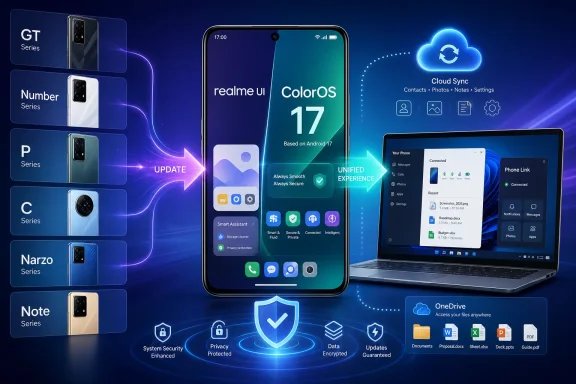 Overview: Why the ColorOS 17 Shift Matters
Realme UI and OPPO’s ColorOS have not been wholly separate from a technical perspective for some time. Both have shared elements of their Android foundations, feature direction, and support tooling, even when their names, visual identity, and product positioning remained distinct. The reported decision to fold Realme’s software identity directly into ColorOS 17 therefore looks less like a disruptive ground-up platform migration and more like an acceleration of an existing convergence. Gizbot’s report frames the change as a consolidation intended to improve development efficiency, stability, and update velocity.
That distinction is important. Users should not expect their phones suddenly to become unfamiliar OPPO handsets after an over-the-air update. The likely practical result is a revised software label, a closer alignment with OPPO’s feature cadence, and potentially more shared applications, services, visual conventions, and system behaviors.
Realme already demonstrates regional variation in how it presents software. For example, official product pages for the realme GT 7 Pro list it as running realme UI 6.0 based on Android 15, while the company’s support material in certain regional contexts refers to updates using ColorOS terminology. The GT 7 Pro specifications and regional support guidance illustrate why a global software-unification effort may be aimed as much at simplifying brand and engineering operations as at introducing a dramatically different user interface.
A branding change with operational consequences
A unified Android skin can deliver real benefits when it eliminates duplicated work. Rather than maintaining parallel feature branches, test schedules, documentation, support workflows, and localization efforts for nearly alike software, the company can concentrate those resources on one platform.
In a best-case scenario, Realme owners could gain:
- Faster major Android version updates
- More consistent security-patch delivery
- Quicker bug-fix deployment across regions
- Earlier access to OPPO-developed AI, camera, gaming, and battery features
- Improved app compatibility testing
- More predictable support documentation and troubleshooting
Those are meaningful outcomes, especially for users who have historically had to interpret inconsistent rollout calendars across Realme’s many product tiers and regional variants.
But software consolidation is not automatically a consumer win. It succeeds only if the merged platform preserves Realme’s strengths—aggressive hardware value, performance-oriented options, and clear device differentiation—without importing unnecessary background services, region-specific restrictions, or more preloaded applications.
The Reported Realme ColorOS 17 Eligible Device List
The broadest reported ColorOS 17 list covers 56 Realme devices. It includes current and anticipated flagship, mid-range, entry-level, and online-first Narzo hardware, a notably expansive scope for an Android version upgrade. NokiaPowerUser’s reported roster divides the phones into six series.
The count is substantial, but readers should keep one qualification in mind: a device name appearing in a leaked list is not the same as a firm, region-specific OTA commitment. The accompanying reporting from Gizbot explicitly says that Realme had not published a final rollout schedule or definitive supported-device list at the time of its report. Gizbot’s eligibility caveat is particularly relevant because the two reported lists do not match perfectly.
Realme GT series: the likely early candidates
The flagship-oriented GT family is the natural place to expect early beta access and initial stable releases. The leaked list identifies eight models:
- Realme GT 8 Pro
- Realme GT 7 Pro
- Realme GT 7
- Realme GT 7 Pro Racing Edition
- Realme GT 7T
- Realme GT 6
- Realme GT 6T
- Realme GT 5 Pro
The GT 7 Pro, GT 7, GT 7T, GT 6, GT 6T, and GT 5 Pro also appear in the more conservative Gizbot list, providing some cross-reporting support for those core flagship entries. Gizbot’s GT series table
For the GT audience, ColorOS 17 will be judged less by its label than by performance. These users will look for improved sustained gaming behavior, fluid animation under high refresh rates, thermal consistency, RAM management that does not excessively close active games, and camera processing enhancements that do not compromise shutter responsiveness.
Realme’s official pages already caution that certain device features and AI functions can arrive at different times in different countries and that official OTA timing controls availability. Realme’s GT 7 Pro product notes offer a useful reminder that even a flagship’s upgrade experience can differ by market. A ColorOS 17 rollout may therefore begin with a limited beta cohort, expand by region, and only later reach carrier-specific or lower-volume variants.
Realme Number series: the mainstream upgrade battleground
The leak lists 13 Number-series devices:
- Realme 16 Pro+
- Realme 16 Pro
- Realme 16
- Realme 16T
- Realme 15 Pro
- Realme 15
- Realme 15 Lite
- Realme 15T
- Realme 15x
- Realme 14 Pro+
- Realme 14 Pro
- Realme 14
- Realme 14T
This is arguably the most strategically important group. The Number series represents the practical middle of the Realme portfolio, where buyers expect premium-looking devices and capable cameras without flagship pricing. A smooth ColorOS transition here would demonstrate that the new platform is more than a perk for GT buyers.
There is also evidence that the newest numbered Realme hardware has a meaningful software-support runway. Realme’s own Android Enterprise Recommended information lists the realme 14 5G, realme 14 Pro 5G, and realme 14 Pro+ 5G with Android 15 as their shipped version and Android 16 as their stated future OS version, alongside security-update end dates extending into 2031 for those models. Realme’s Android Security Advisories page does not independently promise Android 17 for these phones, but it confirms that Realme distinguishes between OS-upgrade commitments and ongoing security support.
That is a critical distinction. A phone can continue receiving security patches after its final platform upgrade. Conversely, security support alone should not be mistaken for proof that a handset will receive ColorOS 17.
P series: a large performance-focused cohort
The reported P-series roster contains 11 entries:
- Realme P4 Pro
- Realme P4
- Realme P4 Lite
- Realme P4 Lite 4G
- Realme P4 Power
- Realme P4R
- Realme P4x
- Realme P3 Ultra
- Realme P3 Pro
- Realme P3
- Realme P3x
This is a broad claim, particularly because it includes multiple P4 variants and entry-adjacent derivatives. The reported P-series list suggests that Realme may intend to use the ColorOS move to normalize software support across more price points.
The risk is that a wide eligibility roster creates expectations the rollout mechanism cannot easily meet. Lower-priced models often differ sharply in chipset, camera hardware, RAM configuration, cellular bands, storage capacity, and country-specific firmware. Each variant adds validation work. If ColorOS 17 is genuinely designed as a shared engineering platform, the P series will be an important test of whether Realme can reduce that complexity in practice.
C series: the budget phones that could benefit most
The leak includes 12 C-series models:
- Realme C100
- Realme C100 4G
- Realme C100x
- Realme C100i
- Realme C85 Pro
- Realme C85
- Realme C85 4G
- Realme C83
- Realme C75
- Realme C75x
- Realme C73
- Realme C71
An Android 17 upgrade for a large C-series cohort would be especially notable because entry-level Android phones have traditionally faced shorter feature-update windows than premium devices. The real value here may not be flashy AI tools; it may be better protection, more polished system optimization, and a user interface that remains supportable for longer.
Realme’s published security advisory currently lists the realme C75 among phones receiving monthly security-patch updates, showing that the company already differentiates update cadence across models. The official monthly-update list is not a ColorOS 17 roadmap, but it reinforces why buyers should examine security policy separately from major Android-version eligibility.
For C-series owners, the most important questions after launch will be straightforward:
- Does the update preserve battery life on modest hardware?
- Does it leave enough free storage after installation?
- Are new AI features useful locally, or merely advertised capabilities unavailable in the user’s region?
- Does the phone continue to receive timely security patches after the platform update lands?
Narzo and Note: online-first phones remain part of the plan
The reported Narzo selection contains nine devices:
- Realme Narzo Power 5G
- Realme Narzo 100x
- Realme Narzo 100 Lite
- Realme Narzo 90
- Realme Narzo 90x
- Realme Narzo 80 Pro
- Realme Narzo 80 Lite
- Realme Narzo 80 Lite 4G
- Realme Narzo 80x
The list also names three Note models:
- Realme Note 80
- Realme Note 70
- Realme Note 70T
NokiaPowerUser’s report presents these models as qualifying for the Android 17-based package. Gizbot’s shorter expected list agrees on several broad family entries—such as Narzo Power 5G, Narzo 100x, Narzo 90, Narzo 80x, Note 80, and Note 70—but also introduces the Realme Pad 3, which does not appear in the 56-phone roster. Gizbot’s table
That discrepancy should temper interpretation of every exact count. The most defensible conclusion is that the reported transition reaches well beyond flagships. The exact final list, device naming, regional scope, and tablet inclusion remain details that Realme will need to formalize.
What ColorOS 17 Could Change in Daily Use
Because the two platforms have already shared technical roots, the initial ColorOS 17 experience may feel evolutionary rather than revolutionary. That should not be read as a failure. In smartphone software, predictability can be more valuable than novelty.
The likely changes fall into several practical categories.
Performance and background management
Modern Android skins constantly balance responsiveness against battery endurance. They decide which applications can remain active, which processes should be paused, when memory should be reclaimed, and how aggressively background network access is constrained.
Reports expect the merged platform to emphasize smoother animation, better RAM and background-app handling, and gaming improvements. Gizbot’s feature overview makes those claims, although Realme has not yet published device-by-device performance targets or benchmark commitments.
For Windows users, intelligent background behavior can be valuable when it keeps an authenticator, cloud-sync client, browser download, or companion connection alive. It can be harmful when it silently terminates a VPN, upload, messaging service, or file-transfer process. ColorOS 17’s success will depend on whether it offers clear controls rather than simply enforcing stronger battery optimization.
AI features and privacy
AI is expected to be a major ColorOS 17 talking point, potentially spanning writing assistance, image editing, search, productivity, camera enhancements, and contextual system tools. But the phrase AI-powered should be approached with discipline.
Feature availability may vary by:
- Phone chipset and onboard AI hardware
- RAM and storage configuration
- Country and language
- Account requirements
- Network availability
- Local regulatory rules
- Staged OTA deployment
Realme itself notes on an official product page that some AI features are released at different times in different countries and regions. The GT 7 Pro’s official notes make that limitation explicit. Buyers should therefore avoid assuming that every feature demonstrated on an OPPO device or announced for ColorOS will appear on every Realme phone immediately.
Privacy will matter just as much as capability. A unified operating system may simplify the way permissions, cloud services, telemetry, and AI processing are handled across brands. That can improve consistency, but it also means users should review permissions, cloud backup preferences, app recommendations, and data-sharing options after installation.
Camera, customization, and gaming tools
The other likely areas of improvement are familiar ColorOS strengths: camera software, personalization, gaming controls, cross-device tools, and system-level convenience features. Some of these may migrate to Realme phones more quickly once the companies share a more direct release branch.
The upside is clear: a Realme mid-range handset could gain software refinements that previously appeared sooner on OPPO’s premium devices. The downside is that a broader feature set can make Settings more complex, increase system-app clutter, or deliver features that are technically present but poorly localized.
The ideal ColorOS 17 implementation would give users control:
- Disable optional recommendation surfaces
- Restrict or remove nonessential preloaded apps where local law permits
- Set background activity rules per application
- Choose which AI features can access content
- Keep visual customization separate from advertising or service prompts
- Provide transparent storage and battery impact information
Rollout Expectations and the Risks of Reading Too Much into a Leak
The reports point to an Android 17 launch window in which ColorOS 17 could arrive quickly after OPPO’s own introduction, followed by beta activity and staged stable releases. Gizbot’s rollout discussion anticipates that beta testing may begin in China before wider regional expansion, consistent with the staggered approach commonly used for major Android revisions.
A phased release is sensible. It limits the damage if an early build introduces modem issues, battery drain, camera regressions, compatibility problems, or app crashes. It also means that two users with the same phone can receive ColorOS 17 weeks apart, depending on their country, firmware channel, carrier relationship, and enrollment status.
The specific uncertainties to watch
The 56-device figure is detailed, but the second report’s smaller list and its inclusion of a tablet show that it should not be treated as contractual. The NokiaPowerUser roster and Gizbot’s expected-device table align on the broad direction while differing on exact devices.
Before a final Realme roadmap arrives, users should be careful about four assumptions:
- Eligibility is not timing. A phone may qualify but receive the update late.
- Timing is not feature parity. Older or less powerful models may receive a reduced feature set.
- A name match is not a firmware match. Regional and carrier variants can follow separate schedules.
- A beta is not a stable recommendation. Early builds may be unsuitable for a primary phone used for work, banking, passkeys, or two-factor authentication.
The company’s own support guidance advises backing up data before updating, keeping the phone charged or above 40 percent battery, and avoiding an interruption during the installation process. Realme’s update troubleshooting instructions are basic precautions, but they are especially worth following for a major Android release.
A Practical Upgrade Checklist for Realme Owners
A ColorOS 17 update is likely to be large, consequential, and delivered in stages. The sensible preparation is not complicated, but it should happen before tapping Download and install.
- Confirm the exact device model and region.
Marketing names can conceal multiple model numbers and firmware tracks. Check the model identifier in Settings and compare it with the eventual official Realme update announcement. - Back up more than photos.
Ensure contacts, documents, two-factor recovery codes, authenticator exports where supported, messaging backups, and app-specific data are protected. Realme explicitly recommends a backup before system updates. Its support guidance also notes that factory-reset actions permanently erase device data. - Free meaningful storage headroom.
Major Android upgrades may need temporary installation space well beyond the download size. Removing old videos, duplicate downloads, and unused games can prevent failures. - Update core apps before the OS upgrade.
Update Microsoft Authenticator, OneDrive, Outlook, Teams, browsers, payment apps, VPN software, and password managers first. This reduces the chance that an obsolete application build becomes the weak point after the operating-system change. - Avoid the first beta on mission-critical phones.
Stable software is usually the better choice for a phone that handles work access, financial approvals, or security credentials. - Review every new privacy and battery setting after installation.
Recheck notifications, background activity permissions, default applications, cloud-sync rules, and data-sharing choices rather than assuming prior preferences survived unchanged.
The Bigger Test Is Support, Not Skin Design
Realme’s ColorOS 17 transition has the potential to be a genuine improvement for Android users. The strategic logic is strong: one software platform can reduce duplicated engineering work, centralize quality assurance, and give a large device portfolio access to features that might otherwise be delayed by branding boundaries.
The reported scope is also encouraging. If Realme follows through with Android 17 support across flagship GT phones, mainstream Number models, P-series performance devices, budget C handsets, Narzo phones, and Note models, the company will be signaling that platform longevity is becoming a portfolio-wide issue rather than a premium-only benefit. The 56-device leak points in that direction.
Yet the real benchmark will be execution. Realme must publish a clear supported-device matrix, identify regional differences, separate beta availability from stable rollout dates, and state which features are hardware- or market-dependent. It must also prove that ColorOS 17 improves update reliability and security support rather than simply replacing realme UI with a different logo.
For users, the most sensible position is cautious optimism. The platform merger could bring a more polished, better supported Android experience to a remarkably broad range of Realme phones. It becomes a meaningful win only when the final OTA builds arrive on time, protect data, preserve performance, and make the devices people already own feel more secure and more capable—not merely newly branded.
