
As reported by The Guardian, iLamps have been installed at a Warwickshire hospital car park, while CPG has announced an agreement to supply 50,000 units to Katsina state in Nigeria. The company says the platform can support smart-city functions including traffic and parking management, connectivity, public-safety sensing and, where deployed under local rules, AI-enabled cameras.
The immediate concern is not that every installed pole is already performing facial recognition. The Guardian could not establish which capabilities are active in the UK installation. The concern is that a networked physical platform can be fitted with, or later upgraded to enable, new collection and analysis functions without the kind of visible change residents associate with installing a new CCTV system.
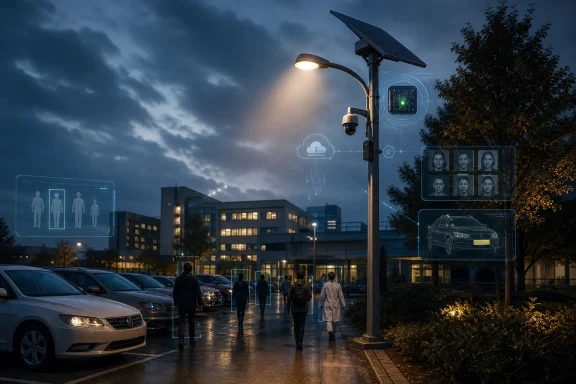 The upgrade path is the real surveillance risk
Traditional CCTV records footage for later review. Live facial recognition instead compares faces against a watchlist as people pass a camera, turning public movement into a potential real-time identity check. Adding number-plate recognition, gait analysis or claimed “suspicious behaviour” detection expands that model further.
Big Brother Watch’s Jasleen Chaggar told The Guardian that the risk lies in infrastructure whose capabilities can be activated later. That distinction matters for councils, NHS trusts and property managers: procurement decisions made for lighting, Wi-Fi or parking occupancy can create a hardware footprint suitable for biometric surveillance long before a public debate occurs.
A camera is not automatically a facial-recognition system, and a smart pole is not automatically a policing device. But buyers need enforceable technical and contractual limits—not merely assurances that certain features are not being used today.
“Distributed AI datacentre” needs extraordinary proof
CPG describes the iLamp as a distributed AI datacentre. Professor Rabih Bashroush of the University of East London disputed the practical case for substantial AI computing from solar-powered poles in the UK, telling The Guardian that the available power and economics would constrain workloads, particularly in Britain’s low-light months.
That does not mean edge computing at a street pole is impossible. Narrow tasks—such as basic occupancy detection, local video processing or environmental telemetry—can be practical when designed around intermittent power, storage, connectivity and maintenance limits. It does mean buyers should treat broad AI-datacentre language as a claim requiring specifications: sustained power budget, battery capacity, compute hardware, thermal limits, network backhaul, data retention and fail-safe behavior.
For Windows-centric IT teams, the operational questions are familiar even if the enclosure is a lamppost:
- The supplier should identify every device OS, management plane, remote-access method and patch-support commitment.
- Video, plate and biometric data should have named controllers, retention periods, access logs and deletion processes.
- Feature activation should require a documented change-control process, privacy assessment and public notice rather than a silent firmware update.
- The contract should specify who owns exported data and whether the customer can migrate it at termination.
Public-sector buyers cannot outsource accountability
The Katsina deployment announcement shows how rapidly a streetlight product can be positioned as a city-scale data platform. CPG says its iLamp can support optional AI-enabled monitoring subject to local regulation and governance; that qualifier is important, but it shifts scrutiny to the authority signing the deal.
A hospital car park is especially sensitive terrain. Cameras may have legitimate security purposes, yet records of who attended a medical site can reveal deeply personal information. Any system that identifies vehicles or faces there should face a higher bar for necessity, data minimisation and transparency.
The lesson from the iLamp story is not that smart lighting is inherently dystopian or that all AI-enabled sensors are fiction. It is that hardware capability becomes policy capability once the poles, cameras, power systems and network connections are in place. Before approving the next “smart city” upgrade, organisations should decide exactly what the system may do—and make it technically difficult for anyone to expand that answer later.
