

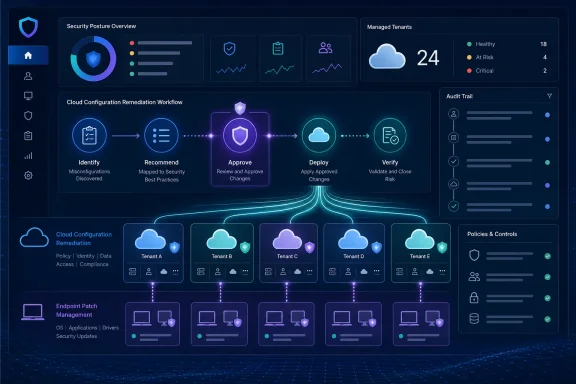
Channel Dive first reported the expansion on August 11, citing ConnectSecure CTO Shiva Shankar. ConnectSecure’s own Business Wire announcement says M365 Auto Remediation and AI-powered Training Assessments are live, while separately pointing customers toward Patch 360, its existing patch-management product. That separation matters for MSPs evaluating whether this replaces existing Microsoft 365 remediation workflows: the new feature concerns supported cloud-security findings, while Patch 360 is a broader endpoint patch-management offering announced in June.
M365 assessments now have a path to enforcement
ConnectSecure entered Microsoft 365 assessment work well before this week. Its M365 Assessment module launched in beta in October 2024, offering scans, reports, scheduled checks and guided remediation based on the CIS Microsoft 365 Benchmarks. In other words, the platform already identified configuration gaps and told MSPs what to do about them.
The new Auto Remediation feature changes the operational model by adding a controlled write action. Instead of a technician reviewing a finding, creating a PSA ticket, signing into the tenant, changing a policy and documenting completion, an MSP can approve a remediation action and apply it across affected customers where the platform supports that finding.
For a service provider running standardized Microsoft 365 baselines, that could materially reduce the labor tied to repeatable work such as correcting an approved configuration drift. It also creates a more defensible managed-service process: the same remediation can be approved under a stated policy and carried out consistently rather than relying on individual technicians to interpret an assessment report tenant by tenant.
ConnectSecure’s prior public material describes the Microsoft 365 integration as an assessment and reporting tool, with guided remediation and alerting. Its integrations page also shows support for Microsoft Entra ID via Granular Delegated Admin Privileges, or GDAP, in both CSP and non-CSP scenarios. The addition of automated remediation therefore represents a significant escalation from read-and-report access to a workflow that can alter customer environments.
Microsoft’s GDAP guidance is relevant here. GDAP is designed to give partners explicit, time-bound and least-privileged access to individual customer tenants, rather than broad standing administrative access. That model can support automated management, but only if the roles granted to the partner and the application are tightly scoped to the controls being changed.
The automation is only as safe as its control catalog
The announcement’s most important qualifier is the word supported. ConnectSecure says MSPs can apply automatic fixes for supported Microsoft 365 security findings. It has not published a catalogue of those findings, however, so customers cannot yet determine whether the tool will address the controls that consume their teams’ time.
That omission leaves several operational questions unanswered:
- ConnectSecure has not said whether Auto Remediation covers only CIS benchmark configuration checks or also Microsoft Secure Score recommendations, Entra ID settings, Defender settings, Exchange Online policies, SharePoint sharing policies, or third-party application permissions.
- ConnectSecure has not specified which Microsoft Entra roles, Graph permissions, or GDAP relationships are required before a remediation can run.
- ConnectSecure has not explained whether approvals are tenant-specific, policy-specific, or reusable across a group of customers with the same standard.
- ConnectSecure has not described whether completed changes include a native rollback function, a before-and-after configuration record, an approval trail suitable for audit evidence, or an exception mechanism for customers that intentionally diverge from the MSP baseline.
- ConnectSecure has not announced whether the capability is included in existing M365 Assessment subscriptions, sold as an add-on, or tied to a particular platform tier.
Those are implementation details, not paperwork. A misconfigured Conditional Access policy, outbound-mail control, authentication setting or sharing rule can affect every user in a tenant. Microsoft’s own Entra administration guidance warns that privileged identities and applications can make broad tenant-wide changes, including through mistakes rather than malicious activity. Approval gates reduce that risk, but they do not eliminate the need to understand exactly what an approved action changes.
The responsible first deployment is therefore not “approve everything marked critical.” It is to connect a nonproduction or low-risk pilot tenant, compare the proposed fix against the MSP’s documented standard, confirm the assigned GDAP roles are no broader than necessary, and verify that the customer-facing audit record identifies the person, policy and time behind each change.
Patch 360 should not be confused with M365 Auto Remediation
ConnectSecure’s August announcement combines three pieces of product news: M365 Auto Remediation, AI-powered Training Assessments, and access to Patch 360. They serve related MSP workflow goals, but they are not interchangeable capabilities.
Patch 360 was formally introduced by ConnectSecure on June 8, 2026. The company describes it as a patch-management system for endpoints, with pilot-first validation, staged deployment, approvals, rollback and prioritization informed by CISA Known Exploited Vulnerabilities, critical-severity findings and Exploit Prediction Scoring System data. Its core purpose is to test and promote software patches without pushing an update blindly to every managed device.
M365 Auto Remediation, by contrast, appears to target cloud-tenant configuration findings rather than operating system and application update deployment. Channel Dive describes the capability as applying approved fixes for supported M365 security findings across multiple customers. ConnectSecure’s announcement does not say that the feature patches Microsoft 365 Apps, Windows, Exchange Server, Microsoft Defender agents, or third-party software.
That distinction should shape procurement conversations. An MSP looking to improve Windows and application patching should assess Patch 360 on its own merits: pilot rings, supported operating systems and applications, rollback reliability, PSA integration and pricing. An MSP looking to standardize Microsoft 365 tenant hardening should evaluate Auto Remediation against its actual supported-controls list and required delegated permissions.
The August launch is best understood as a platform expansion that puts both activities closer together for ConnectSecure customers. It is not evidence that one new M365 automation tool now performs endpoint patch management.
AI-generated training assessments require human ownership
The other new capability, AI-powered Training Assessments, is less technically risky but can become operationally sloppy if MSPs treat generated content as ready to send. According to Channel Dive and ConnectSecure, users can create assessments from a topic, pasted text, uploaded material or templates; they can then review and edit questions, answer choices and explanations before publishing.
That review step should be non-negotiable. Security-awareness tests need to reflect the client’s accepted-use rules, reporting channel, MFA process, recovery procedures and actual Microsoft 365 configuration. A generic question about an impossible control or an obsolete procedure does more than lower the quality of training; it can teach users the wrong response during a real incident.
The feature may be most useful where an MSP already has a repeatable security-awareness program but lacks the staff time to turn revised policies, quarterly phishing trends or new client onboarding material into short assessments. It is a content-production aid, not a measure of whether users can resist a live business email compromise attempt.
What MSPs should verify before enabling it
ConnectSecure has taken a meaningful step beyond Microsoft 365 posture reporting. For providers managing many small and midsized tenants, the ability to approve and repeat a known-safe correction could convert a recurring queue of low-complexity tickets into a standardized service operation.
But the launch arrives with the technical boundaries still largely undisclosed. MSPs should obtain the supported-remediation list, required GDAP roles, per-tenant consent requirements, audit-log format, exception handling and commercial terms before making Auto Remediation part of a customer promise. Until then, it is a potentially valuable automation layer whose usefulness will depend less on its dashboard and more on the exact controls it is permitted to change.
Update: ConnectSecure says M365 changes remain technician-led, with approval automation still planned (August 13, 2026)
Contrary to the initial description of broad Auto Remediation, ConnectSecure CEO Peter Bellini told ChannelE2E that Microsoft 365 remediation currently remains a technician-led process: the platform prioritizes selected findings, but technicians review and apply changes within Azure or Microsoft 365.
ChannelE2E reports that the currently addressable Security Inspector findings include MFA gaps, legacy authentication, risky sign-ins and Microsoft Secure Defaults. Bellini said ConnectSecure is moving toward approval-based automation in which the platform recommends a change, a technician approves it, and the action remains reversible.
That clarification materially narrows the immediate operational claim for MSPs. The platform may reduce assessment, prioritization and reporting work, but it should not yet be treated as an engine that automatically pushes approved configuration changes across customer tenants without technician action.
The report also adds commercial detail: Patch 360 is included in ConnectSecure’s core platform, while M365 Security Inspector and Training & Security Awareness sit in the Silver tier. ConnectSecure prices the Microsoft 365 and training capabilities per tenant rather than per user, according to Bellini.