
The cooler has been on sale since July, despite eTeknix describing it on August 14 as newly launched. Cooler Master’s product page confirms the core specification: a 167.3 mm-tall tower using two proprietary three-pronged heatpipes alongside four conventional heatpipes, cooled by a pair of 120 mm fans that are unusually 30 mm thick. Independent testing by Tom’s Hardware and PC Gamer supports the central claim that this is a serious high-end air cooler. Their results also expose the more useful conclusion: the V8 ACE is at its best in long, CPU-heavy work, while its $120 price and 167 mm clearance requirement sharply limit the audience.
 The extra heatpipe branch is more than a decorative claim
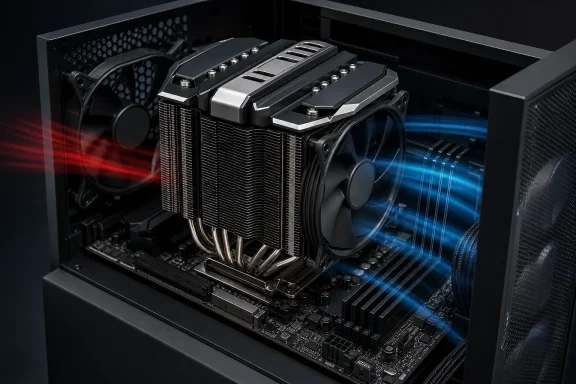
Cooler Master calls the design 3DHP, short for 3D Heat Pipe. Conventional tower coolers generally run U-shaped heatpipes through the base and out through the fin stack on each side. The V8 ACE’s two central heatpipes add a third, vertical branch through the middle of the stack, creating what reviewers have described as a trident-shaped path.
The practical argument is straightforward. A normal heatpipe array concentrates heat transfer around the routes where those pipes cross the fins; the V8 ACE aims to bring more heat directly into the stack’s middle rather than relying on lateral conduction through the aluminum fins. Cooler Master says the design improves fin utilization, but the company does not publish a directly comparable thermal test showing the 3DHP model against an otherwise identical conventional six-pipe V8.
The independent results nevertheless indicate that the design is accomplishing something. Tom’s Hardware tested the AMD version on a Ryzen 9 9950X3D under Precision Boost Overdrive, where the processor can exceed 260 W, and found that the V8 ACE delivered results close to the best coolers its lab had tested. In a noise-normalized test, it recorded the site’s second-best result. That is a meaningful result for a single-tower cooler, particularly when high-power Ryzen CPUs reach their 95 °C thermal limit and reduce clocks with many conventional air coolers.
PC Gamer reached a similar conclusion using Intel’s Core i7-14700K. In its roughly 230 W Prime95 run, the V8 ACE averaged 71 °C normalized to a 20 °C ambient temperature, behind Noctua’s NH-D15 G2 at 66 °C but ahead of several large dual-tower designs. Under a lighter 180 W Prime95 load, however, it averaged 60 °C—identical to the far cheaper Arctic Freezer 36 in that particular test. The V8 ACE has impressive headroom, but it is not magic: its advantage becomes clearer when the CPU is pushed hard enough to challenge ordinary air coolers.
The two fans are doing substantial work
The V8 ACE is not a compact cooler with ordinary fans. Its front 120 mm fan is 30 mm deep, rated for up to 2,500 RPM, 89.6 CFM, and 3.85 mmH₂O of static pressure. The rear unit is also 30 mm deep, but tops out at 2,050 RPM and is rated for 61 CFM and 2.0 mmH₂O. Cooler Master deliberately uses the stronger fan as the intake side, pushing air into a dense fin stack, with the slower rear fan balancing the exhaust side.
That difference helps explain why the cooler performs well in stress testing. The 30 mm fan depth creates more room for a larger blade and motor assembly than the familiar 25 mm format, and the Liquid Crystal Polymer blades are intended to resist flex at high rotational speed. Tom’s Hardware found that the stock fans were already strong enough to extract nearly all the heatsink’s potential; swapping in more powerful aftermarket fans produced little additional benefit.
The trade-off is acoustic. Cooler Master’s own ratings of 37 dB(A) for the front fan and 34 dB(A) for the rear fan are component specifications, not a measurement of the complete cooler installed in a PC. PC Gamer measured 48 dB(A) at 40 cm with the fans at 100%, while Tom’s Hardware recorded 45.6 dB(A) at maximum speed. Those figures do not make the V8 ACE unusually loud for its performance class—it was quieter than Thermalright’s Peerless Assassin 120 SE in PC Gamer’s test—but neither does it deliver Noctua NH-D15 G2-level quietness at full speed.
For a Windows workstation that spends hours compiling code, rendering video, encoding media, or running CPU-bound local AI workloads, a sensible PWM curve will matter more than the headline maximum RPM. Leaving the fans to run aggressively for brief temperature spikes would undermine one of air cooling’s main benefits: predictable, low-maintenance operation without pump noise.
Gaming is where the compact fin stack gives something back
The V8 ACE’s single-tower design saves width compared with large dual-tower coolers, but it does not eliminate clearance issues. At 167.3 mm tall, it is still taller than many mainstream mid-tower cases permit. Builders should not assume “single tower” means universal compatibility; the case specification must list CPU-cooler clearance of at least 168 mm, preferably with a few additional millimeters to account for panel tolerances.
Memory clearance is also conditional. Tom’s Hardware reports official support for RAM up to 45 mm tall, though its 48.8 mm modules fit only after raising the front fan slightly. PC Gamer likewise found that taller DIMMs can require shifting the fan upward, which increases the installed height and compromises the engine-block appearance. The sliding fan rails make this adjustment much easier than wire clips, but they do not change the geometry of a 167 mm cooler.
More importantly, Tom’s Hardware found a weakness during a combined CPU-and-GPU thermal scenario: the V8 ACE trailed more conventional large coolers when the case interior became warmer under a GPU load. Its conclusion was that the reduced fin area of the compact single tower hurts performance when the air feeding the cooler is already hot.
That finding should guide purchases. This is a stronger fit for a CPU-heavy machine with competent front intake and a GPU that does not saturate the case with heat. In a gaming PC carrying a 300 W-class graphics card, case airflow becomes part of the cooler decision. A large dual-tower cooler, or a properly installed liquid cooler, may retain more margin once the GPU has raised internal ambient temperature.
Intel and AMD buyers should select the matching version
Cooler Master sells separate Intel and AMD versions rather than simply bundling one universal base. The AMD model officially supports AM4 and AM5, while the Intel model supports LGA 1851, 1700, 1200, and the LGA 115x family. The cooler’s dimensions, six-year warranty, heatpipe layout, and fan specifications are otherwise the same.
According to Tom’s Hardware, both versions include mounting hardware for both platforms, but the contact surfaces differ: the AMD version is flatter, while the Intel version is more convex. Cooler Master also says the base and mounting are tuned for each platform’s integrated heat spreader shape, hotspot placement, and sustained thermal behavior. In other words, cross-platform mounting may be physically possible, but buying the version designed for the installed CPU is the only configuration supported as performance-optimized.
That detail is easy to miss because the product looks identical in retailer listings. It also matters more than a cosmetic choice on current enthusiast platforms. Intel’s high sustained package power and AMD’s localized AM5 hotspot behavior ask different things of the cooler base; mounting the intended variant is the simplest way to avoid paying a premium for contact optimization and then discarding it.
This is a premium air cooler, not a budget champion
Cooler Master’s V8 ACE 3DHP costs $119.99 at major U.S. retailers, placing it near Noctua NH-D15 G2 territory and well above proven dual-tower alternatives from Thermalright, Cooler Master itself, and others. The comparison is unavoidable: PC Gamer found that Thermalright’s much cheaper Peerless Assassin 120 SE could equal or better the V8 ACE in some thermal tests, although it was noisier. Tom’s Hardware also called out Thermalright’s Royal Pretor 130 as a lower-cost option for buyers prioritizing cooling per dollar.
The V8 ACE therefore earns its place in a narrower category. It is for builders who want high-end air cooling, prefer a single-tower layout to a wide dual-tower block, have a case that supports its 167.3 mm height, and specifically value the non-RGB engine-inspired presentation. The six-year warranty and user-replaceable, rail-mounted fans add some long-term value, especially compared with sealed liquid coolers whose pump is a single point of failure.
The supplied eTeknix review was right to be skeptical of the marketing language around heat routing. What changes the assessment is that two independent test labs found results consistent with Cooler Master’s larger claim: the V8 ACE can deliver dual-tower-class CPU cooling from one fin stack. It does not replace less expensive coolers as the rational default, and it needs a well-ventilated case to avoid losing ground in GPU-heavy gaming. But for a high-power Windows desktop where CPU load is the main thermal problem, Cooler Master’s unusual V8 is a real engineering advance rather than an engine-cover gimmick.
