
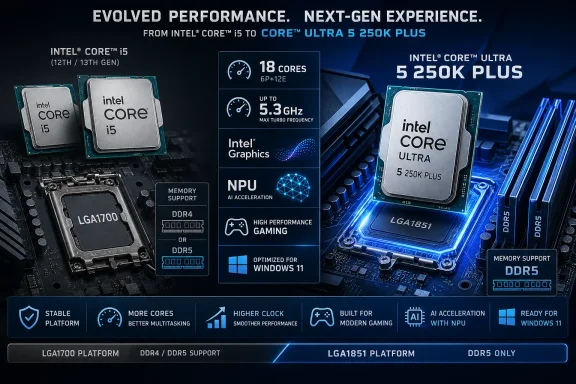
The most obvious omission is Intel’s Core Ultra 5 250K Plus, which reached retail on March 26, 2026. Intel lists it as an 18-core part with six Performance-cores, 12 Efficient-cores, a 5.3GHz maximum turbo clock, 30MB of cache, and a $219–$229 recommended price. That makes a list framed as a July 2026 buying guide look more like a clearance-stock guide.
 Old chips, valid use cases
The older recommendations are not inherently bad. Intel’s Core i5-14600K is still a 14-core, 20-thread CPU with a 5.3GHz boost clock, UHD 770 graphics, and strong Windows gaming and desktop performance. The Core i5-13600K and i5-12600K can also be sensible upgrades for someone who already owns a compatible LGA1700 board.
Likewise, the i5-12400F remains usable for a low-cost 1080p gaming PC, while the i5-9600K only makes sense as a cheap, used-market upgrade for an existing Intel 300-series motherboard. Presenting the latter as one of the eight best i5 purchases in 2026, however, needs far more qualification. It is a six-core, six-thread part on a long-retired platform, not a sensible foundation for a new Windows 11 build.
Platform details matter
The roundup also overgeneralizes memory support. Its 12th-, 13th-, and 14th-generation Core i5 selections can be paired with either DDR4 or DDR5, but only if the chosen LGA1700 motherboard supports that memory type. A board supports one or the other, never both.
That flexibility does not carry over to the current Core Ultra 5 250K Plus. Intel specifies DDR5 memory only, up to DDR5-7200, and LGA1851 support. It also includes Intel Graphics and an NPU, capabilities absent from the older Core i5 parts in the list.
The i5-14400F entry is more accurate on basic specifications: it is a 65W base-power, 10-core/16-thread chip with a 4.7GHz turbo. But buyers should account for its 148W maximum turbo power rather than treating “65W TDP” as a hard ceiling. Intel also confirms that boxed i5-14400F processors ship with a Laminar RM1 cooler, though an aftermarket cooler may still reduce noise during sustained loads.
Stability advice needs tightening
The article says 13th- and 14th-generation stability concerns primarily affected Core i7 and Core i9 models and that the listed i5 chips were “largely
