
Early critic reception suggests that Corsair Cove is more than another pirate-themed coat of paint applied to conventional settlement management. The initial review round-up places its Metacritic average at 79/100 from 11 reviews, with praise focused on its dense environmental design, vertical building systems, progression structure, and atmosphere—although concerns over performance, bugs, naval encounters, and exploration temper the enthusiasm. VP Esports’ review aggregation reports the score and the early spread of critical opinion.
For Windows players, the immediate question is not only whether Corsair Cove’s pirate fantasy sounds appealing, but whether their PC is ready for a game built around complex production chains, thousands of inhabitants, interconnected transport routes, and sprawling settlements layered across cliffs. The good news is that its published minimum specification is approachable for many existing gaming PCs. The caveat is that the recommended hardware—and the early reports of frame-rate instability—make the free Steam demo an unusually important part of the buying decision.
 Overview: A City Builder That Treats Height as a Resource
Corsair Cove is a single-player pirate city builder and strategy game developed by Limbic Entertainment and published by Hooded Horse. Its premise places players in the fading era of piracy, as the Crown’s forces attempt to eliminate pirate havens and bring the high seas under state control. Instead of centering the experience on sword fighting or open-ocean action, the game makes the survival and growth of a pirate settlement its central challenge. Xbox Wire’s game description frames the objective as building a haven, manufacturing equipment, raising ships, and resisting the Crown.
That distinction is important. Corsair Cove may have naval expeditions, raids, ship combat, treasure, and a rowdy cast of pirates, but its core loop is closer to a logistics-driven colony simulation than to an action-adventure game. Players gather resources, move them through a settlement, process them into increasingly valuable goods, satisfy a growing population, and develop the military and maritime capacity needed to survive outside pressure. PC Gamer’s hands-on coverage describes it as a logistics-heavy city builder whose central task is to create an efficient colony.
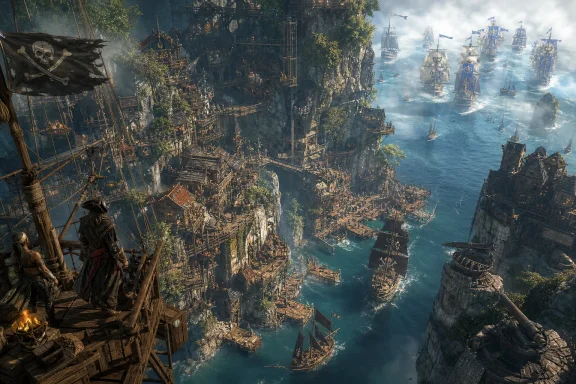
The feature that separates Corsair Cove from more familiar city-building games is the terrain. The settlement is established on a rugged, rocky island with limited flat ground, forcing players to build along cliff faces, hilltops, and elevated surfaces. In other words, verticality is not cosmetic terrain dressing; it is a core management constraint. Limbic Entertainment’s announcement describes the project as a pirate city builder in which players can build freely across the island rather than simply filling out a conventional land grid.
This approach gives Corsair Cove a compelling practical identity. A production building located above a dock or warehouse is not useful unless workers and goods can reach it. That means paths, ladders, ropeways, bridges, elevators, and later upgrades are as consequential as the buildings themselves. PC Gamer’s July preview notes that the game’s connections dynamically incorporate bridges, rope paths, and ladders, and that inefficient travel distances can produce supply bottlenecks.
Release Date, Launch Time, and PC Availability
The official Corsair Cove release date is Friday, July 31, 2026. Steam currently lists that date on its product page, and the title is still marked as unreleased at the time of publication. Steam’s listing identifies Limbic Entertainment as developer, Hooded Horse as publisher, and July 31, 2026 as the release date.
For players trying to plan around a midnight launch, the timing needs a little more precision. SteamDB lists Corsair Cove’s Steam release as July 31 at 15:00 UTC. SteamDB records that launch timestamp, which translates to 11:00 a.m. Eastern Daylight Time, 8:00 a.m. Pacific Daylight Time, and 4:00 p.m. British Summer Time on July 31. In time zones sufficiently far east of UTC, that scheduled release falls after midnight on August 1.
The game’s PC distribution plan is broad rather than tied to one launcher. The original release reporting identifies Steam, Epic Games Store, and Microsoft Store as the expected storefronts, with PC Game Pass access from day one. VP Esports’ launch guide lists those stores and the subscription launch plan, while Microsoft’s Game Pass announcement independently confirms Corsair Cove (PC) for both Game Pass Ultimate and PC Game Pass on July 31.
PC Game Pass Is a Meaningful Part of the Launch
For a strategy game with an ambitious simulation layer, the Game Pass launch matters. City builders commonly demand several hours before their systems reveal whether the settlement’s layout, resource model, pacing, and late-game stressors suit a particular player. A subscription option lowers the barrier to trying that experience, especially when the game is also entering the market with reports of technical rough edges.
Microsoft’s own description positions the game around large-scale pirate-haven construction, fleet building, production chains, and governing a volatile crew. Xbox Wire says players will manage goods ranging from ale to flintlock pistols while attempting to reign over the seas. That is a promising framework for fans of economic strategy, but it also signals that Corsair Cove will likely reward patience, experimentation, and an appetite for interconnected systems rather than immediate action.
Price Has Not Been Announced
Hooded Horse had not disclosed an official Corsair Cove price in the pre-release reporting available at publication time. VP Esports reports that the publisher had not announced pricing and expected store prices to appear at launch.
That lack of a confirmed price is not necessarily unusual so close to release, but it reinforces the appeal of both the Steam demo and the day-one PC Game Pass option. Players who are primarily interested in the game’s technical stability can evaluate it before committing to a full storefront purchase.
Corsair Cove PC System Requirements
Corsair Cove’s official hardware requirements indicate a game designed for reasonably capable modern Windows hardware, but not one that demands a newly built enthusiast PC. The published minimum target is based on older but still capable midrange CPUs and 6GB graphics cards, while the recommended target moves to 16GB of system memory and an 8GB GPU. The official Steam demo page contains the current detailed minimum and recommended requirement lists.
| Component | Minimum requirements | Recommended requirements |
|---|---|---|
| Operating system | Windows 10 64-bit | Windows 10 64-bit |
| Processor | Intel Core i7-7700 or AMD Ryzen 5 1600 | Intel Core i5-9600K or AMD Ryzen 5 3600 |
| Memory | 8GB RAM | 16GB RAM |
| Graphics | NVIDIA GeForce GTX 1660 Super 6GB or AMD Radeon RX 5600 XT 6GB | NVIDIA GeForce RTX 2070 8GB or AMD Radeon RX 6600 XT 8GB |
| DirectX | Version 12 | Version 12 |
| Storage | 30GB available space | 30GB available space |
| Storage guidance | SSD recommended | SSD recommended |
Requirements listed above are drawn from the current official Steam demo specification page.
Minimum Specs: What They Really Mean
The minimum specification calls for a 64-bit version of Windows 10, an Intel Core i7-7700 or AMD Ryzen 5 1600, 8GB of RAM, and either a GTX 1660 Super or Radeon RX 5600 XT with 6GB of VRAM. DirectX 12 support is mandatory, and players will need 30GB of available storage. Steam’s requirements listing also recommends an SSD even at the minimum tier.
The CPU requirement is noteworthy because it does not simply ask for a basic quad-core processor. The i7-7700 is an older four-core/eight-thread chip, while the Ryzen 5 1600 provides six cores and twelve threads. That suggests the game’s simulation, pathfinding, population activity, and production management may be CPU-sensitive—an unsurprising possibility for a city builder that needs to account for many moving workers and goods across a three-dimensional settlement.
The minimum 8GB RAM requirement should be read as a launch threshold rather than a comfort target. Modern Windows installations, background applications, browser tabs, Discord, capture utilities, and hardware-management software can easily consume enough memory to make 8GB restrictive. A PC that technically meets the minimum may run the game, but it could still be more vulnerable to hitching or background-memory pressure during large settlements.
Recommended Specs: The Sensible Target for New Players
The recommended specification raises memory to 16GB, calls for an Intel Core i5-9600K or AMD Ryzen 5 3600, and asks for an RTX 2070 or RX 6600 XT with 8GB of VRAM. Steam’s official recommended requirements identify those specific CPU and GPU pairings.
For most Windows gamers, 16GB RAM and an SSD should be treated as the practical baseline, not merely optional luxuries. The game’s vertical settlements create a density of structures, routes, animations, inventories, and AI movement that can place a different type of strain on a PC than an action game running through linear levels. The game may not need an extreme GPU to begin with, but late-stage city complexity can expose CPU, memory, and storage limitations.
The recommended GPU choices are also revealing. An RTX 2070 and Radeon RX 6600 XT are not cutting-edge products, but each supplies 8GB of VRAM, a meaningful step beyond the 6GB minimum cards. Players on GPUs with 4GB of VRAM, integrated graphics, or aging mobile parts should not assume that lowering a few quality settings will guarantee a smooth experience, especially when a settlement grows more complex.
SSD Storage Is More Than a Footnote
Corsair Cove requires 30GB of free storage, which is modest by current PC game standards. However, the official requirements specifically recommend an SSD. Steam’s specification sheet includes that recommendation for both minimum and recommended configurations.
For simulation games, SSD use can affect more than initial loading screens. Faster storage can improve asset streaming, reduce interruptions when moving around a large settlement, and make saving and loading more tolerable. It will not compensate for an underpowered processor or graphics card, but it is one of the easiest practical upgrades for a system still relying on a mechanical hard disk.
How the Core Systems Set Corsair Cove Apart
Corsair Cove’s strongest idea is its refusal to treat terrain as an obstacle that players simply flatten, route around, or ignore. The island’s cliff faces and height differences are the game’s organizing principle. PC Gamer’s announcement coverage describes a settlement built with rope bridges, ziplines, elevators, and perches created from the wreckage of a former galleon.
Building Upward, Not Outward
Traditional city builders typically ask players to optimize a horizontal map. Roads form the backbone, districts expand outward, and distance is often measured in tiles. Corsair Cove changes that equation. A short straight-line distance can become a long logistical journey if the destination sits above a cliff, behind an inaccessible ledge, or across an inefficient chain of elevated links.
That can create meaningful strategic trade-offs:
- Place workshops close to raw materials and risk isolating them from housing or warehouses.
- Build near storage facilities and accept the cost of complex vertical routes.
- Prioritize fast travel infrastructure early to prevent worker journeys from becoming a bottleneck.
- Reserve convenient terrain for high-throughput buildings instead of visually attractive but inefficient layouts.
- Expand population only as quickly as food, housing, transport, and morale systems can sustain it.
The design has the potential to make every pirate settlement look genuinely different. Rather than arranging familiar grids of buildings, players are likely to build around the specific physical quirks of their island. That sense of place is one reason early coverage has stressed the appeal of Corsair Cove’s rocky island hideout and unusual construction tools. PC Gamer highlighted the game’s elevated hideouts and the challenge of limited usable building space.
Production Chains Have a Pirate Identity
The production model appears to combine familiar management-game logic with distinctly pirate-focused outputs. Players are expected to manufacture goods such as ale, spyglasses, cannons, and flintlock pistols, equip their crews, and prepare ships for activity beyond the island. Xbox Wire’s launch-week overview specifically references production ranging from spyglasses to cannons, while Microsoft’s Game Pass post cites ale and flintlock pistols.
That thematic consistency matters. Good city builders make their production chains feel consequential rather than abstract, and piracy provides natural reasons for goods to connect. Food and drink support a crew; tools and materials support construction; weapons and ammunition support defense; ships extend access to resources and opportunities unavailable on the starting island.
PC Gamer reported that the game features production chains involving more than 50 goods. Its April coverage described the need to manage that variety while expanding from a shipwreck into a functioning society. If the final game maintains that breadth without burying players under needless complexity, Corsair Cove could offer the satisfying escalation that the best management games require.
Progression Through Four Directions
Corsair Cove uses a progression framework described as a Compass tech tree, with advancement distributed across four directions. The four named pillars are Notoriety, Empire, Seafaring, and Wealth. The Steam demo page explains that pursuing these categories unlocks additional buildings, production chains, tools, and more powerful ships.
This is a potentially smart answer to a common city-builder problem: the feeling that there is only one “correct” order of development. A player who needs more productive infrastructure may choose Empire or Wealth-related tools. Another who wants to improve mobility may prioritize ziplines and logistics. A player eager to push outward could invest more heavily in Seafaring and naval capability.
The key question is whether those branches create genuine specialization or simply delay access to mandatory upgrades. The early evidence is encouraging, because the game appears to connect progression to choices about productivity, transport, ships, and expansion rather than presenting a purely decorative technology tree. Steam’s demo description gives ziplines and productivity-oriented buildings as examples of unlockable tools.
Story Mode, Sandbox Play, and Naval Expeditions
Corsair Cove will include both a story-driven experience and Uncharted Mode, a freer sandbox option. The reported opening begins with survivors of a prison-ship crash building their first settlement around a skull-shaped rock, giving the game a strong visual hook and a narrative justification for starting with limited resources. VP Esports’ early review summary outlines the premise, the story/sandbox split, and the structure of the Compass progression system.
The existence of a sandbox is especially valuable for city-builder players. Narrative missions can provide useful direction and carefully paced introductions to systems, but the genre’s long-term audience often wants to test layouts, experiment with scaling, and build without story objectives pushing them toward a fixed endpoint. Uncharted Mode should give Corsair Cove a better chance of sustaining interest after the initial campaign is complete.
Naval activity is intended to expand the game beyond its island base. Players can launch ships, face pirate hunters, fight the Crown’s agents, seek resources, raid islands, and encounter threats in uncharted waters. PC Gamer’s announcement coverage says ships are needed to confront pirate hunters and uncover dangers beyond the settlement, while Xbox Wire mentions raids, treasure, exploration, and war against the Crown.
The concern is that the naval layer may be less consistently successful than the city-building side. Early reviews reportedly criticize repetitive naval battles and a simplified exploration system. VP Esports’ round-up identifies both as recurring complaints. That does not make naval content a failure, but it suggests that prospective players should view it as an extension of the colony-management experience rather than assume a deep standalone naval strategy game.
Critic Reviews: Strong Foundations, Meaningful Reservations
The early score spread gives Corsair Cove a favorable opening. The reported reviews include 9/10 from SECTOR.sk, 87/100 from GameStar, 85/100 from Destructoid, and 8/10 scores from CGMagazine, Eurogamer Germany, SteamDeckHQ, and IGN Deutschland. The lower end of the group includes 7/10 ratings from The Wand Report, Try Hard Guides, and GameBlast, plus 6/10 from Gameliner. VP Esports’ compiled review list provides those early publications and scores.
A 79/100 average is a solid result for a simulation game entering a crowded market, particularly when its design is attempting to fuse vertical urban planning, pirate fantasy, maritime systems, production chains, and dynamic islands. However, the sample is still limited. Eleven reviews provide a useful early signal, not a permanent verdict, and the average can change as additional outlets publish assessments.
What Critics Appear to Like
The positive themes are unusually coherent. Reviewers have reportedly responded well to the environmental design, the sense of place created by the skull-shaped island setting, the progression system, and the vertical construction mechanics. VP Esports identifies those strengths as the core of the critical praise.
That aligns with pre-release hands-on impressions. PC Gamer characterized the project as a vertical city builder full of novelties rather than a simple pirate-themed version of an existing management game. Its July feature specifically contrasted Corsair Cove with a straightforward reskin and stressed the importance of its logistics systems.
The game’s strongest asset may therefore be clarity of design purpose. Corsair Cove is not trying to be every kind of pirate game. Its combat, exploration, and quest systems serve a settlement-management structure built around scarce flat land, travel time, infrastructure, and escalating production demands.
The Technical Risk at Launch
The main warning in early reviews concerns performance and technical polish. The review round-up cites frame-rate drops, minor bugs, and optimization issues as the principal complaints. VP Esports’ report says those problems recur across coverage.
For Windows PC players, this matters more than it might in a short, linear game. City builders can become substantially more demanding as the settlement grows. A performance issue that appears minor during the opening hours can become serious once a save contains more citizens, buildings, production routes, ships, and active simulation processes.
The requirements and the criticism together lead to a practical conclusion: players close to the minimum specification should avoid treating the hardware list as a performance guarantee. The game may run, but the difference between “launches successfully” and “remains smooth during a mature settlement” can be substantial. The recommended 16GB memory target, 8GB graphics cards, and SSD guidance should be taken seriously. Steam’s official requirements provide the baseline hardware context, while the review round-up provides the early performance caution.
Steam Demo: The Best Way to Test a Windows PC
Corsair Cove has a free Steam demo, and it is the most useful tool available to players deciding whether their PC can handle the game comfortably. Steam’s product page includes a direct demo download section and the full current requirements list. Steam confirms that a Corsair Cove demo is available, while the dedicated demo page provides the system requirements and current player-feedback summary.
The demo is also already attracting a meaningful sample of player feedback. At the time Steam’s page was indexed, the demo showed 571 total user reviews, including 518 positive and 53 negative, for a Very Positive aggregate designation. Steam’s demo listing displays those figures. Demo feedback should not be treated as a substitute for reviews of the final build, but it is a useful indication that the core concept has landed with a sizeable group of players.
A Practical Pre-Launch Test Plan
Windows gamers should use the demo to test more than frame rate in the opening minutes. A useful evaluation process includes:
- Check resolution and display settings first. Start with the game’s automatic preset, then compare it with a manually adjusted medium or high profile.
- Monitor frame-time consistency, not only average FPS. Brief stutters during camera movement, construction, or busy production activity can be more disruptive in a city builder than a lower but stable average frame rate.
- Build enough infrastructure to stress navigation. Corsair Cove’s vertical paths are central to the experience, so test how the game behaves once bridges, ladders, routes, and multiple production structures are active.
- Watch CPU, GPU, RAM, and VRAM usage. Windows Task Manager, hardware-monitoring tools, and GPU overlays can help reveal whether the system is running out of memory or reaching sustained CPU limits.
- Test after a save reload. Storage performance and save-state complexity can expose issues that a brand-new session does not.
- Try controller and input preferences if relevant. Even though Corsair Cove is a PC-first city-building game, players using handheld PCs or controllers should test their preferred setup before buying.
- Compare your experience with the recommended tier. If a system merely matches the minimum requirements and the demo already needs aggressive compromises, waiting for optimization updates may be the more sensible approach.
Final Assessment
Corsair Cove arrives with the makings of one of the more distinctive PC city-building games of 2026. Its pirate setting is attractive, but the more meaningful innovation is structural: the game turns cliffs, elevation, transport time, and limited flat terrain into the heart of its economy. That creates a foundation capable of producing settlements that feel improvised, precarious, and authentically pirate-built rather than neatly grid-planned.
The early reviews support that optimism. A reported 79/100 Metacritic average from 11 critics, alongside several scores in the 8/10 range or higher, suggests that Limbic Entertainment has delivered a compelling core system with real genre potential. VP Esports’ review round-up shows broad approval of the game’s design, progression, and atmosphere.
At the same time, the performance warnings deserve equal attention. Corsair Cove’s system requirements are reasonable, but its simulation-heavy design and early reports of frame drops make it a game where the recommended hardware target is more reassuring than the minimum one. The free Steam demo and day-one PC Game Pass release provide low-risk ways to see whether its vertical pirate empire-building works as well on a particular Windows PC as it does in concept.
If post-launch patches strengthen optimization and add depth to the naval and exploration layers, Corsair Cove could become more than a promising new pirate city builder. Its vertical logistics model gives it a strong identity in a genre that too often relies on familiar maps, familiar roads, and familiar expansion patterns.
