
But iLounge’s August 28 assessment misses an important practical distinction: unsupported is not the same as impossible. CodeWeavers currently rates Counter-Strike 2 as “Runs Well” under CrossOver on macOS, and its own testing has found that memory capacity and a Pro-class Apple chip can substantially affect results. The correct answer for an M5 MacBook Pro is therefore more conditional: it can run CS2 through a Windows compatibility layer, but it cannot run Valve’s game as a supported Mac application—and it cannot participate in the full Windows-centric competitive stack.
Apple’s latest MacBook Pro hardware makes that distinction more visible, not less. Apple introduced M5 Pro and M5 Max MacBook Pros on March 3, 2026, with up to an 18-core CPU, a 40-core M5 Max GPU, up to 128GB of unified memory, hardware ray-tracing support, and Thunderbolt 5. Those specifications are ample for a Source 2 shooter if the software path cooperates. The constraint is Valve’s platform support and the layers required to get around it, rather than a lack of graphics hardware.
 Valve’s decision was about support economics, not Apple silicon
Valve made its position explicit after Counter-Strike 2 replaced CS:GO. In its Steam support guidance, the company said macOS, 32-bit Windows, and DirectX 9 systems together accounted for less than one percent of active CS:GO players, and it moved CS2 forward as a 64-bit Windows and Linux title.
That explanation is more precise than the common claim that Apple silicon is inherently incompatible with Counter-Strike 2. Valve did not say the game was technically impossible to bring to Macs. It said maintaining those legacy platform paths was not justified by the player population. CS2’s supported Linux build also demonstrates that Valve is willing to maintain more than one desktop operating-system target when it sees a viable audience and technical route.
The loss was meaningful for existing Mac players because CS:GO had a macOS release for years. When CS2 arrived on September 27, 2023, it displaced CS:GO in Steam libraries. Valve offered a frozen legacy CS:GO build, without official matchmaking, but said Game Coordinator-dependent functions such as inventory access could degrade after January 1, 2024.
For someone purchasing an M5 Pro or M5 Max machine in 2026, that history produces a simple buying rule: do not treat Counter-Strike 2 as a native Mac game merely because Steam is installed and the hardware is powerful. Valve’s current official system requirements remain the controlling record.
CrossOver changes the answer for casual Mac players
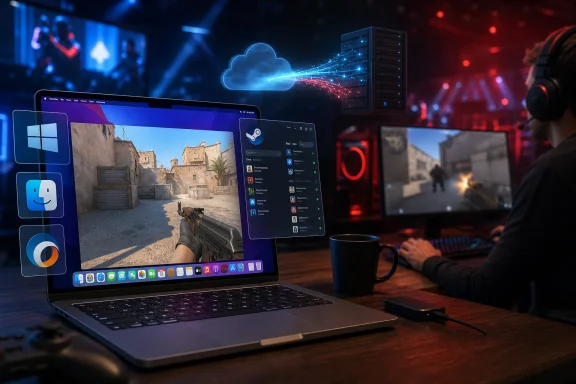
The largest omission in the “neither Mac can run it” argument is CrossOver. CrossOver is CodeWeavers’ commercial Wine-based compatibility layer: it translates Windows application and graphics behavior for macOS rather than installing a full copy of Windows in a virtual machine. CodeWeavers added an installation path for Counter-Strike 2 shortly after the game’s release, and its current compatibility directory lists the game as running well on macOS.
That rating should not be read as an official endorsement from Valve. It is CodeWeavers’ compatibility assessment, based partly on community testing, and Valve can change Counter-Strike 2 in ways that disrupt a translation-layer setup. A player who takes this route is accepting an extra maintenance burden: updates can introduce launch failures, graphical glitches, controller or audio issues, or performance regressions that a normal Windows installation would not have.
Still, CrossOver makes a material difference to the question of whether an M5 Mac can play CS2. CodeWeavers’ published testing from 2024 found that the game behaved far better with more memory and a Pro-class chip, while an M2 MacBook Pro with only 8GB of unified memory dropped from around 40 frames per second to about 10 fps before crashing. That is not a performance profile that supports the idea that Mac configuration is irrelevant.
The M5 Pro and M5 Max should remove much of the basic compute and memory pressure seen on lower-end older Macs, particularly in 24GB, 36GB, 48GB, or higher configurations. But there is no credible basis for promising a specific frame rate across maps, macOS releases, CrossOver versions, or CS2 patches. Frame-time consistency, shader compilation behavior, and translation-layer changes matter more to a competitive shooter than one headline FPS number.
The realistic verdict is straightforward. A properly configured M5 Pro or M5 Max can be a workable CS2 machine for practice, casual matchmaking, and occasional play through CrossOver. It is not the same thing as buying a Windows gaming laptop, installing Steam, and expecting every update, anti-cheat requirement, and peripheral to work without intervention.
FACEIT is the line a Mac workaround cannot cross
The decisive limitation for serious Counter-Strike players is not graphics performance. It is anti-cheat.
FACEIT’s own support documentation says its Anti-Cheat package includes an application, a kernel-mode driver loaded at PC boot, and server-side components that confirm the client is active during protected matches. FACEIT also says the software is available only for Windows 10 and Windows 11; there are no Mac or Linux versions. Its current requirements can also include Windows Secure Boot and TPM 2.0.
That eliminates the idea that a high-end MacBook Pro plus CrossOver is a full competitive substitute for a Windows PC. A compatibility layer can sometimes make the game client run, but it cannot turn macOS into an environment supported by FACEIT’s Windows driver and boot-integrity checks. Virtualizing Windows on an Apple-silicon Mac does not solve the fundamental problem either: it introduces Windows on ARM, x86-to-ARM emulation for the game, virtualized graphics, and a security environment that competitive anti-cheat products may reject.
This is where the iLounge article’s broad recommendation to buy a cheap Windows machine for ranked play is sound, even if its claim that Macs cannot run CS2 at all is not. A modest Windows desktop or laptop with supported drivers, TPM 2.0, Secure Boot, and a stable wired network provides something a Mac workaround does not: a supported path into the tournament and third-party matchmaking infrastructure many committed CS2 players use.
Windows users should not assume that any old device automatically qualifies. FACEIT’s security guidance means a system may need firmware settings adjusted before it can join protected matches. The useful test is to install the anti-cheat client and verify its requirements before spending time tuning CS2 settings or purchasing a used PC.
GeForce NOW is convenient, but it does not erase latency
Nvidia added Counter-Strike 2 to GeForce NOW in October 2023, and the service remains the least complicated way to put CS2 on a Mac without maintaining CrossOver or Windows. It runs the game on remote Windows hardware and streams audio and video to the Mac, which means the local operating system never needs a Valve-supported CS2 executable.
Nvidia has promoted Reflex-enabled, high-frame-rate cloud streaming for Ultimate members. That can improve the cloud experience, but it cannot repeal the physics of distance, Wi-Fi interference, home-network congestion, display latency, and the round trip to Nvidia’s data center. High rendered frame rates are useful; they are not proof of low end-to-end input delay.
For casual play, GeForce NOW is a legitimate answer. It costs less time than configuring a compatibility layer, works on Macs that would otherwise struggle locally, and keeps the game installation off the notebook’s storage. It is particularly sensible for a player who wants to join friends occasionally and has a stable, low-latency internet connection.
For ranked players, cloud streaming remains a compromise. Counter-Strike rewards rapid, repeatable mouse input and clear feedback from movement, recoil, and peeker’s advantage. Adding an internet round trip to that chain may be tolerable in a casual match, but it is an unnecessary handicap against locally running Windows systems.
The M5 upgrade helps only if the software route uses it
Apple has a defensible case that the M5 Pro and M5 Max improve the Mac’s gaming credentials. Its March announcement specifically cited stronger ray-tracing gaming performance in Cyberpunk 2077: Ultimate Edition compared with M4 Pro hardware. The M5 Max’s 40-core GPU and large unified-memory options are real upgrades, and a growing list of native Mac games benefits from them.
Counter-Strike 2 does not become part of that native catalog simply because the M5 Max is capable. Valve has shipped no macOS binary, and no announcement from Valve indicates an Apple-silicon or Metal port is planned. The game’s practical status is best understood in three tiers:
- CS2 is unsupported as a native macOS game and should not be a reason to pay extra for an M5 Max.
- CS2 can be run locally through CrossOver, where a well-equipped M5 Pro or M5 Max is materially better positioned than older low-memory Macs, but reliability remains outside Valve’s support commitment.
- CS2 can be streamed through GeForce NOW, which removes local compatibility problems while replacing them with network-latency considerations.
The purchasing consequence is clear. An M5 MacBook Pro can serve someone whose primary work is macOS development, video work, design, or Apple-platform administration and who wants to play Counter-Strike 2 occasionally through CrossOver or GeForce NOW. Anyone whose purchase is driven by Premier, FACEIT, leagues, or predictable high-refresh competitive CS2 should buy Windows hardware first.
