

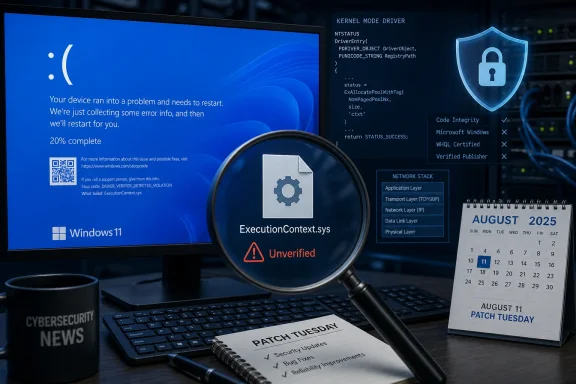
ExecutionContext.sys has surfaced one day before Microsoft’s August 11, 2026 Patch Tuesday, but administrators should treat it as an unverified report rather than a confirmed Windows zero-day. Cyber Kendra says an anonymous researcher has published a proof of concept under the label CVE-2026-62737 and claims it can crash a fully updated Windows 11 25H2 system from a standard-user context.The immediate operational problem is not that a working SYSTEM exploit has landed. It has not. Cyber Kendra’s own account says the available proof of concept triggers a blue-screen crash and still requires a separate kernel-address disclosure to overcome Kernel Address Space Layout Randomization, or KASLR, before it could become a practical local privilege-escalation chain. The more important finding from checking the public record is that the report does not yet provide enough material for anyone outside its author to reproduce the underlying condition.
As of Monday, August 10, neither Microsoft’s Security Update Guide nor the National Vulnerability Database has a public entry for CVE-2026-62737. Microsoft has not acknowledged the issue, listed affected builds, issued a workaround, or indicated that a fix is coming in Tuesday’s release. That does not disprove a privately reported bug or a CVE reservation, but it means the identifier should not be entered into vulnerability-management systems as a confirmed Microsoft vulnerability.
The “PoC” Is Not Publicly Verifiable
Cyber Kendra describes an anonymous researcher’s technical writeup and says a crash dump was released, but its report does not identify the researcher, link a public code repository, identify a disclosure platform, provide the crash dump, or name an exact Windows build and cumulative update on which the test was performed. It also does not say whether Microsoft received the report before publication.
Those omissions are material. A reliable kernel-bug report normally gives independent researchers a way to establish at least the primitive: a driver version, device path, access method, reproducible crash, relevant I/O control operation, and a stack trace that ties execution to the vulnerable path. Here, the available account asks readers to accept the critical parts of the chain secondhand.
The source’s central claim is that an NDIS networking-stack loader or proxy path can reopen access to an otherwise access-controlled device exposed by ExecutionContext.sys. It further alleges that the driver accepts a user-controlled function pointer and queues it to a kernel worker after checking only that the pointer lands in kernel virtual memory.
If that behavior is accurate, the security consequence would be severe: a low-privileged user who can submit a kernel address may be able to steer execution within kernel context. But the alleged access-control bypass and the alleged pointer-validation failure are the two assertions that need independent reproduction. Neither has been independently reported by another security outlet, confirmed by Microsoft, or demonstrated in public technical material.
The distinction is more than academic. Windows kernel drivers frequently expose interfaces that look dangerous when viewed in isolation but are constrained by object security, caller context, opaque handles, feature state, code-integrity protections, or paths that cannot be reached by an unprivileged process on current builds. A crash alone establishes that something happened; it does not establish a usable elevation-of-privilege vulnerability.
ExecutionContext.sys Exists, but That Does Not Validate the Exploit Claim
The driver itself is real. Public Windows event-log metadata associates ExecutionContext.sys with the Microsoft-Windows-Network-ExecutionContext provider, and the component has been observed on Windows 11 installations dating back to the 21H2 era. Cyber Kendra describes it as a Microsoft-signed, demand-start driver connected with high-performance I/O scheduling.
That supports a narrow conclusion: the report names an actual Windows kernel driver rather than an invented file. It does not confirm the published claim about its interface, permissions, or exploitable behavior.
The demand-start description also changes the practical exposure analysis. A driver that is not continuously loaded is not necessarily inaccessible; Windows can load demand-start components when another component asks for them. But it means defenders should not infer that every Windows 11 PC is actively running the driver at all times, nor that disabling or deleting it is a safe response. Removing signed inbox kernel components outside a Microsoft-supported remediation path can damage networking functionality, break cumulative-update servicing, or simply fail to mitigate the alleged route into the driver.
There is another gap: Cyber Kendra says the test involved “the latest Windows build,” but does not state the OS build number, architecture, edition, servicing channel, or installed cumulative update. Windows 11 25H2 has received monthly servicing changes, and Microsoft has also shipped out-of-band updates for specific conditions. Without a build number and the file version of ExecutionContext.sys, “fully updated” is not a reproducible technical claim.
CVE-2026-62737 Has No Public Record Yet
The report’s use of CVE-2026-62737 is premature at best. A CVE number can be reserved before a full public record appears, and not every CVE is immediately visible in the National Vulnerability Database. Microsoft may also be validating a privately reported issue before publishing an advisory. Those are ordinary parts of coordinated disclosure.
But a number without a record is not confirmation that a flaw exists, that Microsoft owns the issue, or that the reported impact is correct. For IT teams, the label currently has no CVSS score, no affected-product list, no exploitability assessment, no remediation guidance, and no linkage to a Microsoft KB package.
That is especially important for organizations whose scanners, CMDB integrations, or exception workflows ingest CVE strings from threat feeds. Marking CVE-2026-62737 as confirmed now would turn one uncorroborated claim into an internal compliance event. The defensible status is under investigation: record the report, retain the source material, and wait for either a Microsoft advisory or a reproducible technical disclosure.
Microsoft’s May 2026 Patch Tuesday guidance is relevant here. The company has said its security releases are growing as automation and AI-assisted research increase vulnerability discovery, while its validation, prioritization, and disclosure process remains in place. That supports the expectation of bigger update payloads and more rapid triage; it does not establish that every claimed AI-assisted finding is valid or patch-ready.
August 11 Is a Checkpoint, Not Proof of a Fix
Microsoft is scheduled to publish its August 2026 security updates on Tuesday, August 11. Administrators should review the Security Update Guide, Windows 11 update-history entries, and cumulative-update release notes once those packages are live. Search specifically for ExecutionContext.sys, the claimed CVE identifier, and descriptions involving local privilege escalation, NDIS, network execution context, or kernel pointer validation.
A missing reference on Tuesday should not be read as a clean bill of health. If Microsoft has only just received the alleged report—or has not received it—the company may need time to reproduce, assess, and service a fix. Conversely, a patch can land under a different CVE or use less specific advisory wording. Patch notes are evidence, but they do not map perfectly to every public researcher claim.
For managed fleets, the appropriate response is disciplined rather than disruptive:
- Apply the August 11 Windows security update on the organization’s normal expedited security cadence after validation in representative rings.
- Keep standard users out of local administrator groups and restrict interactive access on shared workstations, jump hosts, developer workstations, and virtual desktop environments.
- Investigate unexpected bug checks naming
ExecutionContext.sys, but do not treat a crash alone as evidence of compromise. - Preserve crash dumps and event logs from affected systems, including the Windows build number, driver file version, loaded-driver list, and the parent process responsible for activity immediately before the crash.
- Do not delete, replace, or block
ExecutionContext.sysbased solely on this report unless Microsoft or a tested endpoint-security control publishes specific supported guidance.
The Current Risk Is Local Access, Not Remote Takeover
Even if the described bug is eventually validated, the reported condition is a local privilege escalation. An attacker would need code execution on the device first, whether through malware, a malicious installer, a compromised low-privilege account, a browser escape, or another entry point. That makes it a potentially valuable second-stage technique, not a standalone internet-facing intrusion vector.
For most home Windows 11 users, Microsoft’s normal update channel and avoiding untrusted executables remain the practical response. For enterprises, the higher-risk environments are multi-user systems and endpoints where developers, contractors, students, help-desk staff, or automation agents can run code under ordinary accounts. Those are the places where a local SYSTEM escalation can turn limited access into credential theft, security-tool tampering, persistence, or lateral movement.
The available evidence supports watching this claim closely, not declaring a confirmed Windows 11 emergency. The concrete next step arrives on August 11: determine whether Microsoft’s security release acknowledges CVE-2026-62737, names ExecutionContext.sys, or ships a relevant kernel fix. Until then, the report remains one outlet’s account of an anonymous researcher’s unreplicated crash—not a demonstrated SYSTEM-level exploit.
Update: Microsoft confirms CVE-2026-62737 as a Windows kernel elevation-of-privilege flaw (August 12, 2026)
Microsoft has now published an official Security Update Guide entry for CVE-2026-62737, titled “Windows Kernel Elevation of Privilege Vulnerability.” The advisory was published on August 11, replacing the earlier status of an unverified third-party claim with vendor confirmation that Microsoft recognizes a vulnerability under that identifier.
The Microsoft entry confirms the vulnerability category is local elevation of privilege, consistent with the prior assessment that it is not a standalone remote takeover vector. Organizations should now treat the CVE as a confirmed Microsoft vulnerability and check the August 11 security-release guidance and applicable Windows update packages for remediation information.
Microsoft’s publication does not, by itself, validate every technical assertion in the earlier anonymous report, including the claimed ExecutionContext.sys attack path, NDIS access-control bypass, user-controlled function pointer, or the availability of a practical SYSTEM exploit. Administrators should continue to avoid unsupported driver removal or blocking actions unless Microsoft provides specific mitigation guidance.