
Microsoft’s Security Update Guide entry, published August 14, identifies ShieldBreak as an elevation-of-privilege issue in the Microsoft Malware Protection Engine and marks an update as pending. That confirmation arrives after the proof of concept was released publicly on August 12 by the researcher known as Nightmare Eclipse. BleepingComputer first reported that Microsoft was investigating the claim; the later CVE assignment moves the issue beyond an unverified researcher allegation, even though Microsoft has still disclosed few operational details.
The vulnerability is locally exploitable, which means it does not give an unauthenticated internet attacker a direct path into a PC. An attacker needs code execution or an account on the device first. Once there, ShieldBreak can elevate that foothold to NT AUTHORITY\SYSTEM, Windows’ highest local privilege level, allowing an intruder to tamper with services, security controls, system files, and persistent malware components.
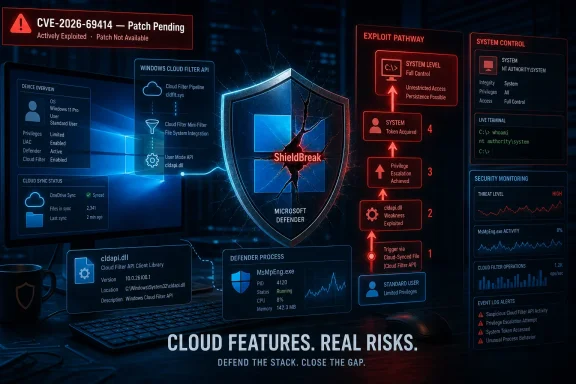 CVE-2026-69414 Is a Separate Defender Problem
The key correction is that ShieldBreak is no longer merely a claim that Microsoft’s fix for CVE-2026-50656, better known as RoguePlanet, failed. Microsoft issued ShieldBreak its own identifier, CVE-2026-69414, and identifies the affected component as the Microsoft Malware Protection Engine.
That distinction has practical consequences for patch reporting. RoguePlanet was addressed on July 8 through Malware Protection Engine version 1.1.26060.3008, rather than through a conventional Windows cumulative update. Systems that updated their Defender engine to that version remediated CVE-2026-50656. They have not, however, received a ShieldBreak remediation because Microsoft has not released one.
Nightmare Eclipse described ShieldBreak as a “full patch bypass,” but independent analysis has challenged the literal reading of that phrase. Kevin Beaumont, who published Microsoft Defender for Endpoint hunting queries, said RoguePlanet used a file-system race involving virtual disks and Defender’s quarantine flow. ShieldBreak, he said, uses a user-mode callback to alter file contents during Defender cloud-hydration scanning through the Windows Cloud Filter API.
Socura’s technical assessment reaches the same broad conclusion: both attacks abuse privileged Defender file-processing behavior to reach SYSTEM, but their underlying mechanisms differ. In other words, Microsoft’s RoguePlanet patch may have fixed the vulnerability it was designed to fix while ShieldBreak exposed another dangerous route through the same larger security boundary.
That does not make the exposure academic. It means organizations cannot use deployment of the July engine update as proof that the current Defender escalation risk has been closed.
Why Defender Being Enabled Is Both Relevant and Misleading
Will Dormann, principal vulnerability analyst at Tharros, independently confirmed that the ShieldBreak proof of concept works and said Microsoft Defender must be enabled for the exploit to elevate privileges. The researcher’s own testing claim covers Windows 11 25H2, Windows 11 Canary builds, and Windows Server 2025; they said Windows 10 and corresponding Server editions were vulnerable but not supported by the released proof of concept.
Those claims should be handled carefully. Microsoft’s advisory currently does not list affected Windows editions, exact engine versions, or a complete attack surface. That leaves administrators without the usual matrix of “install this KB on these builds” guidance. The CVE record is confirmation of the vulnerability, not a substitute for a tested inventory scope.
Defender’s participation in the attack also does not justify disabling Defender. Turning off a built-in endpoint security layer to avoid one local privilege-escalation path would remove malware scanning and real-time protections while doing nothing to prevent an attacker from using other escalation bugs after gaining access. The more defensible conclusion is that Defender must not be the only barrier between an initial foothold and full device takeover.
ShieldBreak belongs in the post-compromise portion of an intrusion chain. Phishing, stolen credentials, malicious software installed by a user, exposed remote-management tools, and a compromised standard account are the problems that create the starting position. A public privilege-escalation proof of concept makes every one of those footholds more valuable to an attacker until the engine update arrives.
Cloud Filter Activity Is the Most Useful Hunting Clue
The public technical descriptions point to the Windows Cloud Filter API, exposed through cldapi.dll, rather than the virtual-disk and quarantine behavior associated with RoguePlanet. The exploit reportedly induces Defender to inspect a file in a location registered as a cloud-sync provider, then interferes with asynchronous file hydration so a privileged Defender process writes attacker-controlled content.
That is a significant change in what defenders should look for. Hunting only for mounted ISO or VHD activity, reparse points, unusual Defender quarantine events, or the earlier RoguePlanet indicators could miss ShieldBreak’s reported behavior.
Beaumont’s published Defender for Endpoint Advanced Hunting queries focus on three suspicious patterns:
- A process outside expected Defender, Windows, or approved management paths loads
MpClient.dll. - An untrusted executable loads
cldapi.dll, the Cloud Filter API library. - The same process loads both
MpClient.dllandcldapi.dllwithin a short period.
These are detection leads, not signatures that prove compromise. Legitimate cloud synchronization products can use the Cloud Filter API, and endpoint-management agents can interact with Defender components. Administrators should baseline known OneDrive, enterprise sync, backup, and management software before creating an automated block rule from the queries.
The higher-confidence event is the behavior after the escalation attempt. Computerworld cited security consultants recommending attention to shells or scripting hosts running as SYSTEM with MsMpEng.exe, Defender’s antimalware service, in their process ancestry. A SYSTEM-level cmd.exe, PowerShell instance, or unexpected DLL load downstream of Defender deserves immediate triage, particularly if it coincides with abnormal Cloud Filter API activity.
The Missing Mitigation Is More Important Than the Disclosure Argument
Microsoft reiterated to BleepingComputer that it supports coordinated vulnerability disclosure and is investigating the reported issue. That policy argument is valid in the abstract, but it does not change the operational situation created by a public proof of concept: defenders need interim controls before a patch, and the current advisory has not supplied a Microsoft-tested workaround.
There is also no public Microsoft statement, as of August 19, specifying whether an out-of-band Malware Protection Engine release is planned or whether the fix will wait for the next monthly security cycle. Malware Protection Engine fixes can be distributed independently of a Windows cumulative update, as RoguePlanet demonstrated, so organizations should monitor Defender platform and engine update status rather than waiting only for the next Patch Tuesday.
For enterprise environments, the strongest available interim control is reducing what a standard user’s process can execute in the first place. Windows Defender Application Control policies or AppLocker rules operating in enforced mode can block unauthorized payloads before they use a local privilege escalation flaw. Those controls require careful testing; deploying an overly restrictive policy without audit-mode validation can disrupt line-of-business software and administrative tools.
Organizations should also review local administrator assignments, service-account permissions, software deployment paths, and users’ ability to run unsigned executables from writable directories. ShieldBreak still requires a local foothold. Reducing the number of paths that produce one is more useful than treating a future Defender update as the entire response.
Patch Compliance Cannot Close This Ticket Yet
The uncomfortable lesson from ShieldBreak is that “patched” is a statement about a particular vulnerability and a particular remediation, not a permanent assurance about a product area. CVE-2026-50656 was patched in July. CVE-2026-69414 remains pending in August, despite both issues involving Defender’s privileged behavior and the same researcher’s public work.
Windows admins should therefore separate the two records in vulnerability-management systems. Confirm that Defender engine 1.1.26060.3008 or later is installed for RoguePlanet, then create a separate exception or tracking item for CVE-2026-69414 with compensating controls, relevant threat hunting, and a clear owner for monitoring Microsoft’s advisory.
Until Microsoft publishes the replacement engine version and affected-product details, the practical standard is simple: keep Defender enabled and updating, assume a local compromise can be escalated, enforce application controls where feasible, and investigate anomalous Cloud Filter and Defender process activity. The pending fix will close one route; the public proof of concept means defenders cannot afford to wait passively for it.
