
Digital Today reported on August 26 that CXMT’s monthly wafer output reached roughly 240,000 at the end of 2025 and has since plateaued. Yet Counterpoint Research, writing in July ahead of CXMT’s Shanghai listing, put the company’s current capacity at 320,000 wafers per month and said it was targeting 420,000 wafers per month in 2027 through projects in Shanghai, Beijing, and Hefei. Other recent market estimates have placed CXMT nearer 350,000 wafer starts per month by the end of 2026.
Those figures may describe different measurement dates, fabs, or definitions of capacity. They are not interchangeable. But they expose the weakness in treating 240,000 wafers per month as a settled present-day ceiling.
For Windows PC buyers, OEM procurement teams, and enterprise hardware planners, the more important result is the same: additional Chinese DRAM supply is arriving too slowly to undo the current shortage cycle. TrendForce expects conventional DRAM contract prices to rise another 13% to 18% quarter over quarter in the third quarter of 2026, even after much sharper increases earlier in the year. The market researcher says memory suppliers are reserving more capacity for server and AI-related products, limiting the supply available to PC DRAM customers.
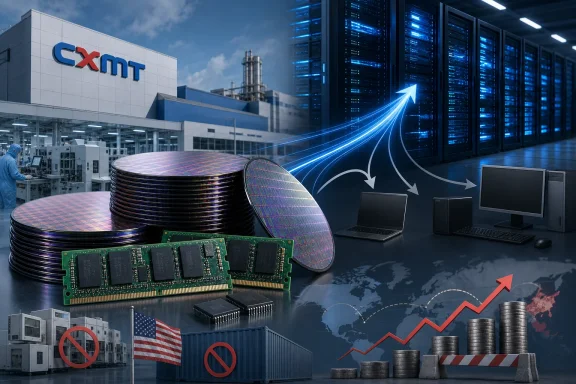 The number that matters is sellable memory, not wafers
A fab’s wafer-start capacity does not equal the quantity of usable DRAM chips shipped to customers. A manufacturer can install tools and begin wafers, yet still struggle to produce enough dies that meet performance, reliability, and cost targets. That is where the reporting on CXMT is most consequential.
Counterpoint’s earlier assessment, cited by ChosunBiz in February, said yields on CXMT’s first-generation 10-nanometer-class, or 1x, DRAM process were around 50% and 42% below the yield level associated with Samsung Electronics and SK hynix’s more mature 1a-generation technology. Those estimates should be treated as analyst assessments rather than audited company disclosures, but the underlying point is straightforward: a capacity increase at a lower-yield node produces far less market-ready memory than the same nominal increase at a mature process.
This is why competing wafer-per-month estimates cannot by themselves settle whether CXMT is positioned to ease a global supply squeeze. A company may be adding nominal capacity while its effective output remains constrained by yield, product mix, qualification requirements, and access to manufacturing equipment.
The distinction becomes sharper in higher-end DRAM. Conventional DDR4, DDR5, and LPDDR parts can help PC and smartphone supply, but the industry’s most profitable—and strategically urgent—demand is for high-bandwidth memory used alongside AI accelerators. Every wafer redirected to HBM or server-oriented memory is capacity that is not necessarily easing the price of laptop SO-DIMMs, desktop DDR5 kits, or mainstream OEM notebook configurations.
CXMT is growing, but the market remains concentrated
There is no question that CXMT has become a material memory supplier. The Associated Press reported that the company raised at least $8.6 billion in its Shanghai STAR Market listing in July, while first-quarter revenue reached 50.8 billion yuan, about $7.5 billion. Counterpoint estimated that CXMT represented roughly 9% of global DRAM bit shipments in the first quarter of 2026, after holding around 8% in 2025.
That growth is significant, especially for a company founded only in 2016. It also means that CXMT is no longer merely a policy project or a regional supplier of older memory products. Its expansion has implications for global component sourcing, Chinese PC and smartphone manufacturing, and eventually the bargaining power of the established DRAM leaders.
But 9% global bit share is not market-clearing scale in a shortage. The three established leaders—Samsung, SK hynix, and Micron—still account for the overwhelming majority of global DRAM shipments, and their decisions about capacity allocation remain the primary determinant of supply available to PC makers.
Counterpoint’s own July analysis is revealing here. It projected CXMT at around 11% global DRAM bit share by 2028, while arguing that the company would need at least 15% of the market to be competitive over the long term. In other words, the firm’s projected growth would be meaningful without being sufficient to displace the incumbent structure in the next two years.
That makes the broad conclusion of Digital Today credible even if its monthly-output figure is outdated or incomplete: CXMT can expand, win domestic contracts, and gain share without becoming large enough to force a near-term correction in global DRAM pricing.
Export controls limit the quality of expansion
The constraint on CXMT is not simply the number of clean-room slots it can build. Its challenge is obtaining, integrating, and operating advanced manufacturing equipment at the level required to improve yields and produce leading-edge products economically.
The Associated Press reported that American-led export restrictions have limited CXMT’s access to advanced chipmaking tools, forcing greater reliance on domestic Chinese equipment suppliers. Counterpoint similarly identified advanced lithography restrictions as a long-term risk for CXMT, even while suggesting that workarounds such as vertical-channel transistors and wafer-on-wafer bonding could become strategic alternatives.
Those are long-cycle technology bets, not immediate capacity fixes. Building a fab is expensive and slow; bringing a new process to stable, high-volume yield is slower still. The large cash infusion from CXMT’s IPO can fund equipment, facilities, R&D, and hiring, but it does not remove export controls or automatically turn experimental manufacturing approaches into volume production.
This is also why a reported five-year supply contract with ByteDance matters. Long-term domestic commitments can secure revenue and justify expansion, but they can also absorb output that might otherwise have reached the merchant market. A company whose available production is pre-sold to major cloud and AI customers is not a flexible safety valve for PC OEMs facing higher component costs.
PC memory buyers are competing with AI allocation
TrendForce’s July forecast is the practical warning for Windows hardware buyers. It expects PC OEMs to continue replenishing DRAM inventories, while higher-cost memory works its way through notebook inventory and pushes retail laptop prices upward. The firm also says suppliers are continuing to meet agreed 2026 volumes for PC OEMs and module makers, but capacity reallocations toward server applications are reducing the supply available for PC DRAM.
That means the immediate risk is less likely to be empty retail shelves than a continuing reset in pricing and product configuration. OEMs can respond by shipping more systems with minimum memory configurations, trimming promotions, using fewer premium configurations, or passing component increases into notebook and desktop prices. System builders and IT departments may see similar pressure in DDR5 upgrades, workstation builds, and server memory procurement.
The supply picture is uneven. AI infrastructure buyers often negotiate long-term supply agreements and purchase at a scale unavailable to smaller OEMs, channel distributors, or enterprise IT shops. TrendForce says long-term agreements are already moderating some server DRAM price gains, but those agreements also lock up supply. Buyers outside those contracts remain exposed to the spot and contract market’s tighter availability.
For IT administrators, the response is operational rather than speculative:
- Review 2026 and early-2027 memory requirements before hardware refresh orders are finalized, especially for laptops standardized on 16GB or 32GB DDR5.
- Treat memory configuration as a procurement variable, because delayed upgrades may cost more than ordering the needed capacity with planned system purchases.
- Verify whether server projects require RDIMMs, high-capacity DIMMs, or memory-heavy AI and virtualization configurations, since these products do not necessarily follow consumer DDR5 pricing in lockstep.
- Avoid assuming that a rise in Chinese DRAM output will produce a prompt drop in North American channel prices.
CXMT’s 2027 ramp is the milestone, not a 2026 rescue
CXMT’s planned 2027 capacity expansion is real enough to watch, particularly because it is directed at a domestic market where Chinese policymakers want local alternatives to Samsung, SK hynix, and Micron. Goldman Sachs has projected that CXMT could cover about half of China’s DRAM demand by 2028, according to recent reporting on the bank’s research. Even that forecast describes a gradual reduction in import reliance, not self-sufficiency this year.
The immediate record points to a simpler conclusion. CXMT is expanding, but estimates of its capacity differ materially and its effective output is limited by yields, product complexity, and equipment constraints. Meanwhile, the DRAM industry is allocating scarce supply toward higher-margin AI and server demand.
PC buyers should therefore read CXMT’s rise as a future competitive force, not as a near-term reason to expect cheap RAM. The relevant date is 2027, when new CXMT facilities are expected to begin changing the company’s production base; until then, the existing shortage is being priced into Windows PCs, servers, and upgrades now.
