
As reported by Phoronix and detailed in 3mdeb’s July 30 release announcement, this is not a replacement BIOS that every AM5 owner can install. It is an early, board-specific firmware release for one MSI B850 motherboard, and its CPU support is narrower than the board’s usual vendor BIOS would suggest.
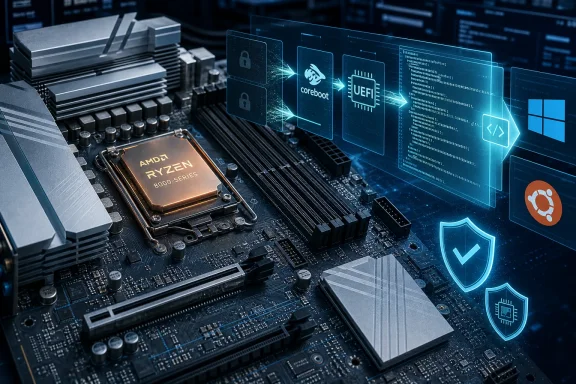 Windows 11 Can Boot, but CPU Choice Is Crucial
Dasharo v0.9.0 supports AMD Phoenix-based Zen 4 AM5 processors, including Ryzen 8000-series desktop APUs. 3mdeb validated the release using a Ryzen 5 8600G and says the Ryzen 7 8700G is the highest-end supported chip in the current branch.
That exclusion matters: standard Ryzen 7000 desktop CPUs, Ryzen 9000 processors, and X3D models are not supported by this firmware release. The limiting factor is AMD’s phoenix_poc openSIL branch, rather than the MSI board’s physical socket compatibility. In other words, an AM5 socket alone is not enough.
For Windows users, the important practical milestone is that the firmware supports UEFI boot, Secure Boot, AMD fTPM, TPM Measured Boot, and Windows 11 25H2. The fTPM implementation runs inside AMD’s Platform Security Processor, allowing normal TPM 2.0 workflows such as BitLocker, Windows Hello, and platform attestation without adding a discrete TPM module.
A Far Smaller Closed Firmware Footprint
3mdeb says its comparison against MSI firmware version E7E56AMSI.2A92 shows a 79.1% reduction in closed-source firmware code. That does not mean the platform is fully open: AMD PSP firmware remains a proprietary binary requirement, and some device firmware and drivers are also supplied as blobs.
Still, the release is a material shift from a conventional AM5 BIOS, where AMD’s AGESA initialization stack and vendor firmware glue are largely opaque. openSIL moves a large portion of processor initialization into auditable source code, while coreboot replaces the conventional proprietary firmware framework.
The project also includes SMM flash-write protection through AMD ROM Armor 3, setup-password support, SATA disk passwords via TCG OPAL, capsule-on-disk updates, serial-console redirection, and memory-context restore for faster subsequent boots.
The First Release Still Has Sharp Edges
This is Dasharo v0.9.0, not a broadly polished retail BIOS alternative. 3mdeb lists four current limitations:
- Staged UEFI capsule updates do not survive a reset; only immediate capsule-on-disk updates work.
- Restoring the prior AC power state after a full power-off is unreliable.
- Ubuntu 26.04 can intermittently hang when serial-console redirection is enabled.
- The onboard Wi-Fi adapter can occasionally disappear until the CMOS is reset, an issue 3mdeb says also occurs under MSI’s own firmware.
There are also familiar enthusiast constraints. The current coreboot port cannot modify AMD’s APCB configuration blocks, so firmware-level CPU tuning, broad feature configuration, and overclocking are not expected soon.
Upstream Work Is the Next Test
The milestone is less about an instant alternative to MSI’s Click BIOS than proof that modern Ryzen desktop firmware can be developed in the open while retaining Windows 11 compatibility and baseline security features.
3mdeb’s next tasks are to upstream the Phoenix and MSI PRO B850-P code to coreboot, contribute its changes back to AMD openSIL, and address pre-boot DMA protection, suspend-to-idle, Wi-Fi reliability, and firmware-update limitations. Until AMD publishes openSIL support for additional desktop silicon, though, Dasharo v0.9.0 remains a promising but tightly bounded option for Ryzen 8000-series AM5 systems.
Update: 3mdeb’s MSI B850-P Dasharo firmware is distributed only with its board package (August 3, 2026)
Igor’sLAB reports that prebuilt Dasharo v0.9.0 firmware images for the MSI PRO B850-P WIFI are not offered as standalone public downloads. Instead, access is tied to a complete motherboard-and-firmware package sold by 3mdeb.
That distinction limits the release’s immediate usefulness for owners of an already purchased retail MSI board, even though the source code, component lists, and technical documentation remain publicly available. It also reinforces that this is currently a specialized platform offering rather than a conventional replacement BIOS distribution.
Igor’sLAB also notes an additional TPM-related caveat in the documented issue list: resetting and reflashing the firmware may not always reproduce identical TPM measurements. IT administrators relying on measured-boot baselines or remote attestation should validate recovery and reprovisioning procedures before deploying the platform in managed environments.
