
The evidence does not yet support calling DDR5 a failed or skipped generation. It has been the only practical route for buyers choosing current desktop platforms, and it remains entrenched in laptops, workstations, servers, and new DIY systems. What has changed is more immediate: the market has made the transition substantially more expensive at the same time that Intel is actively preserving an older, DDR4-capable platform as a lower-cost alternative.
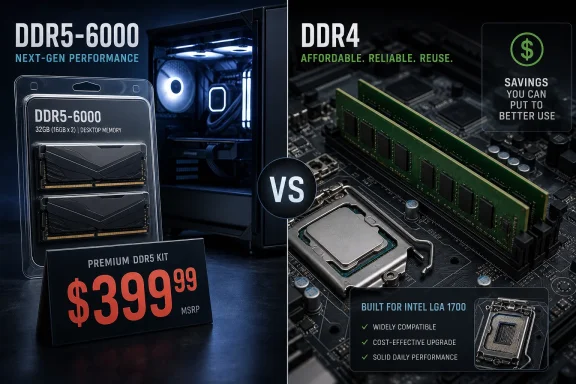
Tom’s Hardware’s latest memory price tracking puts the cheapest 32GB DDR5-6000 kits near $396, versus roughly $72 a year earlier. How-To Geek’s $400-to-$600 range is therefore plausible for common performance-oriented 32GB kits, but it should not be read as a universal shelf price for every DDR5 module. Capacity, speed, timings, RGB hardware, and whether a listing is actually in stock now make an enormous difference.
The more consequential finding is that DDR4 has stopped behaving like a normal outgoing standard. It is no longer merely RAM to reuse from an old system; it has become a lever vendors can use to sell complete platforms at a price DDR5 cannot currently match.
 Intel is treating LGA 1700 as a price-pressure valve
Intel Vice President Robert Hallock told Tom’s Hardware this month that Raptor Lake will remain part of the company’s portfolio for “years to come.” That is a striking position for a platform whose core desktop architecture dates to 2022, especially as Intel is preparing newer processors and has historically moved buyers through socket and memory transitions more quickly.
Hallock’s comments are not a promise that Intel will keep every 13th- and 14th-generation SKU in production indefinitely. They do confirm the broader strategy: Intel sees ongoing demand for LGA 1700 systems because the platform can use DDR4. Intel’s own technical documentation confirms that 13th- and 14th-generation Core desktop processors support both DDR4-3200 and DDR5, while the motherboard determines which memory type a buyer can install. A DDR4 board cannot later be converted to DDR5 by replacing the modules; the board itself must be changed.
For a buyer who already owns 32GB of DDR4, that distinction turns an older platform into a meaningful budget option. Reusing memory can offset hundreds of dollars of current DDR5 spending, and it can also avoid the complication of finding compatible high-speed DDR5 kits and configuring XMP or EXPO profiles. That is a practical advantage, not nostalgia.
But it comes with a constraint that needs to be stated plainly. LGA 1700 is an established, closed desktop platform, not a long runway for future CPU upgrades. A builder choosing Raptor Lake and DDR4 in August 2026 is buying a lower entry price and mature hardware, not an open-ended upgrade path. Intel’s continued availability message makes the choice safer for replacement systems and budget builds, but it does not reverse the platform’s age.
DDR4 saves money, but it does not match DDR5 performance
The most misleading version of the DDR4 comeback story is that DDR4 and DDR5 are functionally interchangeable in performance. They are not. Whether the difference matters depends heavily on the workload, the processor, the graphics card, resolution, and the game or application.
Tom’s Hardware recently retested Intel LGA 1700 systems and reported an average gaming-performance deficit of about 14% for DDR4, with losses reaching 25% in some titles. That is a substantial result, particularly for CPU-limited gaming at 1080p or for buyers pairing a high-end GPU with a fast Core i7 or Core i9. In those cases, selecting DDR4 can leave measurable performance on the table even if the graphics card is unchanged.
For a midrange PC used at higher resolutions, or for office workloads, ordinary web use, and many GPU-bound games, the economic calculation can reverse. Spending an extra $200 or more to move from a DDR4-capable configuration to DDR5 may deliver less real-world improvement than applying that money toward a faster GPU, a larger SSD, or simply retaining a working system for another year.
That is the part of the present market that matters to Windows users and PC administrators. The question is no longer whether DDR5 is technically better. It is whether the system’s workload justifies paying a temporary—and unusually steep—memory premium.
A sensible distinction is emerging:
- DDR4 is a defensible choice for a repair, a replacement desktop, or a cost-controlled LGA 1700 build where existing modules can be reused.
- DDR5 remains the correct choice for a new platform that requires it, for performance-sensitive builds, and for systems expected to receive future CPU upgrades within their current socket family.
- Buying a new DDR4 kit solely because it is cheaper requires care, because DDR4 prices have risen sharply too and the platform savings can disappear once the entire bill of materials is counted.
How-To Geek is right that DDR4 remains surprisingly available. It is wrong to imply that this availability proves DDR5 never became the default. DDR5 became the default where the newest desktop platforms dictated it. The current shortage has instead made “default” and “best value” diverge.
The price crisis is distorting a normal technology transition
DDR5’s awkward reputation comes from timing. It arrived in consumer desktops with Intel Alder Lake in late 2021, initially commanding a premium while offering uneven gains in many everyday workloads. That is a familiar pattern for a new memory generation: early modules carry high prices, motherboard options are narrower, and software or games may not immediately exploit the added bandwidth.
DDR5 then had a period in which the normal transition appeared to be working. Faster kits became widely available, capacities grew, AMD’s AM5 desktop platform made DDR5 mandatory, and the price gap narrowed enough that many new builders chose it without much hesitation.
The 2026 supply-and-price escalation changed the story mid-transition. Tom’s Hardware reports that 32GB DDR5-6000 pricing has increased severalfold year over year, while separate reporting from PC Gamer and TechRadar has documented both the revived appeal of DDR4 systems and retail DDR5 kits selling near the upper end of How-To Geek’s range. Older RAM did not suddenly become technologically superior; the cost of buying the new standard became abnormal.
Calling this a “RAM-pocalypse” is colorful, but the buying effect is concrete. A memory category that normally costs a small fraction of a gaming PC can now rival a processor or a midrange graphics-card upgrade. That alters which platform looks rational before a benchmark is even run.
It also creates an institutional problem. Small businesses, schools, repair shops, and IT teams managing older desktops may find that reuse is no longer simply the environmentally cautious choice; it can be the financially responsible one. A machine with an LGA 1700 Core processor, 32GB of DDR4, a current SSD, and Windows 11 can remain capable for routine productivity, remote administration, browser-heavy work, and many development tasks without a mandatory memory-platform migration.
DDR6 will not rescue a 2026 purchase
The weakest part of the “lost generation” thesis is the implied shortcut to DDR6. Waiting for the next standard is not a practical answer for someone pricing a PC now.
JEDEC has published LPDDR6, the low-power memory standard intended for mobile devices and other tightly integrated designs, but LPDDR6 is not desktop DIMM memory. Desktop DDR6 remains under development, and JEDEC has not published the finalized DDR6 SDRAM specification. That gap matters: until a standard is final, there are no consumer desktop CPUs, motherboards, retail modules, compatibility matrices, or reliable launch dates to plan around.
Even after a desktop DDR6 specification is published, the first consumer systems will require a new memory controller, a new motherboard generation, new modules, early-firmware maturation, and the usual launch premium. DDR6 is therefore a future platform transition, not a credible near-term alternative to a DDR5 purchase delayed in August 2026.
The more realistic outcome is less dramatic than the phrase “lost generation” suggests. DDR5 will remain the installed and required standard for modern desktop platforms, while DDR4 persists longer than expected because extreme pricing has revived the value of older Intel systems and existing AM4 hardware. DDR5 has not been bypassed. It has been caught in a market distortion severe enough to make a previous-generation platform look financially rational again.
For buyers, the decision is immediate: reuse DDR4 only when the total platform cost and performance trade-off make sense, and do not buy an aging platform under the illusion that it offers the same future upgrade path as a current DDR5 system.