

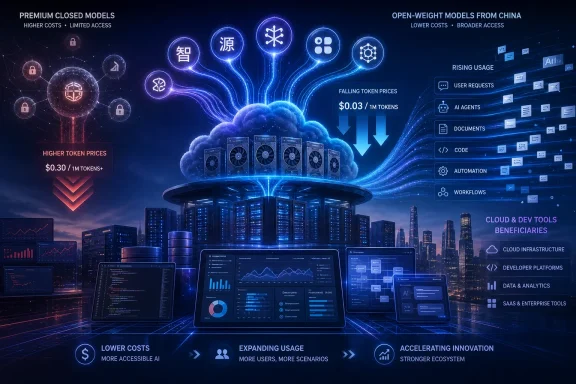
The South China Morning Post frames the shift as a market shock caused by Chinese labs’ increasingly capable, low-cost models, including open-weight releases from companies such as DeepSeek, Moonshot AI, Alibaba and MiniMax. The narrow investor case is painful: if an API token becomes a commodity, the expected payoff from the huge GPU and data-center commitments behind closed frontier models gets harder to justify. The broader technology case is more complicated. Lower per-token prices make AI agents, document processing, code assistance and embedded application features economical in workloads that were previously too expensive to run continuously.
For IT teams, this is no longer an abstract fight over chatbot benchmarks. It changes the cost model for software that reads tickets, summarizes meetings, classifies documents, monitors logs, translates content, writes tests, and operates in multi-step agent loops. A job that was viable only as a human-triggered request can become an always-on background service when each model call costs a fraction of its former rate.
The price decline is real, but the headline number needs scrutiny
The SCMP report cited Silicon Data’s LLM Token Expenditure Index as falling from more than $2 per million tokens in early June to $1.20 during the first week of August. Silicon Data’s publicly visible index page, however, showed a reading of $1.43 per million tokens as of July 27. That does not disprove the reported $1.20 figure—daily prices can move quickly, and the company says the index is published each business day—but it means the August reading cannot be independently confirmed from the public historical snapshot.
There is a second wrinkle in treating a blended market index as a single list price. Silicon Data says its index normalizes across frontier APIs, open-weight inference platforms, dedicated instances and self-hosted deployments, accounting for input/output mix, batching, context windows and reliability. In other words, it is intended to estimate realized cost-to-serve, not tell a developer what one provider charges for one million input tokens.
That distinction matters operationally. An application with long prompts, large outputs, tool calls, retries and weak prompt-cache reuse can cost dramatically more than an advertised input-token rate suggests. Conversely, an enterprise that self-hosts an open-weight model on already-committed GPU capacity may see marginal inference costs that bear little resemblance to public API pricing. The falling blended index is a useful signal of competition; it is not a replacement for measuring an organization’s own token mix and infrastructure utilization.
Still, the direction is not in serious doubt. Vercel’s production data reported that open-weight traffic climbed from roughly 11% of token volume in April to 29% in June. DeepSeek alone accounted for 22.6% of gateway token volume, according to Vercel’s analysis. That is evidence of actual routing behavior, not merely a collection of vendor benchmark claims.
Open-weight models change the negotiating position
Chinese model makers are not succeeding simply by offering lower API prices. The more consequential change is availability of weights: developers can run a model through a hosted intermediary, deploy it in their own cloud tenant, or in some cases operate it inside a controlled environment. That gives customers an exit path from a single frontier-model provider, even when they continue to use closed models for their hardest work.
For a Windows shop, the attraction is straightforward. A company can place a smaller or specialized model behind an internal service connected to Microsoft Entra ID, Windows Server workloads, SQL Server data, SharePoint documents or a line-of-business application without sending every routine request to a premium external API. A local or virtual-private-cloud deployment can also simplify some data-handling decisions, though it does not eliminate security, privacy, licensing or compliance work.
The word “open” needs care. Open-weight means model parameters are available; it does not automatically mean the training data, source code, evaluation process or commercial terms are fully open. It also does not establish that a model is safe for every enterprise workload. Security teams still need to review model provenance, the license, vulnerability response practices, logging, retention, outbound network access and the risk of prompt injection through untrusted documents or web content.
The practical competitive effect is nevertheless clear: a CIO can now tell a closed-model provider, “This workload can move.” That changes procurement even when the organization never deploys a Chinese model in production. The alternative acts as leverage, and price cuts from US model vendors are one visible result.
OpenAI’s reductions expose a moving target
The SCMP report said OpenAI cut developer pricing for GPT-5.6 Luna by 80% and GPT-5.6 Terra by 20%. OpenAI’s public GPT-5.6 launch documentation describes Luna as the cost-sensitive tier and Terra as the lower-cost, broadly capable tier, which matches the positioning in the report. But the company’s currently indexed API model page lists Luna at $1 per million input tokens and $6 per million output tokens, while the launch post lists Terra at $2.50 input and $15 output.
Those published figures do not reflect the discounted prices described in reports of the later reduction. The discrepancy may be a documentation lag, a time-limited promotion, a product-specific pricing condition, or an indexing delay. OpenAI has not made the pricing transition legible enough in its public documentation for a customer to safely assume which rate applies without checking the live billing and pricing pages before deployment.
That is more than a bookkeeping complaint. Teams designing an AI feature around a sharp temporary discount can make the wrong architectural decision if pricing later normalizes or if the rate applies only to particular API paths, model variants, regions or usage thresholds. Model-routing logic should therefore be designed around cost ceilings rather than one provider’s launch-day price.
A robust arrangement uses a premium model where failure has a real cost—complex coding changes, legal review support, sensitive decision assistance, high-value customer interactions—and sends high-volume, lower-risk work to a cheaper model. Vercel’s numbers point to exactly that split: Anthropic represented 61% of spend on 32% of tokens in its June dataset, while inexpensive open-weight models carried much more volume for very little spending. The market is separating premium reasoning from commodity throughput.
Jevons’ paradox favors consumption, not necessarily model vendors
The original Jevons paradox came from coal: more efficient steam engines did not necessarily reduce coal consumption because efficiency made coal-powered activity economically attractive in more places. Applied to AI, the prediction is that cheaper inference will increase the number of calls, the length of context windows, the frequency of automated workflows, and the number of products that add model-driven features.
That helps Silicon Valley only if new usage consumes enough surrounding services. A cheap model call can lead to more GPU hours, vector database queries, storage, data pipelines, agent orchestration, observability, identity checks, human review systems and SaaS subscriptions. It can also expand demand for accelerators because many more organizations can afford to operate AI systems at scale.
But there is no automatic law saying aggregate AI spending must rise fast enough to preserve everyone’s margins. Jevons’ paradox describes a possible demand response, not a guarantee of profitability for every supplier. A closed-model lab that cuts prices faster than it grows usage may increase revenue while reducing gross margin, or increase token volume without recovering its training and infrastructure costs. Investors’ concern about hyperscaler capital expenditure is rooted in that gap.
The near-term beneficiaries are likely to be companies that can monetize the layer above the model: cloud operators with high utilization, application vendors with established customers, AI gateways that route workloads across providers, and enterprise software makers that can turn cheaper inference into a feature customers will pay for. The pure model layer is becoming harder to defend on price alone.
What IT teams should do while the floor moves
The current price war makes a case for avoiding hard-coded dependence on a particular model family. It does not make a case for blindly replacing a trusted provider with the lowest advertised rate.
- Build model abstraction into new applications so that prompts, tools, safety filters and evaluation tests can be run against more than one provider or self-hosted model.
- Track input tokens, output tokens, cache-hit rates, retries, latency and task success rates together. A lower token rate is irrelevant if the model needs more calls, produces more bad outputs, or forces expensive human rework.
- Classify workloads before routing them. Internal knowledge search, ticket triage and draft generation have different data, quality and audit requirements from code deployment, financial operations or privileged administration.
- Treat open-weight model deployment as software supply-chain work. Verify licenses, obtain weights from trusted sources, patch serving stacks, isolate credentials and monitor outbound behavior.
- Preserve a human approval boundary for actions that change production systems, payment records, user permissions or regulated data. Lower inference prices make autonomous loops more tempting; they do not make errors cheaper after the fact.
The Chinese-model wave has punctured the idea that frontier intelligence can command permanently high API prices merely because it is scarce. The more durable result could be an explosion of AI use across Windows desktops, private clouds and enterprise applications—but the vendors selling intelligence by the token will have to prove that volume can replace the pricing power they are giving up.