
The important qualification is that the gigawatt figure remains unverified by DeepSeek, a construction filing, or a power-grid disclosure. What can be independently established is narrower but consequential: DeepSeek began recruiting specifically for senior data-center delivery and operations roles in Ulanqab in April, and those positions described responsibility from project initiation and construction through delivery and operations. Chinese technology outlet IT Home and The Paper documented the listings, which named Ulanqab as the work location and offered monthly pay of 15,000 to 30,000 yuan over 14 salary payments.
That trail supports the conclusion that DeepSeek has been putting a physical data-center operation in place. It does not independently establish that a one-gigawatt campus is financed, permitted, under construction, or supplied with chips. The distinction matters for Windows administrators, enterprises considering DeepSeek-hosted services, and anyone treating the report as evidence of a near-term flood of new Chinese AI compute: a recruiting campaign and a completed gigawatt-class cluster are separated by power procurement, grid interconnection, cooling, networking, chip supply and an enormous amount of capital.
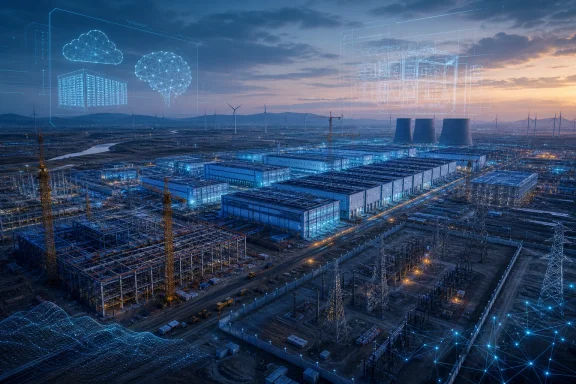 Ulanqab Is Already a Compute Hub, Not an Empty Site
Ulanqab is a deliberate choice, not an exotic outpost. The city sits roughly 350 kilometers northwest of Beijing, has cool weather that can reduce mechanical cooling demand, and is positioned close to the demand center in northern China while offering more land and power-development room than Beijing itself.
Inner Mongolia’s government said in June 2025 that Ulanqab had signed 66 large computing-center projects and had exceeded 71,000 petaflops of aggregate computing capacity, with AI-oriented computing accounting for more than 90% of that total. The same government disclosure said Ulanqab had already undertaken workloads for companies including ByteDance, JD.com and DeepSeek. That reference shows DeepSeek had compute activity tied to the city before the April hiring push, though it does not say that DeepSeek owned the facilities carrying those workloads.
Local reporting in 2026 has leaned heavily on Ulanqab’s ability to market low-cost, renewable-backed power and direct connectivity to Beijing. China News reported that an integrated green-power project supplying a Ulanqab data center began operating in July 2025 and was designed to deliver 848 million kilowatt-hours annually. That is evidence of the region’s infrastructure direction, rather than evidence that it will power DeepSeek’s project.
The Japan Times report says DeepSeek intends to build a new facility while leasing further capacity from other companies. That hybrid arrangement makes practical sense in a market where a greenfield campus can take years to energize, while leased capacity can give a model developer nearer-term headroom. It also means “DeepSeek’s data center” may eventually describe a collection of owned and rented halls rather than one finished building.
One Gigawatt Is a Power Target, Not a Server Count
The report’s central number is eye-catching, but “one gigawatt worth of compute” is too imprecise to translate directly into GPU counts, model-training performance or cost. Data-center announcements often blur at least three separate measures: the electricity available to a site, the power delivered to IT equipment, and the much higher total facility draw after cooling, conversion losses and other overhead.
If one gigawatt means IT load, the project would sit in the top tier of planned AI infrastructure globally. If it means a campus-level power allocation, the usable server load would be lower. If it is a long-term combined total of a DeepSeek-owned facility plus third-party leased capacity, it says less about a single construction project than the headline suggests.
Neither DeepSeek nor the people quoted by The Japan Times identified the metric, power-delivery phase, capital budget, construction partner, utility agreement, networking design, cooling approach, or commissioning schedule for the proposed capacity. No public record located in the available Ulanqab and Inner Mongolia project disclosures identifies a DeepSeek-branded one-gigawatt project.
That missing paperwork is notable because other Ulanqab projects are public. VNET has publicly promoted a much larger long-term Ulanqab plan built around three gigawatt-class clusters, while regional authorities have repeatedly published approvals and development targets for computing parks. A DeepSeek project could still be early enough that detailed disclosures have not surfaced, or structured through a less obvious project entity. But for now, the one-gigawatt figure should be treated as a reported ambition, not a completed deployment or a publicly documented commitment.
The stated earliest availability date reinforces that reading. Late 2027 is only about 17 months away from the August 1 report; early 2028 allows modestly more time. Bringing even a partial AI cluster online in that period is possible if land, substation capacity, equipment orders and a co-location partner are already arranged. It would be much harder if DeepSeek is only beginning site development.
Chips Are the Project’s Real Constraint
The unanswered question is not whether DeepSeek can find a cold, power-rich location. It is what accelerator hardware it can legally and reliably install at the scale it is discussing.
The Japan Times report says the chip mix is unclear, while noting Nvidia’s position as the standard supplier for AI data centers and Huawei’s role as China’s domestic champion. That uncertainty is the story’s pressure point. A gigawatt-scale project built around leading Nvidia hardware, older Nvidia hardware, Huawei Ascend accelerators, or a mixed fleet would differ sharply in software maturity, performance per watt, networking architecture and developer experience.
U.S. export-control rules remain relevant even after Washington adjusted parts of its semiconductor licensing policy in 2025 and 2026. The Bureau of Industry and Security continues to control advanced-computing items and applies China-focused end-use restrictions. The rules do not establish what hardware DeepSeek has acquired or intends to buy, and no public evidence ties this Ulanqab plan to any particular Nvidia or Huawei product.
That gap should stop speculation from hardening into fact. A China-based AI company can operate with previously acquired hardware, domestically sourced accelerators, products authorized under licenses, lower-tier imported chips, or combinations of all of them. DeepSeek has made its name partly through model and training efficiency, but efficiency gains do not remove the need for hardware, memory, high-speed networking and reliable power at this scale.
For enterprise users, the practical consequence is that a larger DeepSeek-owned capacity base could improve the company’s ability to serve domestic customers, train successors to its existing models, and offer more predictable access to its own inference infrastructure. It does not automatically mean that international API users will receive lower prices, better uptime or access to the same hardware. DeepSeek has not announced service-level changes, regional availability, enterprise terms, or any new Windows-compatible on-premises product tied to the Ulanqab expansion.
The Report Marks a Shift From Model Releases to Infrastructure Control
DeepSeek’s April job listings were unusually revealing because they focused on the work that follows a model breakthrough: operating the machinery. The senior delivery-manager description covered the complete life cycle of a data-center project, while the operations role pointed to automated operations tooling and resource utilization. Those are not roles a company posts merely to rent a few racks from a cloud provider.
Owning and operating capacity gives a model developer more direct control over scheduling, training windows, hardware configuration and long-running inference demand. It can also reduce dependence on cloud providers that may compete for the same AI customers. The trade-off is that DeepSeek would take on the execution risks normally borne by data-center developers: power delays, equipment shortages, construction overruns, cooling failures and underutilized capacity if model demand misses expectations.
The reporting also undercuts the simplistic reading of DeepSeek as a company whose efficiency techniques make giant data centers unnecessary. Efficient mixture-of-experts models and training methods can lower the compute needed for a given task. They can also make lower-priced services viable, which can increase usage enough to require more infrastructure. The Ulanqab plan, if it reaches its stated scale, suggests DeepSeek sees efficiency as a way to stretch compute further rather than a substitute for acquiring it.
For now, the cleanest reading is that DeepSeek’s Inner Mongolia operation has advanced beyond rumor: its Ulanqab hiring and the city’s own references to DeepSeek workloads show a real local footprint. The reported one-gigawatt expansion is credible as a strategic objective, but it lacks the public project record needed to call it a built or fully funded facility. The first hard milestone will be a named project company, a power or construction approval, or the arrival of equipment—not another estimate of how many chips the proposed campus might eventually contain.
