
deepseek-v4-flash API identifier with DeepSeek-V4-Flash-0731, a retrained production build that the company says now outperforms its own V4-Pro-Preview across nine agent and coding benchmarks. The practical consequence is immediate: developers using the existing Flash endpoint receive the new behavior without changing an API key, base URL, model string, or listed token price.DeepSeek’s July 31 changelog describes the release as the public beta of the official V4-Flash API. The company says the build keeps the Preview model’s architecture and size and was “only re-post-trained,” making this less a new-model launch than a conspicuous demonstration of what post-training can do to an already-deployed model.
That distinction matters for anyone running coding agents against Windows repositories, Azure workloads, PowerShell automation, or internal developer tools. A model swap at a stable API name is convenient when it improves task completion, but it is also an operational change. Agent behavior can shift in ways that benchmark scores do not capture: tool-call ordering, verbosity, retry behavior, patch size, shell-command safety, and the ability to stop rather than pursue an incorrect plan.
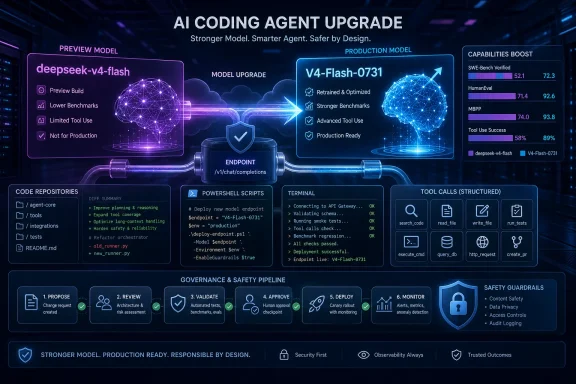 A budget endpoint has overtaken the preview flagship
According to DeepSeek’s published figures, V4-Flash-0731 scored 82.7 on Terminal Bench 2.1, 54.2 on NL2Repo, 76.7 on Cybergym, 54.4 on DeepSWE, 70.3 on Toolathlon Verified, 25.2 on Agents’ Last Exam, 25.1 on Automation Bench, 68.7 on DSBench-FullStack, and 59.6 on DSBench-Hard. DeepSeek says those results exceed V4-Pro-Preview across the set.
The headline number is DeepSWE, where DeepSeek reports a jump from 7.3 for Flash Preview to 54.4 for the July 31 build. DeepSWE is intended to probe long-horizon software-engineering work: understanding an unfamiliar repository, making coordinated changes, invoking tools, and producing a fix that passes verification. A gain of that size, if reproduced, would be materially more meaningful than a modest improvement on a single-turn code-generation benchmark.
The important qualification is that these are still vendor-published measurements. DeepSeek says it evaluated public coding-agent benchmarks with its own “DeepSeek Harness” in minimal mode, configured for maximum effort, temperature 1.0, and top-p 0.95. That harness has not yet been released, so independent teams cannot currently reproduce the full setup. DeepSeek also labels DSBench-FullStack and DSBench-Hard as internal evaluations, which makes them useful directional data but not independent evidence.
Associated Press made a similar point after the V4 family’s April debut: DeepSeek’s claimed competitive performance was notable, but independent evaluation was required before treating the comparison with closed frontier systems as settled. That caution applies even more strongly to a one-day-old retraining release whose most striking scores have not yet received external reruns.
For the moment, the defensible conclusion is narrower but still significant: DeepSeek has published a substantially stronger Flash build, and it has done so without asking API users to migrate.
The change is behavioral training, not a larger neural network
Post-training is the work done after a foundation model absorbs broad language and code patterns during pre-training. It is where a vendor can shape instruction-following, tool use, planning style, refusal behavior, and performance on a target workflow. In coding agents, the most valuable feedback can be unusually concrete: a generated patch either compiles, tests pass or fail, an expected file exists or it does not.
That makes reinforcement learning with verifiable rewards especially powerful for software tasks. A model can attempt an issue-resolution sequence, call a terminal or repository tool, inspect test failures, revise the patch, and receive a result tied to executable ground truth. The process is not magic and it does not guarantee that a model understands a codebase in the human sense, but it can sharply improve the probability that the model selects productive next actions.
DeepSeek’s claim that V4-Flash-0731 was re-post-trained rather than architecturally changed is therefore consequential. It suggests that the prior model may already have held much of the relevant programming and systems knowledge, but did not consistently translate it into effective multi-step agent behavior.
For IT teams, this is a reminder that model parameter counts are an increasingly incomplete purchasing shorthand. A smaller or cheaper model can become the stronger practical choice for a specific workload if its post-training better matches the task loop. In this case, the V4-Flash endpoint is positioned against its larger V4-Pro sibling not as a reduced-capability fallback, but as the more recently optimized agent model.
It also means today’s result should not be projected too far forward. DeepSeek says the official V4-Pro release will follow soon. If that larger model receives a comparable round of agent-focused post-training, the current Flash-versus-Pro ordering may be temporary.
DeepSeek has added the interface agent frameworks expect
Alongside the model update, DeepSeek says V4-Flash now supports the Responses API format natively and has been specifically adapted for Codex. The company’s current API documentation lists Responses API support for V4-Flash but not V4-Pro, with V4-Pro support planned for early August.
The Responses API model is important because agent applications need more than a block of generated text. They need structured tool invocation, state management across a task, explicit outputs, and a reliable way to feed tool results back to the model. For teams using coding-agent shells, internal automation layers, or tools patterned after OpenAI’s agent interfaces, native support can reduce adapter code and eliminate brittle prompt-based workarounds.
DeepSeek’s documentation also lists a one-million-token context length and a maximum output of 384,000 tokens for both V4 Flash and V4 Pro. Those are large theoretical limits, but Windows administrators and developers should treat them as capacity rather than a promise of economical or reliable execution. Long context windows can increase latency, expand the chance of irrelevant context influencing decisions, and make debugging agent failures more difficult.
The service supports both thinking and non-thinking modes, with thinking enabled by default. That deserves attention in cost controls. Reasoning output is not necessarily visible to the calling application, but it still contributes to generated-token consumption. A model that takes more internal steps may complete an issue more reliably; it may also turn an apparently cheap API into a more expensive one on a per-ticket or per-pull-request basis.
DeepSeek currently lists V4-Flash at $0.14 per million cache-miss input tokens and $0.28 per million output tokens, versus $0.435 and $0.87 respectively for V4-Pro. Cached input is listed at a far lower rate for both. The company has also announced a forthcoming peak/off-peak policy under which listed prices would double during two daily Beijing-time windows, although it has not announced an effective date.
Silent upgrades are helpful until they break a workflow
The model identifier remains deepseek-v4-flash, but DeepSeek’s pricing page now identifies the served version as DeepSeek-V4-Flash-0731. This arrangement removes migration friction, yet it creates a familiar cloud-service problem: reproducibility.
A development team may have tuned prompts, tool descriptions, retrieval settings, timeouts, and approval gates against Flash Preview. The same agent can now make different judgments while appearing unchanged in configuration management. A better benchmark profile may improve average results while exposing a regression in a narrow but business-critical workflow, such as a PowerShell remediation script, a configuration migration, or a patch against an older .NET application.
Teams using Flash in production should treat July 31 as a version change and run a focused validation cycle:
- Re-run a representative set of real repository issues, PowerShell tasks, and tool-call sequences that previously failed or required human correction.
- Compare completed-task cost, wall-clock latency, tool-call volume, and retry rates rather than relying on per-token pricing alone.
- Inspect generated changes for destructive shell commands, insecure defaults, unintended dependency upgrades, and over-broad file edits.
- Preserve model outputs and evaluation traces so that changes in agent behavior can be diagnosed after future endpoint updates.
- Keep human approval requirements around production access, secrets, infrastructure changes, and security-sensitive code paths.
This is especially relevant for Windows-heavy environments, where the agent may interact with domain policies, registry settings, deployment scripts, endpoint-management tooling, or PowerShell remoting. Better terminal-benchmark performance is not a substitute for least privilege, constrained execution, code review, and a disposable test environment.
Open weights do not erase hosted-service governance questions
DeepSeek’s V4-Flash model is available under the MIT license, opening a route for organizations that want to operate it on their own infrastructure rather than send prompts to DeepSeek’s hosted API. Self-hosting can offer more control over logging, retention, data residency, isolation, and model-version pinning—but it is not a trivial replacement for an API call.
A 284-billion-parameter mixture-of-experts model remains substantial infrastructure, even if only a fraction of parameters is active for a token. Organizations must account for accelerator capacity, quantization trade-offs, inference software, context-cache management, observability, access controls, and the support burden of running an agent platform. The MIT license lowers legal friction around the weights; it does not turn the model into a laptop deployment.
For customers using DeepSeek’s hosted service, data governance remains a separate decision from raw capability and price. Sensitive enterprise prompts, source code, customer material, credentials, and regulated records should be evaluated against the organization’s approved-data rules and vendor-risk process before any benchmark result enters the conversation.
DeepSeek-V4-Flash-0731 is therefore a notable release not because it settles the frontier-model race, but because it shows how quickly the standings can move after a retraining cycle. The next meaningful milestone is not another vendor chart: it is independent evaluation, followed by evidence from real agent deployments that the new Flash build completes more work correctly, predictably, and cheaply than the Preview it silently replaced.
Update: Additional details (August 2, 2026)
MarkTechPost reports that the Hugging Face repository totals 304 billion parameters because it includes DeepSeek’s DSpark speculative-decoding draft module alongside the 284-billion-parameter base model. DeepSeek-V4-Flash-0731 activates 13 billion parameters per token, according to the report, while the hosted API is listed with a 2,500-request concurrency limit.
For self-hosting, MarkTechPost says DeepSeek’s vLLM example targets a single four-GPU GB300 node. It also cites quantized community builds requiring roughly 110GB of combined RAM and VRAM at 3-bit precision, illustrating that MIT-licensed weights do not make this a lightweight local deployment. The report further says DSpark can be enabled in vLLM with speculative decoding, and that DeepSeek distributes message-encoding helpers rather than a Jinja chat template.
