
The tested 16-core, 32-thread Xeon D-2187NT dates to the Skylake-era Xeon D family, and ServeTheHome found its per-core results were roughly one-third of those from AMD’s newer EPYC 8125P in Geekbench 5, estimated SPEC CPU2026 tests, and the site’s AgentSTH V7 workloads. That gap matters for dense VM hosting, software compilation, and CPU-heavy automation, but it does not erase the VEP4600’s original strength: packing network I/O, remote management, and virtualization support into a compact edge chassis.
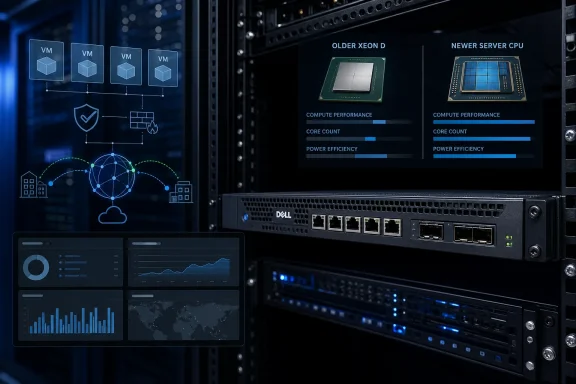 Built for virtual network functions, not benchmark leadership
Dell designed the VEP4600 as a virtual edge platform for enterprise branches and service-provider deployments. The platform supports Intel Xeon D-2100 processors with four, eight, or 16 cores, up to 128GB of memory, two M.2 SATA drives, two PCIe Gen 3 x16-based mezzanine slots, four 1GbE ports, and two 10GbE SFP+ ports.
That specification is more revealing than a raw CPU comparison. A VEP4600 is intended to consolidate functions such as SD-WAN, firewalling, routing, WAN optimization, or small virtual-machine clusters where the appliance’s physical I/O and serviceability may matter more than peak single-thread performance. Dell also documents support for KVM, VMware ESXi, native Linux, and Versa OS.
ServeTheHome’s Linux NAT testing reinforces that distinction. The system was not tested as a dedicated switch, but it showed credible throughput between pairs of 10GbE ports—an outcome that fits a virtual network appliance running software routing or firewall services.
The CPU is now the constraint to plan around
The Xeon D-2187NT remains a 16-core embedded-server processor, but it is a 2018 design. For administrators, the practical takeaway is not simply that “newer is faster”; it is that workloads have changed. Modern endpoint management, observability stacks, infrastructure automation, and AI-assisted developer tools can place more demand on individual cores and on simultaneous tenants than traditional branch routing did.
ServeTheHome’s multi-agent tests showed the older Xeon D trailing the EPYC 8005-series comparison system decisively when several tasks were run at once. Organizations considering a VEP4600 for a lab, a low-cost branch deployment, or a repurposed appliance should therefore size it around network services and modest VM density rather than expect current-generation general-purpose server behavior.
The platform’s hardware features remain unusually attractive in the right role:
- It provides redundant hot-swappable power supplies and fans in a 1U form factor.
- It includes dedicated BMC and CPU management connections, with IPMI 2.0 out-of-band management.
- It combines 10GbE connectivity with four 1GbE ports, reducing the need for add-in NICs in small edge deployments.
- Intel QuickAssist Technology is available on the eight- and 16-core configurations, potentially useful for supported crypto or compression workloads.
A practical second-life platform, with caveats
For Windows-focused IT shops, the VEP4600 is better viewed as infrastructure beneath Windows workloads than as a conventional Windows server. It can host a hypervisor and run a small number of Windows Server VMs alongside Linux-based network functions, but its storage options, older CPU generation, and appliance-oriented firmware make it a more specialized proposition than a current PowerEdge server.
The appeal is strongest when the unit is acquired inexpensively and its port layout replaces several separate devices. The trade-off is clear: the Dell VEP4600 can still be a tidy, manageable edge box, but it is no longer the economical choice for compute-intensive virtualization.
