
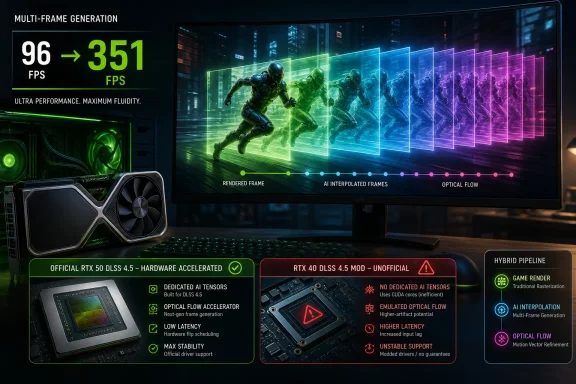
XDA tested the approach on an RTX 4070 Ti Super and reported 351 FPS at the 6x setting in Backrooms: Escape Together, up from 96 FPS without frame generation. The test is a useful demonstration that the mod works in at least one Unreal Engine 5 game, but its own data also shows why “6x” should be read as a frame-generation mode rather than a promise of six times the playable performance. The measured result was a 3.65x increase in the average counter, while system latency rose from 33.4 ms at 1x to 37.5 ms at 6x.
The practical result is a viable enthusiast workaround for offline DX12 games—not an all-purpose upgrade for every RTX owner, and not evidence that Nvidia’s RTX 40-series hardware simply lacks the ability to display more generated frames.
 Nvidia’s official feature remains locked to Blackwell
Nvidia released DLSS 4.5 Dynamic Multi Frame Generation and fixed 5x and 6x modes on March 31, 2026. Its documentation is explicit: the modes that generate up to five AI frames for every traditionally rendered frame are available on GeForce RTX 50-series GPUs, alongside a current Nvidia app release and Game Ready Driver 595.97 or newer.
The company says its second-generation transformer model, frame-pacing changes, and image-quality improvements allow it to move from the prior 4x ceiling to 6x on Blackwell. Nvidia also says the higher multipliers are intended for displays such as 240Hz and 360Hz panels, where a strong underlying frame rate can be converted into visibly smoother motion.
What Nvidia has not published is a detailed technical explanation of why the same fixed 5x and 6x modes cannot be offered on RTX 40-series hardware. That omission matters because the RTX 40 series already supports ordinary 2x DLSS Frame Generation, and the new DLSS 4.5 Super Resolution model is available across the RTX family. Nvidia has extended its newer Enhanced Frame Generation model to RTX 40-series users as well, improving treatment of UI elements in supported games, while preserving the 5x, 6x, and Dynamic MFG gate for RTX 50 cards.
So the product boundary is real, but the precise hardware-versus-product-segmentation rationale remains Nvidia’s unanswered question.
DLSS Enabler changes the frame-generation path
The mod at the center of XDA’s report is DLSS Enabler, maintained by Artur Graniszewski and distributed through Nexus Mods. Version 4.5.0.0 added x5 and x6 support, though newer 4.5.x releases have subsequently addressed stability issues. Its own documentation describes a very different technical arrangement from Nvidia’s native DLSS 4.5 feature.
DLSS Enabler intercepts a game’s DLSS Frame Generation requests and routes them through a modified FSR 3.1 frame generator, Nvidia’s Streamline framework, and NvAPI emulation. On an RTX 40-series card, the mod’s Hybrid MFG mode keeps Nvidia DLSSG for the middle generated frame in x2, x4, and x6 modes; the mod supplies the remaining interpolation frames. In x3 and x5 modes, the developer says FSR 3 handles frame generation exclusively.
That makes the RTX 4070 Ti Super test more interesting than a simple feature unlock. At x6, it is a hybrid frame pipeline: Nvidia’s native optical-flow-assisted frame generation remains involved, but it is supplemented by frames generated through the mod’s FSR-derived code. The output can be useful and visibly smooth, yet it should not be equated with the neural model, quality controls, validation, or latency behavior Nvidia ships for RTX 50-series DLSS 4.5 MFG.
The mod author acknowledges this directly. DLSS Enabler says it is not Nvidia’s DLSS Multi Frame Generation, even when it responds to the same game calls and presents a similar control surface.
XDA’s numbers show the cost beyond the headline FPS
The benchmark reported by XDA makes the limitation visible. The RTX 4070 Ti Super’s average FPS progressed from 96 at 1x to 165 at 2x, 236 at 3x, 296 at 4x, 304 at 5x, and 351 at 6x. The best jump came before the final two modes: moving from 4x to 6x added 55 average FPS, but the 1% low fell from 243 FPS to 172 FPS.
Latency followed the same pattern. It improved from 33.4 ms at 1x to 28.1 ms at 3x, then worsened to 29.1 ms at 4x, 36.7 ms at 5x, and 37.5 ms at 6x. Those figures are from one game and one system, so they cannot establish a general rule. They do, however, reinforce the warning repeated by Nvidia and independent testing of frame generation: high multipliers work best when the GPU is already rendering a high baseline frame rate.
A game rendering at 30 real FPS does not become responsive like a 180 FPS game simply because interpolation makes a monitor display 180 frames per second. Input sampling, simulation, and the actual rendered frames still begin at the original rate. Generated frames can improve perceived motion continuity, especially on a high-refresh VRR display, but they cannot repair a CPU bottleneck, erase traversal stutter, or turn low base performance into low-latency control.
The XDA result starts from 96 FPS without frame generation, which is exactly the kind of baseline where a higher multiplier has a chance to look impressive. It is much less persuasive as a reason to select 6x in every demanding game. The decline in 1% lows and rise in latency after 4x suggest that the 6x setting is best treated as a workload-specific option, not the new default.
Compatibility is narrower than “every RTX GPU”
The headline’s RTX 40-series focus also understates the mod’s broader claim. DLSS Enabler advertises x2 through x6 MFG for RTX 20- and 30-series cards, and says it can operate on older GTX hardware, Radeon GPUs, and Intel Arc. But support in this context means the DLL can attempt to build a compatible frame-generation path; it does not mean every card, game engine, anti-cheat configuration, and display setup will deliver a satisfactory result.
For the x5 and x6 modes specifically, the mod requires a game to use Nvidia Streamline 2.11 or later. The Nexus Mods documentation says older games can be updated manually, but that introduces the exact compatibility work XDA encountered while trying The Witcher 3: Wild Hunt. A game can launch, expose the mod menu, and still leave higher multipliers unavailable if the required Streamline files are absent or incompatible.
The mod also requires a DirectX 12 title with native DLSS support, and it can collide with older DLSS Enabler installations, dummy NVAPI DLLs, or other frame-generation mods. NODIX-TECH’s separate DLSS Enabler Manager tries to automate that setup by scanning game folders, checking Streamline components, installing required files, and making backups before changes. That is convenient, but it also means a third-party manager is downloading and modifying files inside installed games. Users should keep the automatic backup, inspect the changed files, and know how to restore the original directory rather than treating the tool as a harmless driver setting.
Most importantly, the mod’s page warns users not to use it in multiplayer games. DLL injection can trigger anti-cheat defenses and place an account at risk of a ban. This is not merely a theoretical restriction buried in a forum thread; it is the project’s own stated warning. Single-player games, offline modes, and games without competitive anti-cheat are the sensible boundary.
The useful choice is often 3x or 4x, not 6x
There is a temptation to frame the workaround as an easy way for RTX 40 owners to reclaim a withheld Nvidia feature. It is more accurately a community-built option for people willing to trade official support and predictable image behavior for a higher displayed frame rate in compatible offline games.
For an RTX 40-series owner, Hybrid MFG is the key feature because it retains Nvidia DLSSG’s role in the sequence rather than replacing it entirely. But the available evidence does not show that every game will benefit equally, that Ghostbuster eliminates artifacts universally, or that 6x gives the best experience. XDA found its ghosting mitigation effective in one title; the tester appropriately did not claim it as a universal fix.
The sensible procedure is to start with ordinary 2x DLSS Frame Generation or a lower multi-frame multiplier, measure the real base frame rate and latency, then compare 3x, 4x, and 6x in the same scene. Watch UI elements, fast camera pans, particle effects, moving foliage, weapon models, and scene disocclusion—not only the average FPS number. If 6x adds counter speed but worsens frame consistency or mouse response, the lower multiplier is the better setting.
Nvidia’s RTX 50-series lock therefore still stands in the official product stack. DLSS Enabler demonstrates that older cards can participate in a six-frame presentation pipeline, but it does so by substituting and mixing technology rather than by activating a dormant Nvidia setting. For single-player tinkerers with a strong baseline frame rate, that may be enough. For everyone else, the 351 FPS screenshot is less useful than the 37.5 ms latency number sitting beside it.
