
The completion was confirmed by EA and independently reported by the Associated Press, PC Gamer and GamesRadar. Andrew Wilson remains chairman and chief executive, and EA remains headquartered in Redwood City, California. The deal covers the publisher behind EA SPORTS FC, Madden NFL, College Football, Battlefield, The Sims, Apex Legends, Mass Effect, Dragon Age and Need for Speed.
Calling EA the world’s largest “game studio,” as some coverage has, blurs an important distinction. EA is a publisher and corporate owner of multiple studios, not one studio; its scale comes from its annual sports franchises, live-service operations, distribution platforms and worldwide development organization. What is clearly established is that this is the largest private-equity-backed buyout on record, surpassing the $45 billion TXU deal completed in 2007.
The deal was announced in September 2025. It has now moved from a proposed takeover, with shareholder and regulatory conditions attached, to the operating reality for EA employees, partners and customers.
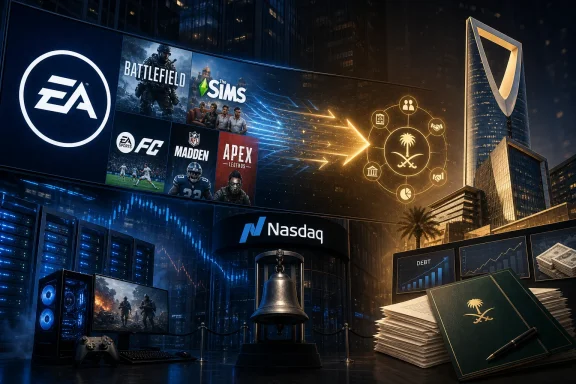 A private EA will disclose much less
Public ownership forced EA to publish quarterly financial results, annual reports, proxy statements, executive-pay disclosures and regular updates on material risks. The company was already limiting some investor communication during the sale process, including earnings calls and forward guidance. Now that its shares are no longer publicly listed, its financial reporting obligations will shrink substantially once deregistration is completed.
That does not mean EA has gained freedom from scrutiny in the way some online reaction suggests. It still has contracts with the NFL, Formula 1, major football leagues, console manufacturers, PC storefronts, advertisers, payment providers and technology partners. It still answers to consumer-protection and privacy rules, employment law, platform certification requirements, and any obligations tied to licensed sports and entertainment properties.
But it does mean that fans, employees and outside analysts will have less routine access to the numbers that reveal whether a game missed its targets, whether live-service spending is rising or falling, and whether a restructuring is working. Public EA’s quarterly reports could show net revenue, net bookings, operating cash flow, share repurchases and changes in headcount-related expenses. A privately held EA can choose how much of that story it tells.
For Windows and PC players, the immediate takeaway is mundane but important: the acquisition announcement does not change the terms of an existing game purchase, EA app account, Battlefield server, EA Play subscription or Steam entitlement. Neither EA nor the consortium announced a migration away from the EA app, a new PC storefront, an account-policy rewrite, or a change to which games will remain available on Windows.
Those could still happen later. They are not part of the completed transaction itself.
The debt, not delisting, is the pressure point
The consortium’s purchase price is often described as a $55 billion cash deal. That is correct as the transaction’s enterprise value, but it does not mean the buyers paid the entire amount from their own cash reserves. EA’s September 2025 announcement described roughly $36 billion of equity funding, including PIF’s rollover of its existing EA stake, alongside $20 billion in committed debt financing. The announcement said $18 billion was expected to be funded at closing.
Subsequent reporting and the completed financing process point to the $18 billion figure as the debt that matters in EA’s post-close capital structure. Kirkland & Ellis, counsel to the consortium, said the $18 billion financing closed into escrow in April ahead of the acquisition. That is a distinction worth keeping straight: the original $20 billion commitment was not the same thing as $20 billion necessarily landing on EA’s balance sheet at closing.
Even at $18 billion, the financial burden is substantial. EA reported $2.553 billion in operating cash flow for its fiscal year ended March 31, 2026, a record for the company. That is a strong base for a game publisher, particularly one with annualized sports titles and recurring live-service revenue. It is also why lenders were willing to fund the deal.
Still, operating cash flow is not free cash. It must cover game development, marketing, technology infrastructure, acquisitions, taxes, working-capital swings and, now, debt service. A company that previously had room for dividends, buybacks and long development bets will be operating with a much more explicit requirement to protect cash generation.
That changes incentives even if Wilson and the existing management team stay in their jobs. The question is no longer whether EA can make money; it plainly can. The question is how much of its creative and operating budget will be reserved for predictable cash-producing franchises versus projects whose payoff is uncertain or years away.
Cost-cutting signals deserve more attention than ad speculation
The loudest player reaction has centered on fears of more in-game advertising, deeper microtransactions and lower-quality games. None of those changes was announced with the closing, and treating them as settled fact would be irresponsible. EA has long used optional in-game purchases, live-service passes and advertising arrangements across portions of its portfolio, but the acquisition itself did not unveil a new universal advertising policy.
There is, however, a more concrete reason to expect financial pressure inside the company. Bloomberg reporting cited by PC Gamer said EA presented debt investors with a plan that included roughly $700 million in annual cost reductions or earnings adjustments. That headline number requires care: reporting on the financing materials indicated that about $263 million related to one-time research-and-development spending on Battlefield 6 and skate., while a further $170 million was associated with “organizational efficiencies,” a category that can include layoffs and consolidation.
The distinction is not semantic. One-time development spending ending after a game ships is not the same as cutting $263 million from EA’s ongoing workforce or studio budget. But the organizational-efficiency target is a direct warning that labor and overhead are part of the post-buyout arithmetic.
EA’s public statements have emphasized growth, innovation and investment. PIF’s Turqi Alnowaiser and Silver Lake’s Egon Durban have also identified artificial intelligence as an area for investment, with the stated aim of improving game development and player experiences. That language leaves enormous room for interpretation. AI can mean developer tools, animation assistance, testing automation, localization workflows, player-support systems, content generation or cost reductions. It does not establish which EA teams will receive new tools, which jobs may be redesigned, or whether AI-generated content will appear in released games.
The first hard evidence will be changes in staffing, studio structure, project cancellations and release schedules—not investor language.
PIF holds the real control
PIF is not a passive minority participant. Deal materials reported before closing put the Saudi sovereign wealth fund’s stake at 93.4%, with Silver Lake holding 5.5% and Jared Kushner’s Affinity Partners holding 1.1%. That makes PIF the controlling owner in practical as well as financial terms.
Silver Lake brings private-equity experience in technology and media transactions. Affinity Partners is a comparatively small participant in the ownership structure but draws political attention because it was founded by Kushner. EA’s original release stressed the consortium’s combined sector experience and access to capital; it did not spell out the future board composition, veto rights, internal investment-approval process or the degree of operational independence delegated to Wilson.
Those omissions matter more now than they did when the transaction was pending. Public investors no longer have a vote, a daily market price or regular filings through which to judge management’s performance. The relevant governance question is whether PIF and its partners behave as patient owners building a long-term media asset, or as financial sponsors seeking rapid returns from a highly cash-generative portfolio.
EA’s sports portfolio gives the owners a durable foundation: annual release cycles, major licenses and established player spending habits. That same foundation can make internal capital allocation more conservative. A new Madden, EA SPORTS FC or College Football release has a more legible business case than a new intellectual property, a long single-player development cycle or a risky multiplayer experiment.
That does not guarantee less creative work. It means experimental work will need to compete against unusually reliable businesses while the company is carrying acquisition debt.
What has not changed for PC players
EA has not announced changes to Windows system requirements, anti-cheat software, cloud saves, cross-play, EA Play, the EA app, Steam distribution, Epic Games Store availability, mod policies or server support as a consequence of the takeover. Games already announced for PC should be assessed on their own release plans rather than treated as casualties of the ownership change.
Nor does private ownership automatically mean EA can remove consumer choice, abandon support commitments or impose new charges on existing customers without commercial consequences. Platform holders, licensing partners and a player base accustomed to competing PC storefronts all place limits on how abruptly EA can change course.
The more immediate risk is quieter: less transparency before a game or service is reprioritized. When public EA closed a studio, cancelled a project, revised forecast assumptions or took a major impairment, the effects eventually appeared in filings and earnings disclosures. Private EA may communicate only what it wants customers to know.
The acquisition is complete. The next observable test is not a hypothetical ad in a game; it is whether EA’s first post-buyout operating decisions preserve development capacity while meeting the cost and debt commitments that helped finance the largest leveraged buyout in the industry’s history.
