
Windows Latest reported on August 23 that the referral prompt is appearing within Edge for Android and iOS, allowing users to generate a personal invite link. Its test found that both the sender and the recipient received 500 points after the recipient completed the required steps. Independent referral listings seen in the UK also describe the same 500-point reward and a two-day search requirement, while an earlier report from Windows Report, relayed by IT Home, documented the “Refer Friends to Edge App” card in Edge Canary earlier this month.
The practical headline is straightforward: 7,500 points requires 15 completed referrals in one month, not 15 shared links. Microsoft’s own Rewards documentation says points have no cash value and that roughly 5,000 points usually redeem for something worth about $5, with redemption choices and rates varying by account and country. So the advertised monthly maximum resembles a promotional credit worth roughly $7.50 under Microsoft’s own general illustration—not a route to a free year of Game Pass or a meaningful cash-equivalent payment.
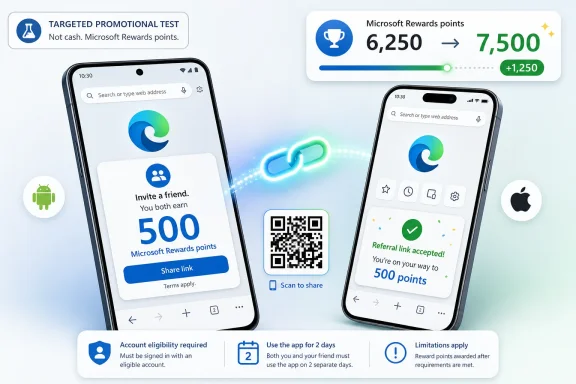 The referral only counts after Edge is actually used
Windows Latest says the invited person must be a first-time Edge Mobile user, sign in with a Microsoft account, and perform searches in Edge on two separate days within 14 days. That makes this an activation campaign, not a reward for merely recommending a browser or persuading someone to tap an install button.
The distinction is consequential. An invite may fail if the recipient has previously installed Edge, installs it without using the referral link, uses another Microsoft account, does not sign in, or does not complete searches on two different days before the 14-day clock runs out. Microsoft has not posted a standalone, public set of promotion rules that specifies how those edge cases are handled.
The public Edge Mobile referral landing page confirms that Microsoft is directing users toward the Edge app and its Rewards program, but it does not expose the referral conditions in a manner that a prospective participant can independently review before receiving an invitation. That leaves the in-app prompt and the referral flow as the operative source of terms—a poor support position if a referral does not register.
For users who see the offer, screenshots of the exact terms and referral status are worth keeping. Microsoft’s broader Rewards rules allow the company to require users to claim offers in a specified period, limit offers by region or account, and change or withdraw particular earning opportunities without advance notice.
This appears to be a wider test than the first Canary sighting
The first reported sighting did not occur in Stable Edge mobile. Windows Report found the referral card in the Microsoft Rewards area of Edge Canary, Microsoft’s daily-updated test channel, in early August. It showed a shareable referral link, a QR code, and social sharing options, with the conversion flow leading recipients toward the mobile app.
That sighting mattered because it established that Microsoft had built a dedicated referral mechanism rather than simply encouraging Edge downloads through an ordinary Rewards quest. Yet Canary availability also meant the feature could have been a small server-controlled experiment rather than a rollout commitment. There was reportedly no corresponding edge://flags switch, which is consistent with Microsoft enabling the offer remotely for selected accounts.
Windows Latest’s newer report suggests the campaign is now being surfaced inside Edge on Android and iOS, rather than staying confined to Canary. The available reporting does not establish whether the prompt has reached all Stable-channel users, which countries are included, or whether iOS and Android have identical eligibility rules. A UK referral listing describes both Android and iPhone/iPad routes, but Microsoft itself has not issued a product-blog announcement or public eligibility map.
That lack of a public rollout statement matters more than it might seem. Microsoft Rewards offers routinely differ by market, and the company’s general terms say users must reside in a participating region to earn and redeem points. A user who sees no referral tile is therefore not necessarily missing a setting; they may simply be outside the offer cohort, in an unsupported market, or using an account Microsoft has not selected for the promotion.
The 90,000-point annual figure is arithmetic, not a guarantee
The 90,000-point number circulating with the promotion is mathematically correct only if a person completes the 7,500-point maximum every month for 12 months. At 500 points a referral, that requires 180 qualifying new Edge Mobile users in a year.
Microsoft has not promised that the referral program will remain available for 12 months, that its 7,500-point cap will remain unchanged, or that the offer can be repeated indefinitely by a given user. Its Services Agreement expressly permits Microsoft to limit points by person, household, or time period, and says eligible offers can vary by region, be time-limited, and include their own conditions.
The company’s rules also contain constraints that make attempts to manufacture referrals a bad bet. Rewards is limited to personal, noncommercial use; each person may hold only one Rewards account; households are generally capped at six accounts; and Microsoft can cancel accounts and forfeit points if it believes a participant has tampered with, abused, or defrauded the program.
That is particularly relevant because referral schemes naturally invite account cycling, device resets, and reciprocal installs. Using a second phone and a separate account may show whether a referral flow technically credits, as Windows Latest tested, but it does not create a blanket exemption from Microsoft’s account, household, and anti-abuse rules. Repeated self-referrals or attempts to conceal a participant’s actual region risk more than the value of the points earned.
Microsoft also defines an eligible Rewards search as a good-faith, manual search for the user’s own research. Automated queries, macros, and searches performed only to simulate activity do not qualify under the published rules. The two-day use requirement therefore appears designed to establish basic ongoing use, while Microsoft retains broad discretion over which activity it recognizes.
The real prize for Microsoft is a signed-in mobile user
The reward is small because the action Microsoft wants is specific. Edge is free to download; the meaningful outcome is a newly installed mobile browser tied to a Microsoft account and used across multiple days. That gives Microsoft a measurable acquisition event and an opportunity to connect the user to Bing searches, Rewards, syncing, and Edge’s broader account-based services.
An app-store download can be deleted within minutes. A referral that requires installation, account sign-in, and activity on two different days has a much higher bar and is more likely to create a retained user. The points are therefore an acquisition cost paid in promotional currency rather than an unusually generous new Rewards benefit.
For existing Edge users, the offer has limited immediate utility unless they know people who genuinely have never installed the mobile app and actually want to try it. It is also not a reason to pressure friends into switching browsers for a few cents’ worth of Rewards credit. A failed referral can create frustration on both sides, particularly when Microsoft has not publicly detailed the timing for point delivery or a dispute process for the specific promotion.
What Edge users should do with the offer
Users who receive the referral notification should read the in-product conditions before sending any links and should assume the offer is account- and region-specific until Microsoft says otherwise. They should invite only genuine first-time Edge Mobile users who are willing to install, sign in, and use the app over the required two days.
Do not reinstall Edge, toggle Canary flags, change regions, or use a VPN in an attempt to force the referral card to appear. Microsoft’s Rewards terms warn that obscuring geographic location can lead to account cancellation and lost points, and there is no evidence that any local browser setting controls access to this campaign.
For everyone else, the accurate takeaway is narrower than “Microsoft now pays people to recommend Edge.” Microsoft is testing or expanding a mobile Edge referral incentive with a 500-point reward for a completed, attributable user activation. Until it publishes offer-specific terms, participating countries, Stable-channel availability, and a clear crediting timetable, the 7,500-point monthly maximum remains a conditional promotion—not a dependable new income stream.