
The key point is not that EDOTCO has discovered AI for tower planning. Its NaPA platform has been in use for years, and EDOTCO has previously described it as an in-house geospatial analytics system for identifying coverage gaps, demand, signal weakness and possible site-sharing opportunities. What is new, according to Microsoft Malaysia’s August 17 account and EDOTCO’s description of the platform, is the attempt to make that underlying data accessible through natural-language queries rather than through a data-science queue.
For enterprise IT teams, this is a more familiar pattern than the “AI tower planning” label suggests: a company has consolidated proprietary data, then adds a generative interface intended to make specialized analysis available to non-specialists. It can reduce turnaround time substantially, but only if access controls, data quality, query guardrails and human approval remain as strong as the conversational front end is easy to use.
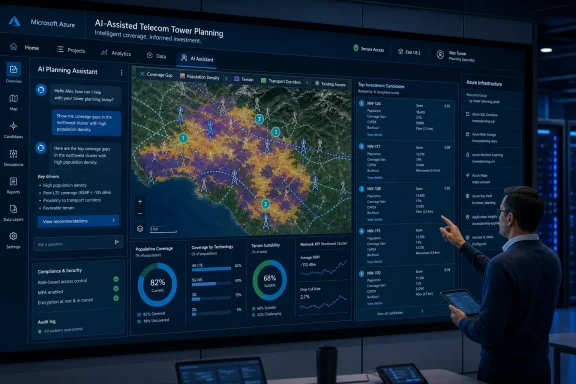 NaPA GPT changes access to an older planning system
EDOTCO says NaPA combines planning, geospatial and operational inputs to assess potential mobile-tower locations. Those inputs include population distribution, terrain, demand growth and areas with weak mobile coverage. In its earlier public material, the company described NaPA as overlaying demand data, mobile-network coverage information and a matching system that can identify nearby EDOTCO sites suitable for sharing.
That is important context for the new Azure deployment. NaPA GPT does not appear to be a system autonomously selecting construction sites or authorizing capital spending. It is a conversational way to request and refine analysis from the NaPA data estate. A planner might ask where future investment has the strongest potential, then limit the suggested areas to transport corridors or rapidly developing districts.
Microsoft Malaysia says the system returns a ranked shortlist based on predefined planning criteria. The phrase predefined criteria deserves attention: the assistant may speed up exploration, but the business logic governing what counts as a viable site still sits in the data inputs and ranking methodology. A fluent answer does not make an underlying recommendation more reliable than its coverage data, demand forecasts, geocoding accuracy or engineering assumptions.
EDOTCO’s older NaPA material shows why reducing friction could be useful. The company has said its platform identified overlap among Malaysian cell sites and supported planning under Malaysia’s National Fiberisation and Connectivity Plan and Jalinan Digital Negara initiative. Whether those historical results translate into better recommendations from NaPA GPT has not been independently demonstrated. The new announcement supplies no comparison of recommendation quality, error rates, rejected recommendations or actual tower deployments attributable to the chatbot.
Azure is hosting the workflow, but the AI stack is not fully disclosed
Microsoft Malaysia identifies Azure Container Apps, Azure Blob Storage and “Azure Generative AI” as the foundation for NaPA GPT. Container Apps is a managed platform for running containerized applications, while Blob Storage is a logical place to store files and large data objects. Together, those details indicate that EDOTCO has deployed an application architecture around its existing data rather than simply handing planners a general-purpose public chatbot.
The description leaves out several technical details that determine whether an enterprise generative-AI tool is ready for sensitive operational decisions. Neither Microsoft nor EDOTCO has named the model behind NaPA GPT, said whether the system uses retrieval-augmented generation, explained how it separates data by market or customer, or described how it prevents unsupported answers from being presented as planning facts.
Those omissions are routine in customer case studies, but they matter more here because telecom planning data can include commercially sensitive coverage, subscriber and rollout information. EDOTCO says the system securely processes complex queries, yet it has not published the security design, identity model, retention rules, logging controls or review process for queries and generated outputs.
An Azure deployment can support those controls, but the platform does not establish them automatically. Administrators deploying comparable internal copilots should treat data permissions as the primary design decision, not an implementation detail. If a planner can ask a broad natural-language question, the system needs to enforce the same regional, commercial and operational boundaries that applied when analysts pulled the data manually.
The reported speed gain is real only at the request stage
The strongest operational claim is straightforward. EDOTCO says planning teams previously had to ask its Data Science team for prepared datasets, a process that could take from three days to a week depending on request complexity. NaPA GPT is intended to eliminate much of that wait by providing a ranked opportunity list within minutes.
That is a meaningful improvement for exploratory work. Telecom infrastructure planning often begins with many potential locations, and teams may need to ask successive questions before choosing which sites deserve detailed engineering, property, regulatory and commercial investigation. Giving planners the ability to iterate without opening a new analytics ticket can shorten the early stage of that process.
It does not mean a mobile tower can be approved, acquired and built in minutes. EDOTCO itself previously noted that tower construction can take months, with site selection and acquisition representing substantial parts of the process. A generated shortlist may accelerate the decision-support phase, but it does not remove land-rights negotiations, municipal approval, structural design, grid-power availability, backhaul requirements, environmental constraints, local opposition or carrier commitments.
The distinction protects against a common mistake in AI project reporting: measuring time saved in producing analysis and presenting it as time saved across the whole business outcome. EDOTCO has not published a before-and-after measure for end-to-end tower deployment, build cost, coverage improvement, avoided duplicate construction or revenue gained from NaPA GPT. Until it does, “within minutes” should be read as the response time for a shortlist, not proof of faster network expansion in the field.
Human review remains the practical control
A natural-language interface is especially useful when the data has already been assembled but is difficult to interrogate. It lets regional and commercial teams explore scenarios without knowing database schemas, dashboard filters or geospatial-analysis tooling. That can relieve specialist teams from repetitive requests and reserve data-science time for model development, validation and unusual analyses.
It also creates a risk that users accept a concise AI-generated ranking as an answer rather than as a starting point. Site selection needs defensible rationale, especially when a recommendation affects substantial capital expenditure or public infrastructure planning. A planner should be able to inspect the source layers behind the output: the coverage evidence, demographic assumptions, terrain constraints, nearby assets, forecast horizon and any exclusion criteria.
EDOTCO has not said whether NaPA GPT displays that evidence alongside each recommendation, or whether users can trace a suggested location back to individual source datasets. That will be the dividing line between an efficient interface and an opaque one. For an IT department, the useful standard is clear: generated rankings should be reproducible, auditable and subject to the same approval workflow as an analyst-prepared recommendation.
The company says NaPA GPT is expanding across multiple markets, though it has not identified the markets, number of users, number of sites evaluated, or rollout dates. It also says it is working toward predictive planning, what-if simulations and AI-assisted investment recommendations. Those are logical extensions of NaPA’s existing analytics work, but they remain future-facing plans rather than published capabilities with measured outcomes.
EDOTCO’s Azure project is therefore best understood as a targeted modernization of access to planning intelligence. It may genuinely remove days of waiting from the first pass at a tower-location decision, but the decisive test will be whether EDOTCO can show that its planners retain evidence, controls and accountability as the chatbot reaches more markets and more consequential infrastructure choices.