
That distinction is increasingly important in 2026. Verizon’s latest Data Breach Investigations Report found that exploited vulnerabilities were the leading initial access path in 31% of breaches, while ransomware appeared in 48%. Those numbers do not argue for buying the largest detection platform by default. They argue for knowing where an attack can enter, whether the affected systems produce usable telemetry, and whether someone is authorized and available to contain it.
For a Windows-heavy organization, the baseline remains straightforward: protect endpoints, collect endpoint evidence, patch exposed systems, enforce phishing-resistant identity controls where possible, and maintain tested recovery. NGAV, EDR, XDR and MDR each address different portions of that work. A gap in any one of them can matter more than an upgrade from one acronym to another.
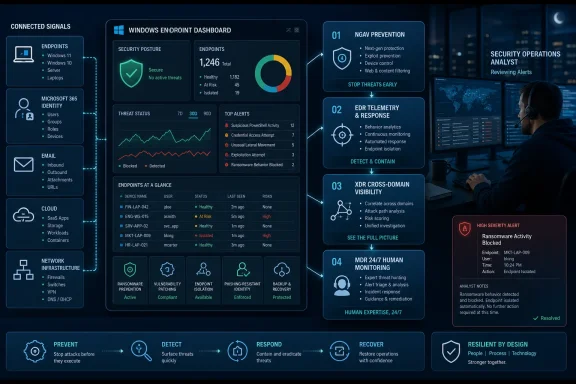 NGAV Is Prevention, Usually Embedded Rather Than Bought Separately
Next-generation antivirus describes endpoint prevention: behavioral detections, exploit protection, reputation services, machine-learning models, and ransomware controls intended to stop malicious activity before it succeeds. In a modern Windows estate, that means watching more than a file hash. The protection layer should recognize suspicious PowerShell activity, credential dumping behavior, abuse of signed system binaries, process injection, encryption bursts, and exploit-like behavior in applications.
The practical catch is that NGAV is now often a capability inside an endpoint protection platform or EDR product. Treating “NGAV” as a mandatory separate line item can lead to duplicate agents, competing exclusions, overlapping web or ransomware controls, and ambiguous ownership when a legitimate installer or line-of-business application is blocked.
Acronis positions its behavioral anti-malware capabilities as part of Cyber Protect Cloud, and that is representative of the market’s direction: prevention is bundled into a broader endpoint stack. The right procurement question is not “Do we own NGAV?” It is whether the selected endpoint agent delivers prevention on every supported workstation and server, whether its protection policies are enforced, and whether exclusions are reviewed rather than inherited indefinitely.
NGAV also has clear limits. It cannot establish whether a user’s Microsoft 365 account was accessed from an anomalous location, whether an OAuth application was granted dangerous permissions, or whether a VPN appliance was exploited before the attacker reached a managed endpoint. It is essential, but prevention at the endpoint is not a complete detection strategy.
EDR Is the Operational Baseline for Managed Windows Endpoints
EDR adds continuous endpoint telemetry, investigation records, search and hunting, and response actions such as process termination or host isolation. It preserves the evidence an administrator needs after prevention fails: which parent process launched a payload, what persistence mechanism was created, which machines exhibited related activity, and whether an affected device contacted an external command-and-control address.
The U.S. Office of Management and Budget’s M-22-01 memorandum defined EDR in similarly practical terms: continuous endpoint data collection coupled with automated response and analysis. It directed federal civilian agencies to adopt robust EDR and emphasized consolidated, retained endpoint data. That is a useful test for commercial deployments as well. An endpoint tool that displays a verdict but does not keep enough telemetry for investigation is not equivalent to an operational EDR program.
For most organizations, EDR should be the default starting point once devices are centrally managed. A Windows fleet without EDR will struggle to answer basic post-incident questions, particularly when attackers use built-in tooling rather than dropping obvious malware. Event logs alone are valuable, but they are not a substitute for retained, normalized endpoint process and network telemetry with a response workflow attached.
EDR still cannot see everything. An attacker exploiting an internet-facing firewall, abusing a cloud identity, or accessing data directly through a SaaS application may leave little useful endpoint evidence until late in the intrusion. Verizon’s 2026 DBIR finding that vulnerability exploitation has overtaken credential abuse as the leading initial access vector reinforces an uncomfortable point: an EDR rollout does not compensate for weak external-asset management or slow patching.
CISA has made the same point through its red-team assessments. In one assessment of a U.S. critical-infrastructure organization, CISA found that reliance on host-based EDR without adequate network-layer protections left material blind spots. The conclusion is not that EDR is insufficient or disposable. It is that EDR is a sensor with a defined vantage point, not a universal control plane.
“XDR” Must Be Tested Against the Actual Data Sources
XDR is supposed to extend detection and response across endpoint, email, identity, cloud and network signals. In the ideal case, it turns disconnected clues into one attack narrative: the phishing message, the malicious sign-in, the endpoint execution, the mailbox-rule change, the lateral movement, and the outbound transfer.
That broader view can be valuable in Microsoft-centric environments, where an incident frequently crosses Entra ID, Microsoft 365, Exchange Online, Teams, SharePoint, Defender products, Windows endpoints and third-party SaaS services. But the label XDR has become broad enough to conceal major architectural differences between products.
Acronis’ own Cyber Protect Cloud documentation illustrates why buyers need to read past the label. It says its XDR layer works only with EDR incidents and does not independently ingest third-party data. Connected integrations can add external nodes to an endpoint-led incident graph, but that is different from a vendor-neutral platform continuously collecting, normalizing and independently alerting on broad third-party telemetry.
That is not necessarily a defect. An endpoint-led XDR design may be simpler to deploy and useful for an MSP managing a consistent stack. But it changes the product’s practical scope. A suspicious Microsoft 365 sign-in that has no associated EDR incident may not be handled the same way as it would in a platform that can generate an identity-led detection on its own.
Before paying the XDR premium, organizations should require a precise answer to four issues:
- The vendor should identify every telemetry source that is native, every source that relies on an integration, and every source that is unavailable without an endpoint incident.
- The vendor should explain whether identity, email and cloud signals can create their own alerts or only enrich an existing endpoint case.
- The deployment team should document retention periods, licensing limits, ingestion caps and the visibility lost when a device is offline or unmanaged.
- The security team should run a proof-of-concept attack chain that begins outside the endpoint, such as an anomalous cloud sign-in or a malicious mailbox rule.
The XDR decision should follow the organization’s attack surface. A company operating a relatively simple, endpoint-centric Windows environment may get better risk reduction from disciplined EDR coverage, patch management, MFA and recovery testing. An organization with extensive Microsoft 365, SaaS, cloud workloads, privileged identities and remote access needs identity and cloud visibility that endpoint telemetry cannot supply. Whether the answer is XDR, SIEM, or a combination depends on the actual sources and response workflows—not the badge on a sales slide.
MDR Solves an Operations Problem, Not a Visibility Problem
MDR is a managed delivery model. It layers a provider’s security operations center, analysts, triage processes, threat hunting and response playbooks on top of EDR, XDR or a broader security stack. It does not turn an endpoint-only tool into a cross-domain platform, and it does not eliminate the client’s responsibility for identity design, asset management, patching, backup policy, legal notifications or risk decisions.
The value proposition is staffing. ISC2’s 2025 workforce study found that 95% of respondents reported at least one cybersecurity skills need, while 59% characterized those needs as critical or significant. Maintaining an internal 24/7 security operation requires more than purchasing a console; it requires experienced analysts, alert tuning, escalation coverage, incident authority and someone able to improve the program after each incident.
Acronis says its MDR service begins investigation of high- and critical-severity alerts within 15 minutes and has a 60-minute mean-time-to-respond objective. Those are meaningful operational targets, but they should not be confused with a guaranteed 60-minute recovery, remediation or business restoration. As Acronis itself notes in its discussion of MDR service tiers, actions such as containment, rollback, recovery and patching depend on the selected services, configuration and customer authorization.
This is where contracts and runbooks matter more than dashboards. Every MDR buyer should establish, in writing, whether the provider may isolate a Windows endpoint, disable an account, kill a process, revoke sessions, block an IP address, initiate a rollback, restore data, or only recommend those actions. The agreement also needs named contacts, severity definitions, escalation paths, after-hours authority, evidence retention, and a clear explanation of when the service-level clock starts and stops.
A provider that “responds” by notifying a customer is delivering something materially different from a provider authorized to contain the incident. Both may call the metric MTTR. That acronym is unreliable unless the contract defines whether it means time to react, respond, remediate, resolve or recover.
Choose Coverage First, Then Choose the Operating Model
The cleanest selection model is a two-axis decision. First determine whether the environment needs endpoint prevention alone, endpoint detection and response, or visibility across email, identity, cloud and network activity. Then determine whether the organization can operate that capability continuously with its own people.
A small business with no dedicated security staff generally needs managed EDR with integrated prevention, reliable backups and tested recovery procedures. It may not need an expansive XDR deployment on day one, but it does need an MSP or MDR provider with authority to act during a ransomware event. Verizon’s 2026 DBIR data makes this operational gap hard to ignore: ransomware’s role in nearly half of breaches is a direct continuity problem, not merely an alerting problem.
A mid-market organization with an internal IT team but no staffed security operations center is often the clearest MDR case. Internal staff can manage endpoint deployment, patching, user support and business approvals, while the managed service handles overnight detection and escalation. Co-managed arrangements work best when the division of authority is rehearsed, rather than decided during an incident.
An enterprise with a mature SOC may justify self-managed or co-managed XDR when it can act on identity, email and cloud detections at scale. Even there, XDR does not replace vulnerability management. Verizon reports that organizations fully remediated only 26% of the relevant known-exploited vulnerabilities in its 2025 dataset, and the median time to complete patching rose to 43 days. Detection shortens attacker dwell time; patching removes the door that was left open.
NIST’s Cybersecurity Framework 2.0 puts the issue in the right order: Govern, Identify, Protect, Detect, Respond and Recover. Detection tooling occupies only part of that model. The critical governance decision is who may take disruptive action, while the recovery decision is whether restores have been tested against the systems that matter.
The procurement milestone should therefore be a live exercise, not a feature checklist: simulate a cloud or email-originated attack, confirm what the tools actually see, time the escalation, isolate a test endpoint, restore a protected workload, and record every manual handoff. The result will show whether the organization bought NGAV, EDR, XDR or MDR—or whether it bought a console that still leaves the hard work unassigned.