
Digital Reviews’ August 23 review describes the updated IMPACT 1000 as the same headset platform with revised voice processing, Bluetooth changes, and a simplified five-SKU lineup. EPOS announced the refreshed range in June, while Microsoft’s Teams-certified device catalog lists the new IMPACT 1000 MS models as certified on June 12, 2026. EPOS’s current product page also says the range is certified for Microsoft Teams and supports a dongle-free connection.
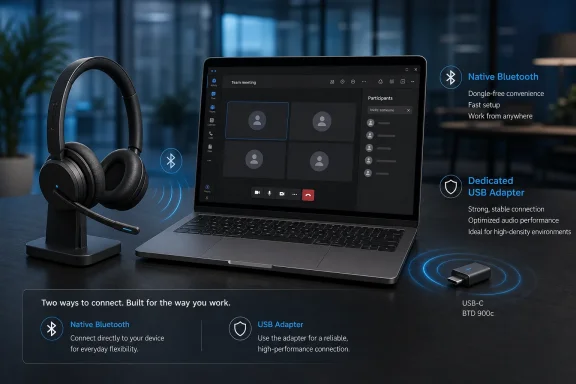
The important qualification is that certified does not mean every Windows PC will deliver the same experience. EPOS’s own deployment material says native Bluetooth depends on the host computer’s Bluetooth stack and chipset, and explicitly warns of possible random disconnections, audio-switching trouble, and feature differences between PCs. For a single user with a recent, well-maintained Windows laptop, leaving the dongle at home may be a welcome upgrade. For an enterprise trying to make call behavior predictable across thousands of mixed Windows endpoints, the new BTD 900c USB-C dongle remains the safer default.
 Teams support arrived after EPOS’s paperwork said it was still pending
The reporting around the update reveals an easily missed timing problem. EPOS documentation distributed with the refreshed range said a future EPOS Connect software release, planned for the end of June, would enable Microsoft Teams over native Bluetooth. That wording persists in some of the company’s June technical documents.
However, EPOS’s current US product page says the native-Bluetooth IMPACT 1000 is Teams certified, and trade publication Pro Audio reported on August 11 that Teams certification over native Bluetooth was live for the IMPACT 1000 and IMPACT 500. Microsoft’s own Teams device directory now includes the new IMPACT 1000 MS headset entries under its Bluetooth audio-device certifications.
The practical conclusion is straightforward: buyers should treat current firmware and EPOS Connect updates as part of the purchase, not optional housekeeping. A June-era fact sheet in a procurement folder may describe a capability that was planned at the time, whereas a headset updated today should have a different feature set. EPOS has not made the firmware version that flips the switch especially prominent in its public product material, which is an avoidable gap for organizations managing standardized endpoint images.
For Teams administrators, this also changes the purchasing question. The older IMPACT 1000 was already a Teams-certified headset in dongle-based variants. The refresh is valuable because it gives organizations a choice between native Bluetooth and a dedicated radio without changing their headset family, training, accessories, or core call controls.
The BTD 900c is still more than a USB-port tax
The strongest part of the revised IMPACT 1000 proposition is choice, but the dongle-free configuration should not be mistaken for a full replacement of the dongle in every workflow.
EPOS says the BTD 900c provides functions unavailable through native Bluetooth: Dictation Mode, Auto Pause, and Usage Mode. The first is particularly relevant to the company’s new AI-assistant positioning, since dictation is one of the headline use cases EPOS is selling. The dongle also arrives pre-paired on applicable SKUs, avoiding the support burden of having every employee discover Windows Bluetooth pairing, select the correct device, and troubleshoot a failed connection.
That pre-pairing advantage sounds mundane until it reaches a help desk. Native Bluetooth transfers responsibility for connection quality to each laptop’s radio, drivers, Windows build, power-management settings, and nearby wireless environment. A dedicated USB adapter creates a known configuration with vendor-controlled firmware. It also provides a consistent physical recovery path: remove it, reconnect it, and re-establish the approved headset link.
EPOS itself makes that distinction in its FAQ. The company promotes native Bluetooth as a clean way to preserve USB ports, while acknowledging that PC-specific Bluetooth behavior can produce instability or awkward switching between devices. That is not a reason to dismiss native Bluetooth; it is a reason to pilot it before removing dongles from an approved hardware standard.
Digital Reviews reported successful multi-device testing with the refreshed model, including switching between Windows PCs and mobile devices, but noted that source switching can take several seconds. The outlet’s experience is encouraging, but it remains one reviewer’s setup rather than broad fleet evidence. Organizations that depend on a headset to move cleanly between Teams calls, mobile calls, and transcription tools should test the exact Windows models they issue.
The AI accuracy claim needs a clearer benchmark
EPOS’s headline claim is that the IMPACT 1000 captures more than 99 out of 100 words correctly; one company FAQ raises that figure to 99.5 out of 100. The company frames the metric around feeding speech into AI assistants, automated transcription, and voice prompts rather than simply ensuring another caller can understand a conversation.
The direction is sensible. A missed word in a human conversation can be corrected in real time. A missed word in a transcript can become an incorrect meeting summary, an erroneous action item, or a flawed prompt supplied to Copilot, ChatGPT, or another AI system. For workers who dictate notes or rely on meeting transcription, microphone performance is now an input-quality issue, not merely a comfort feature.
But EPOS does not prominently explain the testing conditions behind its word-accuracy claim on the product page or in the public technical sheet. There is no clear public account of the speech-recognition engine used, the languages and accents tested, the background-noise profiles, or whether the figure represents a comparison against a baseline headset. Without that methodology, the number should be read as a vendor performance claim rather than an independently established measure of real-world transcription accuracy.
Digital Reviews says it dictated part of its review into ChatGPT using the headset and found that the transcription retained the spoken words and corrections. That is useful anecdotal testing, especially because it examines the workflow EPOS is trying to address, but it cannot validate a 99-percent-plus figure across users, languages, software platforms, and open-office noise conditions.
The underlying hardware also appears less transformed than the marketing suggests. EPOS continues to specify six digital MEMS microphones on ANC stereo models, with four used for voice pickup, adaptive beamforming, and a 100 Hz to 16 kHz super-wideband microphone response. Hybrid adaptive ANC, a 580 mAh battery, and the quoted maximums of 55 hours of music playback without ANC, 32 hours with ANC, and 20 hours of talk time also carry over.
In other words, the refresh is a software, certification, codec, and connectivity story built on a platform that was already strong—not evidence of a fundamentally new microphone design.
LC3 is welcome, but Windows compatibility still decides the outcome
The new range adds LC3 to its supported Bluetooth codecs alongside SBC and AAC. LC3 is part of Bluetooth LE Audio and can improve efficiency and audio quality under supported conditions, but the headset alone cannot guarantee that benefit. The Windows PC, its Bluetooth hardware, its drivers, and the active connection path all have to support the relevant capability.
That is why the BTD 900c deserves more attention than its small size suggests. In a standard Windows deployment, it gives EPOS control over the radio path and helps reduce variation between laptops. A native Bluetooth connection gives employees one fewer accessory to carry and one more available USB-C port, but it also exposes IT to the reality that not every otherwise-supported Windows laptop behaves alike.
EPOS has also kept triple simultaneous Bluetooth connectivity and support for pairing with up to eight devices. That can suit hybrid workers who alternate between a Windows laptop, work phone, and personal device. It can also create a more complex support case when audio routes to the wrong device. The refreshed headset does not remove that trade-off; it gives users more ways to encounter it.
Existing owners have little reason to replace working hardware
Digital Reviews’ central buying advice holds up under closer examination: current IMPACT 1000 owners do not need to replace a working headset merely because a refreshed model exists. The physical design, microphone arrangement, ANC approach, battery capacity, and quoted endurance remain substantially the same.
The upgrade becomes more compelling for an organization buying new headsets, especially one that wants fewer product variants and a viable native-Bluetooth Teams option. EPOS has reduced the revised range to five variants, which should make selection and purchasing less confusing than a sprawling catalog of Teams, UC, dongle, stand, mono, and stereo combinations.
For new Windows deployments, the decision should be made by use case rather than by the appeal of a dongle-free desk. Issue native-Bluetooth models to mobile workers with validated recent laptops and a strong preference for freed-up ports. Keep the BTD 900c in the standard configuration for shared desks, support-sensitive call-center roles, noisy wireless environments, and fleets where Windows hardware varies widely.
The 2026 IMPACT 1000 does not make the original obsolete. It gives Teams users a better-defined path away from a USB dongle while quietly confirming why the dongle still exists: in enterprise audio, predictable behavior remains more valuable than a cleaner-looking laptop.