
The more important detail is what has—and has not—changed. Microsoft’s own ExpressRoute location record already lists Equinix as a connectivity provider for Kuala Lumpur and Jakarta2, the latter at NTT Global Data Center Indonesia. The new development appears to be broader availability through Equinix’s local data-centre footprint, rather than evidence that Microsoft has installed a new Azure edge directly inside every Equinix IBX site in either city.
That distinction will matter to network teams planning for latency, fault domains and data-residency commitments. A service sold as “private Azure connectivity in Jakarta” can still involve a Fabric path from the customer’s Equinix deployment to Microsoft’s designated ExpressRoute peering location. It removes public-internet transit, but it does not erase the need to map the actual physical and logical path.
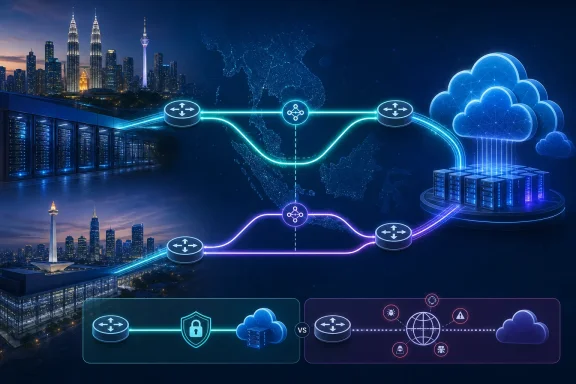 The expansion is a networking option, not a new Azure region
Data Centre Magazine frames the move around Malaysia’s AI ambitions and demand for more resilient infrastructure. That is directionally accurate: AI projects frequently tie data stored in local systems to Azure-hosted model training, inference, analytics and managed data services. The difficult part is less often the GPU cluster itself than moving large, sensitive datasets predictably between a customer environment and cloud resources.
Equinix Fabric is built for private virtual connections between customer deployments, network providers and cloud services. Azure ExpressRoute is Microsoft’s private connectivity product, designed to link a customer network or colocation environment to Microsoft’s network through a provider rather than through public internet routing. A customer can use those services to establish Azure private peering for virtual networks, or Microsoft peering for certain Microsoft public services.
But a new connectivity path is not the same thing as a new Azure compute location. Microsoft identifies Malaysia West as the Azure region associated with the Kuala Lumpur ExpressRoute locations, and Indonesia Central as the local Azure region associated with Jakarta and Jakarta2. Enterprises must still choose the Azure region where their workloads, storage accounts and managed services run.
For administrators, the result is a potentially cleaner hybrid design: local systems or colocation gear in Kuala Lumpur can attach privately to Azure workloads in Malaysia West; Jakarta deployments can do the equivalent for Indonesia Central. It is not, however, a promise that every Azure service is available in those regions, that an application will remain entirely within a single city, or that workloads will receive a particular latency result.
Microsoft’s peering record exposes the physical reality
Microsoft’s current ExpressRoute documentation provides the clearest check on the announcement’s broad wording. In Kuala Lumpur, Microsoft identifies TIME dotCom’s Menara AIMS facility as the ExpressRoute location, with Equinix listed among available connectivity providers. In Indonesia, Equinix is listed as a provider at Jakarta2, whose named location is NTT Global Data Center Indonesia—not at the separate Jakarta location, which Microsoft identifies as NeutraDC HDC.
That does not contradict the Equinix announcement. Equinix can provide a private connection from its IBX footprint to a Microsoft peering point operated elsewhere. It does show why buyers should avoid reading “available in Equinix data centres in Jakarta” as a claim that Microsoft’s edge hardware is necessarily in the same building as their racks.
The consequence is operational rather than semantic. A single provider relationship may simplify procurement and reduce the time needed to order a cloud connection, but physical diversity is not guaranteed merely because a service is called resilient. The customer needs to know the Equinix IBX site, the Fabric access port, the provider’s onward route, the Microsoft peering location, and whether the primary and secondary paths share building entries, metro fibre, carrier infrastructure or power dependencies.
Microsoft’s architecture guidance is explicit that highly available ExpressRoute designs require redundant connections. Azure provides redundant Microsoft-edge ports, but customer-side resiliency depends on using the paired connections and designing redundant BGP sessions. For workloads that cannot tolerate a metro-level failure, Microsoft recommends multiple circuits across different peering locations. A single Equinix Fabric connection may be private and professionally managed; it is still a single connection until the architecture proves otherwise.
“Private” does not mean encrypted
The announcement correctly stresses private connectivity, but private routing and encryption are separate controls. Microsoft states that ExpressRoute traffic is not encrypted by default. The circuit avoids the public internet, which improves route predictability and reduces exposure to internet-borne disruptions, but it does not automatically provide end-to-end confidentiality for traffic on the connection.
That is a significant planning point for companies moving customer records, healthcare data, source code, financial transactions or model-training datasets between local infrastructure and Azure. Teams that require encryption in transit should evaluate IPsec over ExpressRoute private peering, or MACsec where they are using ExpressRoute Direct and the topology supports it. MACsec is not an option for a standard provider-provisioned ExpressRoute circuit; Microsoft restricts it to ExpressRoute Direct ports.
This also has performance implications. IPsec introduces encryption overhead and may change the throughput profile of a connection, especially if the VPN gateway or appliance becomes the limiting component. A design review should therefore test encrypted traffic at the bandwidth required by the workload rather than treating “private” as a completed security requirement.
The service also remains a multi-party operational arrangement. Equinix provisions the Fabric side, Microsoft provisions the Azure circuit and the customer must configure the required peering, BGP details and virtual-network links. Microsoft’s provisioning workflow shows that an ExpressRoute circuit is unusable until the provider side reaches the Provisioned state and the relevant peerings are enabled. A portal object marked “Enabled” on the Microsoft side is not proof that application traffic can yet flow.
What Equinix has not specified
Neither the supplied Data Centre Magazine report nor the public Microsoft location tables provide the implementation details a network team needs to turn the news into a deployment plan. No public material located for this announcement specifies:
- The Equinix IBX facilities in Kuala Lumpur and Jakarta from which the Azure service can be ordered.
- The available port and virtual-connection bandwidths, or whether there are local capacity constraints.
- The date on which the offering became generally available, rather than merely announced.
- The service pricing, including Fabric, cross-connect, ExpressRoute circuit, data-transfer and support costs.
- The primary and secondary path topology or whether separate carrier and facility diversity can be purchased.
- Any latency objective between individual Equinix sites and the Microsoft ExpressRoute peering locations.
Those omissions do not make the service suspect. They do mean the announcement is insufficient as a capacity-planning document. Equinix and Microsoft both offer established products; the unanswered question is the exact local implementation and commercial packaging in these two metros.
For Windows and Azure administrators, the sensible next step is to treat Kuala Lumpur and Jakarta as additional procurement and architecture options, not as automatic resilience upgrades. Confirm the actual IBX and Azure peering location, order dual paths where the workload warrants them, validate BGP failover, and decide explicitly whether IPsec is required. The useful change is the possibility of a private route into Azure closer to Malaysian and Indonesian deployments; the resilience and security outcome will still be determined by the circuit design behind it.
