
The Everlaw announcement, made at ILTACON 2026, packages four integrations and partnerships around a single pitch: make Everlaw the governed evidence layer beneath whatever AI interface a legal team prefers. Alongside Microsoft 365 Copilot, the company announced planned work with Thomson Reuters CoCounsel Legal and Harvey, plus a private-preview connector for Google Cloud’s Gemini Enterprise for Legal.
The distinction between those announcements matters. Google Cloud has independently named Everlaw as an integration partner for Gemini Enterprise for Legal, and Thomson Reuters has described its first CoCounsel integration as a way for mutual customers to bring Everlaw documents into CoCounsel Legal in bulk. But Everlaw’s Microsoft connector remains an announced future product, expected in fall 2026, not a connector legal departments can deploy today.
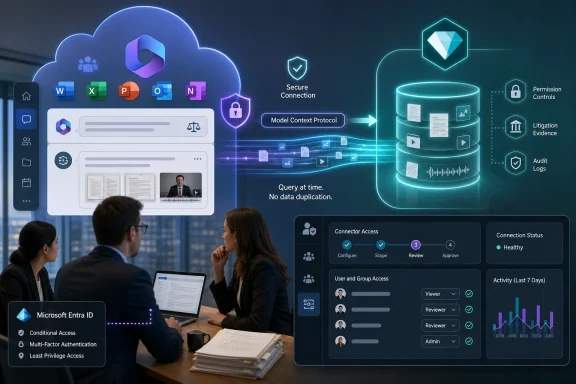 The Microsoft connector is supposed to retrieve evidence live
Everlaw describes its Microsoft 365 Copilot integration as an MCP connector that brings its “evidentiary system of record” into the Microsoft environment where lawyers create briefs and collaborate. In practical terms, the advertised scenario is a lawyer asking Copilot to help prepare deposition questions using facts and documents already organized in an Everlaw matter.
Microsoft Learn explains that federated Copilot connectors use MCP to call outside systems in real time. They do not synchronize the source content into Microsoft Graph, and they use the authenticated user’s identity and permissions at the source system. For legal departments worried about discovery data being duplicated into another index, that architecture is more consequential than the conversational AI layer on top of it.
A traditional synchronized connector can be useful for broad enterprise search, but it involves ingesting content and metadata into Microsoft Graph. Federated MCP connectors instead are aimed at live and often regulated data that needs to remain in its system of record. If Everlaw ships the connector as described, a Copilot prompt should trigger a live Everlaw query rather than add a second repository of litigation material inside Microsoft 365.
That does not eliminate governance work. It shifts much of it to the Everlaw matter configuration, its permissions, the connector’s exposed tools, and the Microsoft 365 tenant’s connector policies. A user who is entitled to see a document in Everlaw may be able to ground a Copilot response in it; a user without that Everlaw entitlement should not, according to Microsoft’s federated-connector model.
Administrators will control whether it reaches users
Microsoft’s current federated-connector documentation makes clear that third-party connectors are not simply switched on by an individual lawyer installing an add-on. A partner connector must first be approved and made available through Microsoft’s connector publishing process, after which a tenant administrator can enable it, disable it, or stage it to specified Microsoft Entra ID groups.
That creates a deployment sequence legal IT teams should plan for now, even though Everlaw has not published installation documentation, licensing terms, supported Copilot surfaces, or exact release timing. The fall 2026 target is broad; it does not identify a month, a preview program, or whether availability will begin in selected regions or customers.
Microsoft’s documentation lists federated connector support in Microsoft 365 Copilot Chat, Copilot in Excel, the Researcher agent, and Cowork. It does not establish that every external MCP connector automatically works inside Word, Outlook, Teams, or every Copilot experience. Everlaw’s description mentions the environments in which legal teams draft briefs and collaborate, but neither Everlaw nor Microsoft has yet specified the exact apps and workflows supported by the pending connector.
That gap is important for buyers. “Available through Microsoft 365 Copilot” can mean a lawyer can ask questions in Copilot Chat, but it does not necessarily mean Everlaw sources will appear directly inside a Word drafting pane or an Outlook thread. Legal departments should not purchase or promise a particular drafting workflow until Everlaw publishes the supported experience matrix.
Microsoft’s Connectors Gallery currently lists Harvey among legal federated connectors, but not Everlaw. That is consistent with Everlaw’s fall target: there is no public evidence that the Everlaw MCP connector has been published, approved for customer deployment, or enabled in tenants as of August 25.
Four integrations, but not one common technical model
Everlaw’s announcement bundles different commercial and technical arrangements under an interoperability narrative. The Microsoft and Google items are described as MCP connectors, while the Thomson Reuters and Harvey items are strategic partnerships with planned integrations. Treating all four as equivalent would obscure the operational differences.
Google Cloud’s Gemini Enterprise for Legal launch announcement says Everlaw will let users search and analyze Everlaw litigation and investigation data, uncover case insights, and build timelines in Gemini Enterprise. Google says responses will be grounded in source documents while access remains governed by the user’s existing Everlaw permissions. Everlaw says that integration is in private preview and should reach joint customers in the coming weeks.
Thomson Reuters provides a more concrete initial description of its work with Everlaw: mutual customers will be able to bring Everlaw documents into CoCounsel Legal in bulk for use in CoCounsel’s research, analysis, drafting, and workflow features. Thomson Reuters calls that the first planned integration in a broader partnership, with availability expected in fall 2026.
That wording suggests a potential difference worth watching. A bulk document transfer into CoCounsel Legal is not necessarily the same thing as an MCP-based live query that leaves documents in Everlaw. Thomson Reuters has not yet detailed whether bulk transfer creates a copied working set, how continuing permission changes will be handled, or what auditing and retention controls apply after material crosses between the products.
Harvey’s planned integration is also scheduled for fall 2026. Everlaw says it will connect Harvey’s legal AI to Everlaw’s governed evidence layer for large, complex matters. Harvey has already built a separate Microsoft 365 Copilot integration, announced earlier this year and later made available as an agent within Copilot. The Everlaw connector would therefore add another possible route: a firm could use Harvey in Copilot, or use an Everlaw connection in Copilot, but Everlaw has not explained whether those paths will be composable in a single workflow.
The evidence layer claim still needs testing
Everlaw’s pitch rests on a legitimate problem for litigation teams. General-purpose AI assistants are good at drafting and summarizing, but litigation work requires a defensible connection between generated language and a changing record of documents, custodians, metadata, productions, and privilege constraints. Search quality, access controls, and traceability can matter as much as the fluency of the answer.
Still, a live MCP connection does not by itself make an AI output defensible. The quality of a Copilot response will depend on which Everlaw tools the connector exposes, how those tools interpret queries, whether searches produce sufficient source material, and whether lawyers can inspect the documents behind the response. Microsoft says federated connectors return information dynamically from the source system, but Everlaw has not yet said what response-level provenance, document links, logging, export controls, or prompt auditing its Microsoft integration will expose.
The immediate advice for Microsoft 365 administrators is straightforward: treat Everlaw’s fall connector as a regulated-data integration, not as a generic productivity plug-in. Inventory Everlaw matter permissions, identify the Entra groups that could be eligible for staged access, confirm which Copilot experiences are in scope, and insist on written answers about logging, data residency, external sharing, retention, and what information—if any—leaves Everlaw during a live request.
Everlaw has established that a Microsoft 365 Copilot connector is on its roadmap. What remains unannounced is the detail that decides whether it will be useful in a real legal tenant: exactly where Copilot can invoke it, what Everlaw functions it can call, and whether the resulting evidence trail is sufficient for lawyers who must explain how an AI-assisted work product was produced.