
The part worth preserving is not that Evslin was an early believer in SMTP or flat-rate dial-up. It is that both Microsoft and AT&T initially approached the internet as an attachment to their existing businesses. In each case, the attachment became the product’s defining feature — and forced a redesign of the underlying assumptions.
Microsoft’s own historical material confirms the technical heart of Evslin’s recollection: Exchange’s early internet support was a gateway, not its center of gravity. AT&T’s 1996 launch record likewise shows that WorldNet’s $19.95 unlimited-access offer was not a small pricing experiment. It was a direct operational bet that a national carrier could make internet access routine before its competitors did.
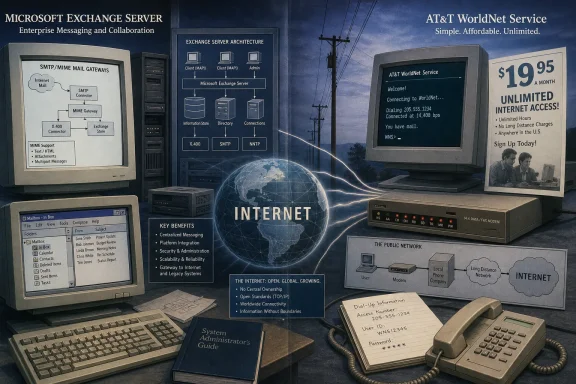 Exchange 4.0 shipped with SMTP — but treated it as an edge connection
According to The Register, Evslin joined Microsoft after assets from his software company, Solutions, were acquired and became responsible for connectivity and gateway work around Microsoft Mail and its successor, Exchange. He recalls a group of internal “internet radicals” arguing that Microsoft needed to make its forthcoming products properly relevant to the internet before shipping them. Bill Gates, Evslin says, was unwilling to hold the releases for that work.
That recollection is credible in the narrow technical sense. A later Microsoft Exchange Team history describes the original Exchange architecture as rooted in X.400 for server-to-server messaging and MAPI for the internal mailbox store. SMTP and MIME support entered Exchange 4.0 through the Internet Mail Connector, a service built on the existing gateway model used to connect other mail systems.
That design mattered. SMTP was not simply another checkbox on a compatibility list; it required Exchange to translate between the proprietary MAPI-centric data model inside the product and MIME messages used for internet mail. The connector could route email and convert attachments, but it did so at the boundary. The public internet was, in effect, treated as one more external mail system alongside the cc:Mail, GroupWise, X.400, and legacy Microsoft Mail worlds that corporate IT departments already had to bridge.
Microsoft’s April 1996 Exchange Server announcement advertised Internet Mail Connector support for SMTP and MIME as part of the Enterprise Edition. The company even characterized Exchange as offering internet access and administration from a single workstation. So the historical record does not support a simple claim that Microsoft shipped Exchange before adding internet email. It shipped with it.
The more precise conclusion is sharper: Exchange shipped with internet mail because the internet had already become impossible to exclude, but Microsoft still designed it as an add-on around the product’s earlier enterprise messaging model.
Microsoft’s own later retrospective makes the shift plain. Exchange 5.0 added POP support, Exchange 5.5 added IMAP4, and by Exchange 2000 the company had inverted the old hierarchy: SMTP became the primary mail-exchange protocol between Exchange servers, while X.400 became the special-case connector for older environments. The technology Microsoft initially modeled as a peripheral gateway became the transport foundation.
For Exchange administrators, that history is more than trivia. The product’s long-running tension between rich internal collaboration features and interoperable internet mail began at the architecture level. Many of the familiar practical concerns — MIME conversion, transport connectors, external relay controls, message-format oddities, and the distinction between internal and internet mail flow — descend from that original boundary.
Gates’ internet reversal came before Exchange reached customers
The Register presents Evslin’s disagreement with Gates as an early-1990s clash between people who saw the internet coming and a company more worried about Lotus Notes. That is a fair description of Microsoft’s pre-1995 posture, but the product timeline changes how the episode should be read.
On May 26, 1995, Gates circulated his “Internet Tidal Wave” memorandum to Microsoft executives. The memo described the internet as the company’s highest-priority strategic development and warned that Netscape could weaken Windows’ control over the application platform. The U.S. Justice Department later entered the memo into the record in the Microsoft antitrust case, documenting how seriously Microsoft’s leadership had come to view the web and internet software by that point.
Exchange 4.0 did not become generally available until spring 1996. Microsoft’s Exchange history dates the core 4.0 release to March 1996, while Microsoft announced availability on April 2, 1996. Either way, it arrived roughly ten months after Gates’ company-wide internet escalation.
That chronology does not disprove Evslin’s memory of Gates resisting a release delay earlier in Exchange’s development. It does show that the most consequential decision was not “ship first, worry about the internet later.” By the time customers could buy Exchange, Microsoft had already absorbed the internet into the product through SMTP/MIME connectivity and was reorienting the rest of the company around it.
Lotus Notes still explains why Microsoft funded Exchange so heavily. Gates had reason to fear a collaboration platform becoming a new application layer above Windows. But Netscape and the web changed the danger calculation. Notes was a proprietary enterprise platform; the internet was a platform that no single vendor could license, control, or delay.
Outlook arrived later, with Word integration but a separate identity
Evslin also tells The Register that the Exchange client was intended from the beginning to support graphics, fonts, and Word-like document formatting. He says he believed Word and Outlook should have merged more deeply than they did.
The release history supports the broad product direction, although not every architectural detail of that recollection. Microsoft Office 97 reached manufacturing in November 1996 and became broadly available in January 1997. It included Outlook 97, the first Outlook release, alongside Word 97, Excel, PowerPoint, and the other Office applications.
Microsoft promoted Outlook 97 as an integrated place for email, calendars, contacts, tasks, and documents. It also included WordMail 97, allowing Word to be used in the email-composition experience, while Outlook supported internet mail, Exchange Server, Microsoft Mail, MSN, CompuServe, and cc:Mail.
The timing matters because Outlook was not the client that launched with Exchange 4.0. Exchange’s first client was the Exchange Client, later associated with Windows Messaging. Outlook emerged as the Office-facing front end after the server product was in the market. That sequence helps explain why Exchange’s transport choices and Outlook’s document-editing ambitions did not emerge as one unified product decision.
Evslin’s observation about separate formatting engines also foreshadowed a tension that has never entirely disappeared from Microsoft messaging. Corporate email needs to preserve compatibility across a huge range of servers and clients. Office users, meanwhile, expect rich document-like composition. Those are different goals, and the compromises between them have helped shape everything from HTML mail behavior to the peculiar rendering problems that Outlook users still encounter.
WorldNet turned flat-rate access into an operational problem
Evslin’s next assignment was more immediate: take AT&T into the ISP business. The company launched AT&T WorldNet on February 27, 1996, offering AT&T residential phone customers five free hours of access per month for the first year and an unlimited-access plan priced at $19.95 per month.
That price was the important move. Smaller internet providers had already offered flat-rate access, but AT&T’s scale gave the model a different impact. Time reported at the time that WorldNet’s offer threatened established online services and access providers, while financial markets promptly punished stocks tied to America Online and Netcom after the announcement.
WorldNet did not create unlimited internet pricing from nothing, and Evslin’s own later biographies sometimes overstate that point by saying the service “invented” it. What AT&T did was make a national telecom brand commit to a simple consumer proposition: pay one predictable monthly fee rather than treating online time like a long-distance call.
The demand problem was real. Wired reported in May 1996 that AT&T’s phone lines had been swamped with prospective WorldNet customers. By February 1997, AT&T said WorldNet had more than 750,000 members and retained the $19.95 unlimited plan even as it ended the five-free-hours promotion.
The Register’s comparison to “America On Hold” needs one distinction. That nickname was principally attached to America Online, whose December 1996 flat-rate offering produced notorious congestion and busy signals. WorldNet’s appeal in early 1997 partly came from those AOL failures; Wired reported that AT&T said roughly a third of its new sign-ups were arriving from dissatisfied AOL members.
AT&T therefore had the less glamorous but more durable challenge: enough dial-in capacity, local access points, authentication systems, customer support, and upstream connectivity to ensure that an unlimited plan was actually usable. Flat-rate pricing created demand. Capacity planning decided whether the provider survived it.
Evslin left AT&T in 1997 to found ITXC, a wholesale voice-over-IP carrier. The move made sense precisely because the internet was dissolving the old separation between network services. Exchange had learned that public internet protocols would overtake proprietary enterprise transports; WorldNet had demonstrated that internet access could become a mass-market utility. VoIP was the next place where packet networks threatened an incumbent business model.
The common thread is that the “radical” position was not merely enthusiasm for the internet. It was the insistence that the internet’s standards, pricing, and scale would eventually dictate the terms to established vendors. Microsoft and AT&T both adapted, but only after their original designs had been overtaken by the behavior of users.
