
The cancelled entry, updated August 14, 2026, had projected a preview in October 2025 and general availability in December 2025. Both dates are now in the past. Microsoft’s cancellation language says the item “is no longer accurate” and directs readers to look for separate items covering inbound support in worldwide and GCC environments and outbound support, but it does not identify a new item for GCC High or DoD.
That leaves a gap for the customers most likely to need an unambiguous answer: organizations handling controlled data in sovereign Microsoft 365 tenants, where email-transport changes typically require a documented configuration path, change-control review, and validation before they can be treated as available.
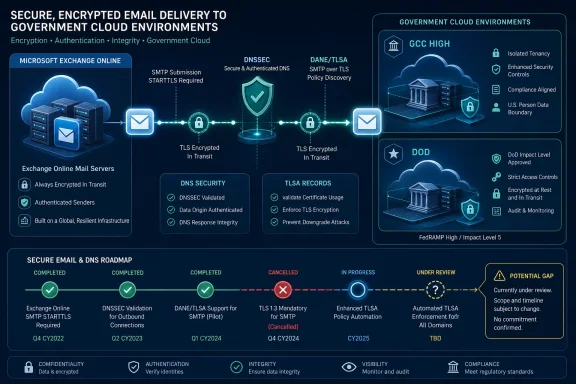 The cancelled listing was already out of step with Exchange Online’s broader DANE rollout
Microsoft’s Exchange Team announced general availability of inbound SMTP DANE with DNSSEC for Exchange Online in late 2024 and has continued to maintain implementation guidance. SMTP DANE uses DNSSEC-protected TLSA records to bind an SMTP destination to expected TLS certificate information, protecting against attacks that redirect mail delivery or force a connection away from TLS.
The technology is therefore not speculative. Microsoft’s current Exchange Online documentation still describes how to enable DNSSEC and inbound SMTP DANE for an accepted domain, including the PowerShell-based setup process and prerequisites for a healthy accepted domain. The company also published an April 2026 update on its DNS-security work, saying customers that need DNSSEC-protected inbound mail must use dedicated mx.microsoft subdomains rather than the legacy mail.protection.outlook.com mail-flow namespace.
But broad Exchange Online availability and confirmed availability in GCC High or DoD are different claims. Microsoft’s documentation is written around the Exchange Online service and does not, in the material accompanying the cancellation, explicitly state which government-cloud tenants can complete the workflow. That distinction matters because the now-cancelled roadmap entry was specifically scoped to GCC High and DoD, not the commercial Microsoft 365 service.
Administrators should therefore avoid both easy but incorrect readings of the update:
- The cancellation does not establish that Microsoft withdrew inbound SMTP DANE from Exchange Online.
- It also does not establish that the originally promised GCC High and DoD deployment occurred on the October and December 2025 schedule.
- Microsoft has not used the cancellation notice to provide a successor ID, revised release date, or a government-cloud enablement statement.
DNSSEC changes have already altered Exchange Online mail-flow assumptions
The most practical consequence is not limited to DANE. Microsoft has been moving Exchange Online’s DNS foundations toward the mx.microsoft namespace so that DNSSEC can protect the records supporting mail delivery. In a February 2026 Message Center update, Microsoft said new accepted domains provisioned after July 1, 2026 would use subdomains under mx.microsoft, and warned administrators not to assume that an Exchange Online MX target will always end in mail.protection.outlook.com.
This has a direct operational implication for organizations and service providers that automate domain onboarding. Code that derives or constructs MX targets from a domain name, validates only the older mail.protection.outlook.com pattern, or relies on legacy A-record behavior is no longer safe. Microsoft identifies the Microsoft Graph serviceConfigurationRecords endpoint as the source for the actual mailExchange value rather than treating a familiar hostname pattern as authoritative.
That change is separate from turning on inbound DANE, but it is part of the same architecture. DANE requires DNSSEC to provide trustworthy DNS answers; Microsoft cannot offer a defensible DANE implementation by simply adding TLSA records beneath an unsigned or legacy mail-flow arrangement. The migration to DNSSEC-capable mx.microsoft zones is the plumbing that makes the security control usable.
For GCC High and DoD, that means a roadmap cancellation should trigger a review of existing DNS and provisioning assumptions even if the organization is not ready to enable DANE. DNS automation that still expects only mail.protection.outlook.com deserves attention now, because Microsoft’s service-side DNS provisioning change has already passed its July 2026 milestone.
Inbound DANE is an administrator-enabled mail-flow configuration
Inbound SMTP DANE with DNSSEC is often described as a simple security enhancement, but it changes the trust model for mail arriving at Exchange Online. Rather than relying solely on opportunistic STARTTLS and conventional public certificate validation, sending systems that support DANE can use DNSSEC-validated TLSA data to verify that they reached the intended Exchange Online destination with the expected certificate material.
Microsoft’s documented workflow requires more than publishing a record at a registrar. The domain must first be an accepted domain in Exchange Online and show a healthy status. DNSSEC must be enabled for the customer’s domain. The mail-flow DNS configuration then has to be transitioned to Microsoft’s DNSSEC-capable Exchange Online infrastructure before SMTP DANE can be enabled.
Organizations with a third-party secure email gateway need to be especially careful. If a gateway receives inbound internet mail and relays it to Exchange Online, DANE protection for the final hop depends on the gateway’s ability to perform outbound SMTP DANE and DNSSEC validation. Enabling a setting in Exchange Online does not magically secure the upstream connection from every third-party service. Microsoft’s earlier implementation guidance explicitly noted that gateway users might need a different deployment process and potentially support from their gateway provider.
This is why GCC High and DoD customers should not regard a cancelled roadmap line as a reason to alter MX records immediately. DNS changes can affect mail delivery, and a sovereign-cloud tenant may have service-specific limitations or support requirements not reflected in the public, general Exchange Online documentation.
What GCC High and DoD administrators should verify now
The immediate job is to separate confirmed service behavior from an old roadmap promise. Exchange administrators should check whether their tenant exposes the required accepted-domain and Exchange Online PowerShell capabilities, whether their authoritative DNS provider supports DNSSEC with DS-record publication, and whether any mail gateways sit in front of Exchange Online.
They should also review domain-provisioning automation. Microsoft’s current direction is clear: retrieve the MX value that Microsoft provides rather than constructing an MX hostname based on legacy conventions. This is relevant whether the organization pursues DANE now or merely adds a new accepted domain after the July 2026 provisioning transition.
A disciplined pre-change review should include the following:
- Confirm that each planned domain is an Exchange Online accepted domain in a healthy state before attempting DNSSEC or DANE changes.
- Identify any MX provisioning scripts, monitoring checks, allow lists, retry logic, or certificate-validation rules that require
mail.protection.outlook.com. - Document whether inbound mail first traverses a third-party gateway, because that provider may determine whether DANE protects the connection into Exchange Online.
- Test DNSSEC validation and mail delivery in a controlled change window rather than treating an MX transition as a cosmetic DNS update.
- Obtain written confirmation from Microsoft or the organization’s government-cloud support channel before claiming inbound SMTP DANE is available in a specific GCC High or DoD tenant.
Microsoft still owes government tenants a definitive status
The cancellation resolves one narrow issue: Roadmap ID 361914 should no longer be used as evidence of an October 2025 preview or December 2025 general-availability commitment. Microsoft itself says the entry is inaccurate.
What it does not resolve is more consequential. The company has publicly described inbound SMTP DANE with DNSSEC as generally available for Exchange Online, maintained current deployment guidance, and advanced the DNS infrastructure needed for it. Yet the cancelled government-cloud entry supplies no replacement schedule and no explanation of whether GCC High and DoD were delayed, delivered under another tracking item, or moved to a different service plan.
Until Microsoft publishes the promised successor roadmap item or updates its documentation with explicit sovereign-cloud availability, government tenants should treat inbound SMTP DANE as a capability to validate—not a feature whose status can be inferred from either a cancelled 2024 roadmap record or Exchange Online’s commercial rollout history.
