
The FCC has moved to block new imports of foreign-made humanoid and quadruped robots and power inverters deemed a national-security risk, a decision that will land most heavily on Chinese suppliers and could reshape procurement for AI infrastructure projects. As first reported by Axios, the action places the equipment on the FCC’s Covered List, preventing authorization for affected new products unless they receive conditional approval.
The policy is broader than its “Chinese hardware” framing suggests. The FCC’s determination applies to products made outside the United States regardless of the manufacturer’s nationality, but China is the dominant supplier in both the fast-growing robotics market and much of the inverter supply chain.
For Windows and enterprise IT teams, the immediate issue is not a change to PC imports or ordinary Windows software. It is the growing overlap between operational technology, networked robotics and the data-center power stack—three environments increasingly managed through the same identity, endpoint, monitoring and incident-response systems.
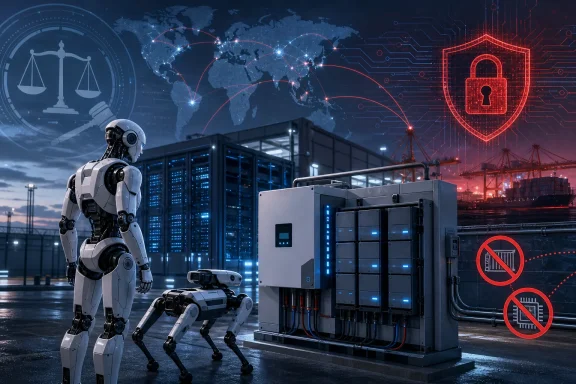
The restrictions target new robot and inverter models, rather than automatically removing equipment already sold in the United States. Reuters reported that the measures took effect when published, while the FCC retains authority to revisit authorizations already granted for existing products.
That distinction matters for organizations with deployed robot fleets, warehouse automation pilots, solar-plus-storage installations or battery-backed facilities. Existing hardware is not necessarily unusable overnight, but its vendor’s next-generation replacement model could be unavailable without an exemption.
Manufacturers may seek conditional approval through a process involving national-security agencies. That creates a new procurement variable: technical qualification will no longer be enough for equipment in the affected categories.
The administration’s case is that remotely manageable inverters could create opportunities for cyberattack, supply-chain manipulation or disruption of electricity infrastructure. With hyperscalers and enterprises building power-hungry AI data centers, the argument is no longer confined to residential solar hardware: inverter sourcing is being framed as an AI-capacity and resilience issue.
That may complicate data-center projects using on-site solar, batteries, microgrids or distributed generation. CIOs and facilities leaders will need to verify not only country of origin, but also whether a planned inverter model holds the required FCC authorization and whether its cloud-management features introduce separate security concerns.
Axios pointed to previous research involving Unitree’s Go1 robot dog that raised concerns about an apparent pre-installed backdoor. Whether or not a particular product is covered by the new action, the episode illustrates the standard organizations should apply to any connected robot: treat it as a privileged mobile endpoint, not as an appliance.
Security teams should demand network segmentation, documented update channels, software bills of materials where available, local logging, clear data-retention terms and a tested means of disabling remote access. Those controls are useful regardless of the supplier’s country, but the FCC decision makes them central to market access for future foreign-made models.
The near-term effect will be a narrower U.S. supply of advanced robots and inverter products, plus more compliance work for vendors and buyers. The longer-term test is whether domestic and approved foreign alternatives can meet demand without turning AI buildouts, industrial automation and distributed-power projects into slower and more expensive deployments.
The report also cites CVE-2025-2894, a 2025 vulnerability affecting Unitree robot products that could have enabled unauthorized remote access. Unitree said the issue involved a third-party remote-control service and was addressed in May 2025.
The policy is broader than its “Chinese hardware” framing suggests. The FCC’s determination applies to products made outside the United States regardless of the manufacturer’s nationality, but China is the dominant supplier in both the fast-growing robotics market and much of the inverter supply chain.
For Windows and enterprise IT teams, the immediate issue is not a change to PC imports or ordinary Windows software. It is the growing overlap between operational technology, networked robotics and the data-center power stack—three environments increasingly managed through the same identity, endpoint, monitoring and incident-response systems.
New models face the immediate barrier
The restrictions target new robot and inverter models, rather than automatically removing equipment already sold in the United States. Reuters reported that the measures took effect when published, while the FCC retains authority to revisit authorizations already granted for existing products.That distinction matters for organizations with deployed robot fleets, warehouse automation pilots, solar-plus-storage installations or battery-backed facilities. Existing hardware is not necessarily unusable overnight, but its vendor’s next-generation replacement model could be unavailable without an exemption.
Manufacturers may seek conditional approval through a process involving national-security agencies. That creates a new procurement variable: technical qualification will no longer be enough for equipment in the affected categories.
Power hardware is now part of the AI-security argument
Power inverters convert and control electricity between renewable generation, batteries, the grid and local loads. They are also increasingly network-connected for telemetry, remote maintenance, fleet management and demand-response functions.The administration’s case is that remotely manageable inverters could create opportunities for cyberattack, supply-chain manipulation or disruption of electricity infrastructure. With hyperscalers and enterprises building power-hungry AI data centers, the argument is no longer confined to residential solar hardware: inverter sourcing is being framed as an AI-capacity and resilience issue.
That may complicate data-center projects using on-site solar, batteries, microgrids or distributed generation. CIOs and facilities leaders will need to verify not only country of origin, but also whether a planned inverter model holds the required FCC authorization and whether its cloud-management features introduce separate security concerns.
Robot procurement becomes a governance problem
The FCC’s rationale for advanced robots focuses on their sensors, connectivity and potential remote-control capabilities. Humanoid and quadruped machines can carry cameras, microphones, mapping sensors and autonomous-navigation systems into warehouses, campuses, factories and public spaces—places where a compromised device could become both an espionage and safety concern.Axios pointed to previous research involving Unitree’s Go1 robot dog that raised concerns about an apparent pre-installed backdoor. Whether or not a particular product is covered by the new action, the episode illustrates the standard organizations should apply to any connected robot: treat it as a privileged mobile endpoint, not as an appliance.
Security teams should demand network segmentation, documented update channels, software bills of materials where available, local logging, clear data-retention terms and a tested means of disabling remote access. Those controls are useful regardless of the supplier’s country, but the FCC decision makes them central to market access for future foreign-made models.
The near-term effect will be a narrower U.S. supply of advanced robots and inverter products, plus more compliance work for vendors and buyers. The longer-term test is whether domestic and approved foreign alternatives can meet demand without turning AI buildouts, industrial automation and distributed-power projects into slower and more expensive deployments.
Update: Additional details (July 30, 2026)
Wccftech reports that the policy could disproportionately affect Unitree, whose lower-cost quadruped and humanoid platforms are widely used by U.S. research and development teams. Nvidia recently used a Unitree humanoid chassis in a reference design for AI-powered robotics, underscoring the potential impact on developers that rely on foreign-built platforms for prototyping.The report also cites CVE-2025-2894, a 2025 vulnerability affecting Unitree robot products that could have enabled unauthorized remote access. Unitree said the issue involved a third-party remote-control service and was addressed in May 2025.
References
- Primary source: Axios
Published: 2026-07-28T20:50:13.392559+00:00
Trump administration bans Chinese hardware with eye on AI race
The action targeting China comes as the race between Beijing and Washington to dominate AI heats up.www.axios.com
- Related coverage: en.vijesti.me
Reuters: Trump administration to ban imports of new Chinese humanoid robots
Predsjednik je jasno stavio do znanja da SAD moraju imati nezavisne i bezbjedne lance snabdijevanja za kritične i nove tehnologije, kao što su robotski uređaji i ...en.vijesti.me - Primary source: wccftech.com
US FCC Blacklists Foreign Robots on Huawei List as Surveillance Fears Grow - Striking NVIDIA Partner Unitree As Well
The Covered List now spans humanoids and power inverters, sidelining a key supplier of GPU-driven robots inside the US AI buildout.wccftech.com